Game Marketing Tips, Analysis, and News


Showing posts with label PSP2. Show all posts

Monday, January 31, 2011

NGP Vs. 3DS: How Sony Can Win

Sony has surprised me in several ways with their most recent announcements. First, I didn't expect that they would put so many features or so much power into the NGP (Next Generation Portable, formerly known as the PSP2). The device had been rumored for so long I was afraid it had lost its way. Apparently Sony has been busy seeing just how many things they could stuff into it, and the answer is: A lot. If you gave me a clean sheet of paper and asked for a feature set that would be possible (maybe not reasonable)  for a cutting-edge handheld gaming device, it would pretty much look like the NGP. About the only thing I can think of that they left off is an HDMI output, and I can see why they might not want to do that... it could impact the PS3 if you could plug an NGP into your TV set.

The elephant in the room, though, is the retail price. Sony won't say what the NGP will cost, and the cost could be so high it could strangle sales for a long time. (Remember the PS3 at $699? Ouch.)

I remember the PSP introduction, and it seemed like an amazing piece of hardware... but it was expensive. And the capabilities were never realized for a long time; not enough cool games, awkward attempts at movie sales, no online store for music, movies, etc. The device did quite well in Japan, but never was a big hit in the USA. The DS juggernaut squashed the PSP, and price was an important reason. Another was the DS's array of interesting and useful capabilities, like the dual screen, the touchscreen, the microphone, and so on. Game designers got creative, and there were many interesting games. The PSP never had enough games... although that's been changing, but it was too little, too late.

Enter the second big Sony announcement, which in some ways may be more significant than the NGP: The Playstation Suite. Or as I like to think of it, Sony's Playstation Android Terminator, a heavily armed, unstoppable device designed to seek out and terminate its target: The 3DS.

Wait, what is this Playstation Suite? It's a software development toolkit and specifications for putting PS One games on Android phones. There are many details left to fill in, but it looks like any phone that runs Android 2.3 will be able to handle PS One games (assuming the hardware is beefy enough... which most any new Android phone is). Sony will be selling PS One games on Android phones, raking in revenue for games that they wrote off all costs for many years ago. Better still, they'll be getting people interested in Sony games, perhaps looking for sequels on the PS3 or the NGP. I'm sure Sony is exploring the possibility of making the same thing available on the iPhone or the iPad. And I'm sure the Playstation Suite will be working just fine on Google TV, which (no coincidence) is built into some new Sony TVs.

It's a brilliant strategy, one that Nintendo would do well to emulate... but probably never will. They're apparently going to stick with their business model, regardless of how the world might have changed.

Sony, at least, seems well aware of the changes in the marketplace. Sony's not dismissive of smartphones and the impact they've had on mobile gaming; Sony is actively looking to harness that power to their own ends. Nintendo prefers to pretend that smartphones have absolutely no effect on Nintendo's sales.

Sony's executives clearly know the market and what it will take to succeed. They've put together a handheld gaming device with a quad-core processor, a 5" OLED touchscreen, dual analog joysticks, a backside touch panel and a full array of sensors and networking capability. This puppy makes the 3DS look like a DSi with a 3D screen gimmick tacked on and a bit faster processor, which is about what it is.

What does Sony have to do to win?

Three words: Price, Price, Price. Those are the three most important things. The sheer size of the feature set makes you wonder just how much Sony will sell it for. I could easily see a $499 price point, if not more, if you needed to make a profit on every sale. If they price the NGP there, it's pretty much going to be a lovely thing you'll never see in the wild. At $249 they would stomp the 3DS flat. So how much can Sony afford to lose on each unit? That's an unknown. I'm sure they'll hold off on pricing as long as possible, waiting to see what the component prices will be when they actually go into production... and what the game lineup looks like, and how much they can expect to make from it. If the NGP is over $299 it's going to be tougher to get good sales momentum.

Unleash The Media. No, not the Kraken... though maybe that would help, if it could take on some recalcitrant executives within Sony. This device should do what the PSP should have done: have a full array of movies and music available to play on it. (See iTunes for hints on how to do this.) Sony owns a ton of media; if they can just boot a few executives out on their ass in those divisions, maybe they can get some cooperation. Digital distribution is the future of media. The NGP should have books, music, movies, TV, and the Internet...sell them all and you will make a mint, Sony. Don't worry about cannibalizing your other devices; better you than some other company. Like Apple. Duh.

The NGP Needs Apps. Not just games, Sony. The NGP should be able to handle just about every App in the App Store or the Android Market. Make it so. Open the doors to developers, make it easy to get an App in your store. The NGP needs a full range of capabilities to compete with smartphones. You don't have to build them; just give developers the invite and then stay out of the way to avoid getting trampled.

Embrace new revenue models. In-app purchasing, baby. Freemium. Include some free games with the NGP that have a freemium model, and watch the dollars roll in.

Skype. You don't need a phone carrier. Just a killer Skype implementation. There will be a 3G version of the NGP; with that and Skype you can compete with a smartphone very nicely, thank you very much.

DLC. Sell the add-ons to games, new and old. Extend each game in every way you can, and let the fans pay for what they want. Sure, give out free stuff to chum the waters; you'll get plenty of bites on the pay stuff.

Connect to the PS3. Use the Playstation Network. Make sure every NGP owner wants to become a PS3 owner, if they're not already. Have some games use an NGP as a cool add-on (hidden information).

Sony, you have shown hardware that can take the handheld gaming crown away from Nintendo, and defend it against the smartphones. Now it's all about the execution... so do it right.

Thursday, January 27, 2011

PSP2 (Now NGP) Vs. 3DS Vs. Smartphones: Who Wins?

2011 will go down in history as the Final War for domination of handheld gaming. The declarations of war have been made (in the guise of launch events for the gaming press), and the machines of war are heading to the battlefield. Three platforms enter... will only one leave? The situation is more complex than that.

Nintendo plays the role of Rocky Balboa, the scrappy kid who became the world champ a long time ago and has been resting on his laurels far too long. Sure, he's been in training some, had some bouts, made a few minor comebacks with the DSi and the DSi XL. But sales have been dropping... Nintendo just announced their latest numbers, and have once again revised their sales estimates downwards for the fiscal year, as their profits have dropped 74% and DS sales will end the year with about 22 million sold, for an all-time total of about 145 million.

Nintendo's war machine for this battle is the 3DS. It's basically a DS with a faster processor and a 3.5 inch 3D display, with a resolution of 400 x 240 in 3D mode. The trick is that the 3D effect doesn't need glasses, but the battery life of the 3DS is a fraction of the DS; 3-5 hours instead of 12-15. The price is $249, and games will be in the $40 to $50 range. Backwards compatibility with DS games is included. The 3DS ships at the end of March in the US. Nintendo's got Rocky Balboa who's been trying to get back into shape.

Sony has finally opened the kimono to reveal the PSP2, now called (for the time being) the NGP (Next Generation Portable). It's got a 5 inch screen at 960 x 540 resolution, dual analog controls, a back-of-the-unit touchpad for control, an Organic LED (OLED) touchscreen, a gyroscope, accelerometer, compass, GPS, front and rear facing cameras, an ARM Cortex A9 quad-core processor, an SGX543MP GPU (a PowerVR chip), 3G, Bluetooth, WiFi b/g/n, and a new flash memory storage for games. Plus backwards compatibility with PSP games. It will ship around the end of 2011, and the price is as yet undisclosed. But you can bet that it won't be cheap; with that spec list I'd put it around $399 at least, that's if Sony wanted to make money on the device from the hardware sales alone. Sony has Ivan Drago (Dolph Lundgren from Rocky 4), the incredible physical specimen with unreal stats.

A glimpse of Sony's NGP.
The final contender is the iPhone 4, and probably this summer the iPhone 5 (as yet, still just a speculation). The current iPhone 4 has an Arm Cortex A8 processor (Apple's version, the A4 chip) with a PowerVR GPU, a 960 x 640 3.5 inch screen, front and rear cameras, full sensor array, and an App Store stuffed with 300,000 titles. The rumored iPhone 5 will use an ARM Cortex A9 dual core, along with a spiffier PowerVR GPU. Apple's bringing a Mixed Martial Arts expert to this boxing match. Pricing will probably be around the current iPhone 4 pricing, with the iPhone 4 moving down to $99 (subsidized) and the iPhone 5 at $199 or $299 (subsidized).

Really, Nintendo's decided to once again avoid battling on sheer technical specs of resolution, polygons, and processor speeds, and instead try to do something different. This is how they succeeded with the Wii; knowing that Microsoft and Sony would be shooting for the most power in a console, Nintendo opted to be different with the interface, and won handily. The 3DS is a hope that 3D without glasses will be a hit with gamers, much more so than mere polygon counts. It's not an unreasonable hope.

Sony's decided, apparently, that the way to win the handheld market is sheer muscle. Bigger, better, faster, stronger, as well as cooler. Interface? Sure, let's throw in all of the sensors and interface ideas we can, and perhaps something awesome will emerge. Actually, it's not an unreasonable hope; give game developers a lot of different tools and they will surprise you every time.

Apple's competing against phones, not handheld gaming devices, but their iPhone 5 will be a pretty close match to Sony's NGP, at least much closer than the 3DS. If game developers can really start to charge somewhat higher prices for really awesome games, perhaps the return on investment for iPhone game development might look more like handheld game development.

Android phones will continue to march along with a wide variety of hardware specs, but you can bet on increasing processor power and more attention to GPU strength. The best Android phones will likely be pretty competitive with Apple's iPhone offerings.

The interesting part is beyond the hardware specs; it's the software and online offerings. Nintendo is trying to advance a bit, ditching the unbelievably awkward Friend codes and moving to a somewhat easier multiplayer matching. They're touting their eShop as a way to buy less expensive games, but of course they will continue to keep those games completely separate from the full price games sold only at retail stores. Sony's got more interesting things going on, with a development environment designed to bring Playstation games to any Android device. This is a brilliant move, basically trying to coopt the smartphone market by bringing the Playstation games to them. It's not clear what pricing will be like, but the really interesting part is that Sony's trying to make it easy for developers to bring games to any platform.

Meanwhile, Apple's going to make progress in the game market without really trying, as they work to compete in the phone market.

Here's my assessment of the three contenders.

Nintendo'ssmartphones and computers. Nintendo's not really changing its business model, and mostly ignoring the digital possibilities, and that will become more and more of a problem for them in the future. They really have to put some serious effort into their digital offerings if they hope to compete. I think Nintendo will have a good launch, but I think by the summer they will be selling 3DS at a rate lower than the current DS rate unless they lower the price.

Sony's exceeded my expectations on their hardware; they are clearly swinging for the fences. They have obviously spent time thinking about the current market, and their Playstation Suite plan is a good response with lots of possibilities for the future. The major question mark is the price; if it's $399 I think it will merely be a niche product. Even at an aggressive $249, it's going to be a touch sell given its size (see below).

Still, there will be multiple SKUs and perhaps some interesting phone-like capability (built-in Skype would be amazing, especially with reasonably priced 3G connectivity options) which may make it a reasonable choice for your only pocket device. Sony will probably want to see a range of full price games, but they're liely to have many more low-cost game choices than Nintendo.

Apple's certainly going to keep introducing better devices, but they'll never add dedicated gaming controls like an analog joystick. Still, they have established themselves as a huge game market without hardly trying. If they finally activate the Apple TV app store and bring those games to the family room, the whole issue gets even more complex. Apple will be hampered if they fail to develop a market for higher priced games, but at least for the iPad and the iPhone 4 there are some encouraging signs.

For developers, it's just getting more difficult to make choices. You have to decide on allocating your development resources, and that is getting tougher. One thing's for sure, though: Develop your brands and milk the IP you create as much as you reasonably can. Any game you create should be considered as a product line, not just a product. The development is an ongoing process, and so is the marketing, not a one-off event that you fire and forget. Create something that's extensible, refine it, make it popular, then put it on everything that uses electricity.

Monday, January 3, 2011

7 Console Gaming Predictions For 2011

In 2011, radiation from 3D TVs will cause gamers to emit a green glow.
The console gaming market is now the "traditional" game market, composed  of software sold in retail stores. Of course, publishers are exploring other business models and types of games, investing in social games, mobile games, freemium games and more. The console gaming market is the bulk of game sales; if you just look at software, it was $10.6 billion in the US this last year (if you add in hardware sales, including accessories, the total is north of $21 billion).

The last couple of years have not been kind to the traditional segment of the business, though. Sales grew an amazing 28% in 2007 to hit a total of $18.85 billion overall ($9.5 billion in software), but the worldwide economic problems of 2008 were bound to have an effect. Game sales in 2008 were up 19% to over $21 billion (up more than 26% in software to over $11 billion), though signs of the slowdown were already showing up in holiday sales. Then 2009  showed up and hit hard with an 8% decline in overall sales to $19.66 billion (software slid to $10.5 billion).

While the year-end figures aren't tallied yet, 2010 looks like a decline again despite a record November that wasn't enough to rescue the year. Total sales will probably end up a few percent below last year (it was down 8% until November, which was enough to make it only 5% lower than last year). What's on tap for 2011?


  • Software sales continue to erode. The overall picture doesn't look great for $60 software titles. While some releases will do well, overall I think the sales decline will continue as gamers move to lower-cost alternatives. And more lower-cost alternatives will continue to appear, and they'll be better.
  • Console sales stay steady due to price cuts. Much as they will resist it, price cuts will happen by the holidays for all the consoles, though they may be minor. Or they may be hidden by increasing the value of the bundle you get (an extra controller, more software, etc.) Growth in smartphones, tablets, social games, and F2P (free-to-play) will tend to keep people from console purchases unless the price gets more attractive.
  • Big hits are rare, and will get rarer. The high sales points get even higher for titles like Black Ops, but fewer titles will achieve orbital status. The publishers with the megahits may do well, but the ones without will be gasping for oxygen. It's going to be a cruel market.
  • XBLA and PSN continue to grow sales. Meanwhile, though, those sneaky little download games will continue to gain despite the barriers placed in their way. (I mean, Microsoft Points instead of dollars? Really? Or how about that interface, and all of the non-existent tools for finding the types of games you're interested in...) Heck, even WiiWare will do better, despite Nintendo's almost criminal neglect. It turns out that customers are interested in lower-price titles they can have via download without a trip to a retail store. Who would have thought that?
  • Nintendo finally reduces Wii to $149, then to $99 by Christmas. This one is actually more wishful thinking than a prediction. Yes, it would certainly be sensible for Nintendo to do this, but since they've been studiously avoiding sensible moves lately who can say what they will actually do.
  • A successor to the Wii is finally announced, but it won't appear until 2012. Although Nintendo may not actually announce this, and information will just leak out, to avoid ruining already devastated Wii sales. By the time it actually appears the market may be so different that no one will care, unless Nintendo embraces the market changes.
  • The 3DS and PSP2 appear to good initial sales that quickly decline to disappointing levels. Partly because the price points will be so high initially. Once the fanboys have gotten their units, less fanatical customers will look at the prices and think about buying a smartphone instead. Many will. Developers in particular will be annoyed, because developing for these new handhelds will be significantly more expensive than the old handhelds, yet software sales will be worse. This will lead to a quick fall-off of third-party support.
Overall, I expect the console business for 2011 to be up somewhat, mostly due to Kinect. Move, and price cuts. The software part of the business (at least the traditional retail boxed part) will be flat. Significant growth will continue to be in other areas like mobile, social, DLC and F2P.

Monday, December 27, 2010

PSP2's Touching News

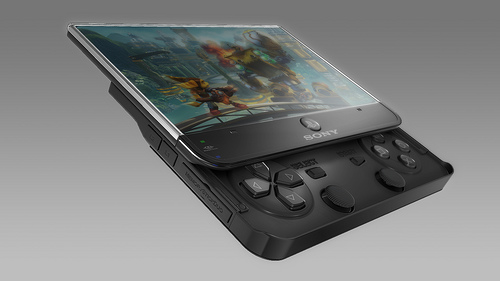
Still my favorite mockup... I hope the PSP2 looks like this.
More information on the PSP2 is leaking out from Sony, as the release date gets closer. Now Kaz Hirai is talking about touch screens and how they are pretty spiffy as an interface for playing games, and having one would be really useful in competing with Apple. But standard game controllers are useful, too, he hastens to point out.

Reading between the lines, it's pretty clear we should expect a touchscreen to be part of the PSP2, as well as the usual controllers. I'm guessing they're going to include dual analog controllers, as an inexpensive way to add a useful gaming feature not shared by the competition. Certainly the PSP2 is going to need all the nifty features it can get in order to compete with the 3DS and the smartphones.

Sony is playing it cagy with release dates and other information, but I expect we'll be hearing a lot more about the PSP2 in the next few months... especially as Nintendo ramps up its PR blitz for the 3DS. Sony will naturally want to piggyback on Nintendo's publicity, and maybe get some people to hold off spending their money on the 3DS by touting the PSP2's features. I don't really think that will work unless the PSP2 release date is fairly close to the 3DS, which seems unlikely for a piece of hardware that hasn't been officially unveiled. I expect we'll see the PSP2 in detail at E3, with a summer or fall release date.

And don't forget Sony's PSP phone that is supposedly coming out from Sony Ericsson... though I'm not sure if this is a coherent strategy or just another example of Sony's divisions running amok. Rumors continue to leak out that Howard Stringer's days are numbered as Sony CEO, and they may be ready to go with Kaz Hirai. The PSP phone will purportedly run Android 3.0, and feature PS One level games and perhaps some existing PSP titles... it just leaves me wondering how this would get in the way of the PSP2 launch. Is Sony just going to throw everything against the wall and see what sticks?

Usually that just makes a mess.

Wednesday, December 8, 2010

3DS, PSP2 May Lose To Smartphones

This is not a picture of the 3DS.
Here's the proof of what I've been saying... the smartphones are taking over the handheld gaming market.


Money quote: "The report, "The Phone Gaming Revolution: Do the DS and PSP Stand a Chance?," found that 43.8% of the phone/DS/PSP gaming market plays games on phones, which represents a significant 53.2% increase over the past year. At the same time, Interpret says that the proportion of those who play on the DS or PSP has fallen by 13%." 


Interpret also said "Gamers appear to be defecting from their handheld gaming devices to phones to get their gaming kicks: a full 27.2% of consumers who indicate that they play games on their phones only (and not on the DS/PSP) actually own a DS or PSP, but do not actively use the device(s)."
So even people who own a handheld gaming device as well as a smartphone are spending more time playing games on the smartphone and leaving the handheld alone. It makes sense; how many portable devices do you want to lug around? You're always going to make sure you have your phone... so the DS gets left behind. As we've seen before, the multifunction device beats the single-purpose device. The PDA got eaten by the cell phone (or what was previously called a smartphone). Who carries a calculator these days? Phones do it. Cell phones are even taking away market share from point-and-shoot cameras... as the cameras in smartphones get better and better. Why carry a camera or a video camera when your phone does a pretty good job?

The prospects for the 3DS and the PSP2 look dimmer. Not that the hardware won't be powerful; the latest reports on the PSP2 indicate it may have almost half the processing power of a PS3. And while the 3DS may have a fairly low-res screen, the 3D without glasses is a neat trick. The difficulty is both of these devices will likely only play games. So you're going to leave it behind if you only have room for one device when you go out, because you always want to take your phone so you can stay in touch.

Another problem for the 3DS and the PSP2 is the parent problem. When the parental units are considering what to buy for their young techlings, the 3DS and the PSP2 will be in the range of $250 to $300. OK, an iPod Touch is $225... and it also plays music, videos, is a high-powered camera and video camera, it surfs the web, sends email, can even make Skype calls. Or for $99 they can get an older iPhone model and make it a full phone, with the data plan. Oh, and games for the 3DS or PSP2 will be at least $30, maybe even more. Versus thousands of free games or games that cost a few dollars.

So it's not about hardware specs; it's about multifunctionality and the business model.  Downloading and installing new software instantly, for free or a few dollars, is far more attractive than having to find a game store and spend $30 and then remember to keep the cartridge around with you at all times.

One more hidden problem: We already know the 3DS will require higher development costs for publishers than a DS, and if the PSP2 has near PS3 level graphics, you can bet development costs will be much higher than for the PSP. Which makes it even harder for publishers to make money, which will make them warier of developing for those platforms, which means not as much software, which means the platforms are even less compelling to buy.

Even at the rosiest assumptions, how many 3DS or PSP2 units would be selling a month? 1 million units would be amazing at those price points... yet iPhones are already cruising at north of 4 million units per month, and Android phones at 6 million per month. And newer, more powerful versions are introduced every few months.

This is a race that does not look good for the dedicated gaming machines.

How could they compete? By opening up to multiple applications and allowing developers to create software as easily as they can for iOS or Android. Have a killer online store for downloading everything, including the latest full game titles you can find in the stores. Have a 3G option to include phone service. Will either Sony or Nintendo do that? Highly unlikely... too difficult and painful for them. I suspect they'll continue to say everything is fine, no cause for alarm, and hope that a massive asteroid strike destroys Apple and Google in one blow.

Saturday, October 30, 2010

The AppDroid Apocalypse

Apple TV and Google TV: Threat or Menace?
The Appdroid Apocalypse is coming, and it poses a threat to the survival of the console business as we know it. Surviving, or better still, thriving, will require understanding the coming changes and changing business models in response. It won't be easy, and for some companies it may prove impossible. For others it's a huge opportunity. Either way, the Appdroid Apocalypse is arriving soon, and we'd all better be ready.

What is the Appdroid Apocalypse? The same App Store/Android Market that's busily eating up market share from the Nintendo DS and the Sony PSP is coming to a family room near you. The Apple TV and the Google TV will eventually offer the same gaming apps that you find on iPhone/iPad/iPod Touch and Android, but they'll be played in your family room. Yeah, the same place your console is plugged in. These apps, numbering in the tens of thousands, cost an average of less than $1.50. Thousands of them are free, or free-to-play. The most expensive ones are still under $10. The Apocalypse part is where this new console business turns the existing console business into a scorched wasteland... or at least, a market where sales are declining from year to year rather than growing.

Whoa, wait a minute, you say. That's not what Apple TV does... Apple hasn't said anything about offering Apps on Apple TV. Sure, and they didn't do that for the first year of the iPhone, either. Everything is there to make it happen; the new Apple TV runs on iOS, after all. You think maybe Apple hasn't noticed they've made a billion dollars selling Apps? Or the potential of selling a few billion more in family rooms? Apple can flip a switch and turn on an App Store for Apple TV at any time. They probably just want to get everything ready for the launch, so they can hit the ground running. It could happen soon, or they could wait a year. But it's going to happen.

Google is in a similar place. They see how much action they've gotten from the Android market, and how Apple has done with the App Store. Does Google want to lose the family room to Apple? No way.

One thing Apple and Google have in common is that neither one particularly cares what happens to the traditional console business. Gee, Microsoft might lose a lot of money? A happy side effect of Apple and Google's plans.

Where's the evidence for this Apocalypse? Let's look at the numbers. Android phones are now being activated at the rate of 200,000 per day, according to Eric Schmidt. Combined, Android (8.5 million through 2009) and Apple smartphones (according to this report) will be in excess of 150 million by 2012, and with iPod Touches and iPads, along with Android tablets, it may be well over 250 million units (Gartner Group projects over 100 million tablets sold in 2012). Compare this to an installed base of 132 million DS units as of June 2010; that's likely to grow by another 15-20 million units by 2012, but that still leaves it about half the size of the iOS/Android installed base.

Nintendo's DS business is faltering; both hardware and software sales are down (43% and 23% over the last six months). The 3DS is coming next year, but it will likely be $250 to $300, and it still won't have a business model akin to Android or Apple's relatively open markets. There are over 300,000 Apps in the App Store, and the Android app market has hit 100,000. By comparison the DS has in the low thousands of titles, and many are no longer available because you just can't find a cartridge. All of the apps are always available, since there is no physical inventory.

At least 25% of those apps for iOS are games, and the average price is around $1.50. Thousands of them are free, and many are free-to-play. Apple and Google are integrating advertising into their platforms, which promises to keep game prices low as publishers can make money from ads. Freemium business models, such as used in social games like Farmville, are wildly successful (to the point where Zynga is looking at $1 billion in annual revenue by 2012); this is not a model planned for consoles. Nintendo has some 241 downloadable titles available for the DSi, but they are mostly $5 or $8 (and the DSi is a small part of the overall DS base). Nintendo is careful to preserve its retail business by keeping retail titles out of its download store. They saw what happened when Sony introduced the PSPGo, which offered no way for retailers to take a cut from software sales since it was all downloads.

The handheld videogame business is rapidly being outsold by Apple and Google, and the trend will accelerate. Sony has done pretty well with the PSP (over 50 million sold) but it has paled in comparison to the DS and the iPod; their attempt to get into the future of the business with the PSPGo (which used digital distribution) failed miserably as a high price and massive retailer pushback doomed the device. They may try again with the PSP2, but they'll have to innovate with their business model to find a way to get retailers to support digital distribution (Sony also needs to get their internal music and movie units onboard, which also promises to be a fight). Nintendo has come out squarely against the idea of digitally distributing core titles. The even more fundamental problem is that Sony and Nintendo offer devices that are only game machines, while Apple and Google offer devices with a wide range of functions. The greater efficiencies of scale mean that Apple and Google can put more and more power into their handheld devices at lower and lower cost, and they release new hardware on a yearly schedule instead of the 3 year or more schedule of Sony and Nintendo.

Now Apple and Google are poised to bring this business model innovation into the family room (here's an overview of their current offerings). You'll see an App store for the Apple TV and the Google TV, offering many different titles. Developers can easily release software without elaborate bureaucracy. There will be thousands of titles available at average prices an order of magnitude below standard console games.

These Google TV and Apple TV boxes will not be close to the power of current consoles; at least, not at first. But they'll be plenty powerful enough to run, say, Farmville. Or any of the thousands of games on iPhone or Android. Advertising will be built in, and free-to-play business models will be welcomed.

And this is how the classic console industry starts to decline. Does anyone think the last two years of declining sales have just been a fluke?

Do these things mean AAA console titles are obsolete? No, there will still be demand for them. But development costs have to be kept in check to make these titles consistently profitable. Mid-range titles are getting squeezed by lower sales and higher budgets, and there's only so many AAA titles the market can absorb.

Surviving the Appdroid Apocalypse means investing in new types of games and new business models. We're already seeing EA buying mobile and social game companies; Activision is talking about a subscription model for Call of Duty. It's a difficult task, though, to take a company mostly based around a 2-3 year development cycle for its games and completely change the way it approaches business. There will be wrenching readjustments along the way. Creating a steady flow of profits on free or 99 cent software is a huge challenge, and it will mean different development models.

It's not all bad news, though. The changes favor smaller developers who can more easily adjust to a new market of smaller budgets and shorter development times. The indie developer has many more possibilities opening up than seemed possible a few years ago.

It's also true that marketing becomes a huge issue when you're trying to stand out among tens of thousands of titles all competing for attention, and that will be a big problem for smaller developers. Developers of all sizes will have to be able to make a profit on a game that may be given away. Big publishers will have many advantages going into this market due to their size, audience awareness, and the amount of dollars they can throw at things. Small developers will have more of a chance to break through into a big market than they've had before, but it won't be easy.

We're all going to have to figure out out how to first survive, and then thrive, after the Appdroid Apocalypse. Because it's coming soon to a family room near you.

Friday, October 29, 2010

Earnings Roundup For The Big Three

Sometimes it can be hard to sort out what's going on at the Big Three console manufacturers when their PR machines are churning out clouds of smoke. Fortunately, every once in a while we get financial reports that slip a few facts in there. Let's look at what's being reported. (I'm only going to cover revenue for the games divisions of Sony and Microsoft, but for both of those companies it's usually true that if the games division is doing well, the whole company is doing well.)

Microsoft, as you might have expected, had a great quarter with the release of Halo: Reach. The Xbox 360 business went up 33% over the same quarter in 2009. They sold 2.8 million Xbox 360's, about 38% higher than last year. Total revenues for the game section were $1.2 billion, with Halo: Reach accounting for over $350 million of that all by its lonesome. The division made $382 million in profit for the JAS quarter, which was a 46% increase from last year. Looks like a AAA sequel can still rake in the bucks, and doing an Xbox 360 themed around the release certainly didn't hurt. Microsoft expects to do well for Christmas, too with the Kinect poised to enter the market. They expect a 30% boost over last year's sales for the entire Entertainment and Devices division, though some of that is due to Windows Phone 7.

Looks good for Microsoft, but how's Sony doing? It's a mixed report for them. The PlayStation section had overall sales drop by almost 13% over last year, down to $2.12 billion. The PS3, though, had its number of units sold increase 9% over last year due to the PS3 Slim and the Move introduction, with total units sold hitting 3.5 million. Software sales rose from 23.9 million units to 35.3 million units. Why did sales overall drop? It's all thanks to the PSP, which saw sales drop by 50% year-over-year (I believe the technical term you see in the financial press is "plummet"). The PSP sold only 1.5 million units in the quarter, matching the 10-year-old PlayStation 2. PSP software saw a 2 million unit drop to 13 million, and PS2 software was almost halved with a drop to 5.6 million units, versus 11.4 million last year. Sony expects the PlayStation division to sell 15 million PlayStation 3s, 8 million PSPs, and 6 million PS2s for the year. Not bad, but not as good as Microsoft.

Looks like Nintendo gets to be the bearer of purely bad news. They lost almost $25 million over the last six months (compare that to the same period last year, when they had a profit of over $75 million; that's a $100 million dollar swing). Nintendo saw DS sales drop 43% over that period, down to 6.69 million units (about 1.1 million per month on the average). Wii sales dropped over 14%, down to 4.97 million units for that six-month period, with Wii software sales dropping a similar amount. DS software sales only dropped 23%, which I guess is cause for celebration compared to all the other numbers.

Some analysts think Nintendo can still pull out a good Christmas, but others (like this one) disagree, and don't see any happy surprises under the tree for Nintendo. Put me in the "Nintendo's gonna get worse before it gets better" camp. Though I'm not sure how much better they're going to get. I'm sure the 3DS will have a good launch, but that still doesn't solve the Wii problem, which probably wouldn't get new hardware until next fall at the earliest. The 3DS may have a rough time maintaining good sales with an impending PSP2 launch, and the continuing successes of the iPhone, iPod Touch, iPad, and Android devices.

It gives you some perspective when you look at the sales numbers from the Big Three and compare them to iPhone numbers (currently selling close to 5 million per month) or Android numbers (6 million per month) or even iPad numbers (currently at 1.3 million per month and rising). When iPads are outselling DS's, and the iPad is at least 5 times the price on average, you know Nintendo has a long-term problem. At least Nintendo is finally acknowledging that Apple is a threat. Of course, that's not the same as actually doing something about it, like opening up the DS to all kinds of software development with little or no bureaucracy.

We'll see where the industry sits once the glow of Kinect and Move introductions has worn off. I expect 2011 to be another lackluster year for software sales on traditional consoles.

Wednesday, October 27, 2010

PSP2 Rumor Roundup & Analysis

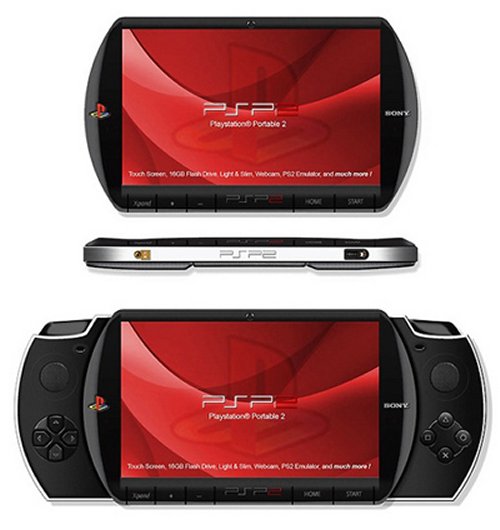
One possible PSP2 configuration
The rumor mill has been grinding out factoids like crazy lately about the PSP2, so I thought I'd round up all the rumors and season it with some analysis and some inductive reasoning.

This article is a an interesting roundup of one analyst's thinking. He makes a lot of good points about the PSP's history, though he fails to mention they have sold over 55 million units. Not bad at all, just not anywhere near the DS line's 125 million units. The PSP has also been plagued with piracy, which has kept developers away, and the launch of the PSPGo didn't help matters either. (Retailers hated it because they couldn't sell software for it.)

Based on various reports (here, here, and here) we are likely to see the PSP2 shipping next fall. The usual pattern is to show the machine publicly at E3, where you announce the ship date and the price. If you're aggressive about the release, you start showing the machine even earlier, like at the Game Developer's Conference (though you probably hold off mentioning exact specs or pricing). If you want to hit the ground running, you've been seeding key developers with advance hardware units and early dev kits for at least a year ahead of time. Which is just what the rumor mill has been saying; developers have had it in their hot little hands for months.

What also seems to be clear is that the hardware design isn't yet locked down. There are still battery and heat issues to take care of, so the final spec is not yet complete. Here's what seems to be pretty sure, though:
  • Higher resolution screen (at least 1" bigger also), so that they can say HD (which leaves them some wiggle room, as there are several resolutions that qualify for that title)
  • Dual analog controls
  • Physical media (yes, it won't be download-only)
  • Backside touch controls
  • More powerful graphics/CPU than a 3DS or even an iPhone 4
 It would be a big break with the past if Sony decided to court small developers and independent developers, but given how the iOS market has progressed it would certainly be a smart move on Sony's part. Sony would be really smart if they opened the device up to other applications besides games, and made it a music player and video player, with a slick online store that sold all sorts of media. Don't hold your breath, though.

Price? I'd guess somewhere between $249 and $349 depending on many factors, such as the 3DS price and how it's selling, and exactly what hardware is in the PSP2 and how much Sony wants to profit on the hardware.

I think that Sony has a good shot at a reasonable chunk of market share, IF they really push the downloadable content angle and create something that resembles the iTunes store in its ease of use and breadth of content. Both Sony and Nintendo have to realize the reason Apple is grabbing their market share is not the hardware, it's the business model. I fear neither Sony nor Nintendo will be able to deal with the forces that prevent them from adopting the Apple model, even in part. I hope that they will be able to.

Tuesday, October 26, 2010

Pandora: The Other Handheld

Here's another contender in the handheld gaming device market... only it's not really trying. Still, it's got some impressive hardware. It's an interesting testament to crowdsourcing: They managed to put together a fully realized handheld gaming device at a reasonable price of $349, which is pretty impressive considering the minuscule production runs (800 so far).

It's a cross between a gaming handheld and a PC, with an 800 x 480 touchscreen and enough horsepower to run various gaming emulators. You can surf the web, play videos, and use the built-in gaming controls to play a wide range of games. You've got WiFi, Bluetooth, dual SD card slots... the specs are really quite impressive. And it's only slightly bigger than a DS. You'll also have noticed the full QWERTY keyboard on it, which will make your Quake games easier (yes, you can play Quake with it).

What's the catch? It's a Linux box, which means you need to be comfortable with installing software and tinkering with the system. Not to mention hunting down software. This device does not have a mass-market veneer on it; it's a raw hacker's delight.

It took their team a couple of years to pull it together, which is not bad considering it was a hobby project. Heck, hasn't Sony been working that long on the PSP2? Which, by the way, continues to heat up the rumor mills. More people are saying it will ship sometime in 2011. Some people are looking at Sony job postings and wondering if their open reqs for Android programmers has anything to do with the PSP2. Others are looking at patent applications and talking about a backside touch-sensitive control scheme (while you're holding the PSP2, your fingers could be controlling it by touching the back of the device). Apparently there may still be battery and heat issues to overcome, though, as Sony stuffs plenty of power into a small package along with a drop-dead gorgeous screen.

Well, Sony should take their time and get it right; the competition is fierce, with the 3DS poised to hit in March, and the iPhone 4 already rocking an amazing screen and some serious horsepower (plus an array of sensors that makes for some interesting game design possibilities).

Still, the Pandora and the PSP2 and the 3DS are lacking a key competitive advantage the iPhone possesses: the iTunes store. Not just because it has a huge array of music and video to choose from, but because it makes buying games and media products dead simple. Yes, it can be hard to find the right choose among a zillion games, but compare that to the DSiWare store... it is to laugh.

I only hope Sony is putting some energy into an online store experience. Or hoping to tap into the Android Market. Nintendo... I'd love to be shocked and see them come up with a real online store for a wide range of products.

The Pandora? It's a niche machine, to be sure, but it sure looks like a fun one. A hat tip to Randy Reiss who told me about it. Randy, I hope you have fun with your Pandora!

Tuesday, October 19, 2010

New Apple Numbers Smashing Records

Apple has announced its numbers for the quarter ending September, and they are eyepopping. They hit a record $20 billion in revenue, with a profit of $4.3 billion. They sold 14.1 million iPhones... and they could have sold more, only they couldn't build them fast enough. Meanwhile, they also sold 9 million iPods and 4.2 million iPads (oh, yes, and Mac sales hit 3.9 million, a 27% increase).

Some very interesting information came along with this. First, the App Store has hit 300,000 Apps (for comparison purposes, the Android Market is over 90,000 Apps). Second, the number of iOS devices out there has hit 125 million, which is getting pretty darn close to the number of Nintendo DS units out there (132 million as of June). Clearly, given the respective sales rates, Apple will easily pass Nintendo's installed base this next quarter, and never look back no matter how well the 3DS does. Third, the iPad has become one of the fastest-selling gadgets ever, if not the fastest. Some analysts were disappointed Apple didn't sell 5 million, but there were supply constraints.

Oh, and Apple managed to sell over 9 million iPods, too, though that number was down 11% over last year. Probably had to do with the transition to the new iPod based on the iPhone 4. The new Apple TV sold 250,000 units, though of course it didn;t have very much of that quarter to work with. Still, it managed to match the Wii in sales for that month. (Wait until Apple puts the App Store on the Apple TV, then the floodgates will open.) Plus, Apple said they had hit a peak of 300,000 iOS product activations per day, handily beating Google's 200,000 per day. Apple also casually mentioned that Blackberry sold 12.1 million units in that period... the iPhone has now blown past the business leader. The iPad is making strong inroads into the business market, which is surprising to some people. Netbooks, notebooks, and consoles are all beginning to feel the impact of the tablet revolution, which is only just beginning. Note that the iPad-specific apps number over 35,000 and climbing.

What can we expect in the next year? Their numbers will only look better. Assuming Apple can get over their supply problems, they should be able to maintain their iPhone sales at least at that level. The long-rumored Verizon iPhone may actually appear next year, and if it does those numbers will climb higher. We should be seeing at least 5 million iPhones every month, maybe more. The iPad will probably hit close to 2 million per month. The iPod Touch will probably be 2 million per month. The Apple TV may even hit 1 million per month once it gets an App Store.

Consider, this, too: Apple is now the second largest company in the world by market capitalization. Their sales make them bigger than Microsoft, and in the upcoming quarter they'll beat Google and Microsoft, too. Cash in the bank is close to $50 billion... which means they can acquire whatever they feel they need to in order to increase their business. If they want to spend a bit more on marketing in any category, they can overwhelm any competitor.

Those numbers put the entire console business in the dust. No wonder sales are down. Will console makers figure out that their business model needs to change? Will Microsoft somehow get it together with Windows Phone 7 and the Xbox 360 and the Kinect to make a solid family room competitor? Can Sony put together a PSP2 and an online media store connected to the PS3 that will offer a compelling alternative? Will Nintendo finally create a successor to the Wii and reinvent their WiiWare and DSIWare stores? Or is Google the only effective competitor left?

Wednesday, October 13, 2010

3DS Too Pricey For Japan, Survey Says

Apparently the 3DS connects to your bellybutton.
A recent survey of 1,000 Japanese consumers by Getnews.jp showed that 80% of them felt the 3DS, priced at 25,000 yen for its release in Japan ($299 at current exchange rates), is too expensive. One would think that this feeling would make them less inclined to buy the unit. But Nintendo isn't buying that idea; Iwata-san says that the device will still be cheaper than purchasing a home console, as they do not require add-ons such as screens.


"You do not need any other hardware devices to be connected in order for you to play with it," he told investors recently.

Nice try, but I'm afraid the judges will have to score that one as a miss. I think it's pretty safe to say that everyone considering buying a videogame console already has a TV set of some sort, so you're comparing apples to horse apples, so to speak.

Nintendo is feeling pretty cocky right now about the 3DS after all the nice things that were said about it at E3. In fact, they used that as justification for charging a premium price for the device. On the heels of that came word that 3DS software will likely be priced higher than current DS software.

The really fascinating thing is how disconnected from reality Nintendo appears; are their marketing folks not reporting properly from the field (gathering intelligence about the market is one of the tasks of marketing)? Let's look at the points of disconnect one by one:

The people at E3 who liked the 3DS were industry folks with a vested interest in seeing it succeed. Yes, there were magazine reviewers there who liked it a lot and their jobs don't depend on it's success directly. But all of the retailers and publishers and their employees have some very good reasons to hope Nintendo's new hardware succeeds. If it does, they stand to make more money. You weren't putting the device in front of consumers in proper focus groups; you were showing it to people who are desperate for something, anything to turn around the industry's sales trends of the last two years. Nintendo, you've confused those guys with the actual market that buys or doesn't buy your product. Your marketing team should be interviewing potential customers, not inhaling their own press releases.

The entire DS line is tanking. Sales are down 20% over last year, which should be a hint that things are not all rosy. Even after you dropped the price by $20, sales didn't recover. Software sales are even worse. Everybody's sales of traditional videogame hardware and software is down, many by double digits, for the second year in a row. The economy worldwide is still wounded, and the consumers in your core demographic of 15- 25 are hurting the worst for jobs. Your response: $299 for the console and higher prices for the software. That sure would be nice for your bottom line, considering Wii sales are also dropping, but only if it actually works. If people don't buy it, you'll have to drop the prices... and price-protect the inventory already out in the channel, and hope like hell that the early high price hasn't permanently branded the console as too expensive.

The competition is tough and getting tougher. Nintendo may like to think that with the PSP only hitting about 25% of DS sales currently that they've won the console war and it's all over, everybody who wants handheld gaming will just buy whatever Nintendo puts in front of them. (Have they not seen The Jungle?) While the current PSP is weak, Sony is likely to introduce the PSP2 soon, and it will certainly offer some additional mojo over the current one. But the real threat is the iDevice (iPhone, iPod Touch, iPad) and Android markets; together they represent over 10 million units sold every month (and growing!) with over 50,000 games with an average price of $3, and tens of thousands of free ones. Downloadable, carry your whole library of games with you at all times, plus you have an incredible array of other functions at your fingertips... and they are cheaper than a 3DS (depending on the unit and how you buy it). With this competitive reality, you're going with a premium price and no new initiatives in downloadable content?

The 3DS may well have a good initial sell-in, and do pretty well for a while. But every month that passes will see the DS market fall further behind the handheld gaming curve as the inexorable math of 10 million units per month beats down on Nintendo's sales numbers (1 million per month, perhaps, after a few months... if they are lucky). A year of that math and it's pretty clear where all the developers will be headed.

 And it's not in Nintendo's direction.

Monday, October 11, 2010

The Handheld Is Dying; Long Live The Handheld

Two trends are apparent that seem contradictory: Handheld game consoles are faltering in sales, and smartphone sales are skyrocketing. They are really two sides of the same basic fact: Most people will likely carry only one handheld device with them. Unfortunately for Nintendo and Sony, that's going to be a phone for any adult and most teens.

Part of why smartphones have taken off is that they know incorporate multiple functions. Smartphones were a small market segment when they consisted of Palm OS, Windows Mobile (or Windows CE), Symbian, and Blackberry. Blackberry was a huge hit because of email; it was the corporate must-have. It still is, but it's starting to fade. When Apple introduced the iPhone, it was popular not because of Apps; the App Store didn't even exist (and Steve Jobs apparently wasn't interested in creating an open software market). What sold the iPhone then was the integration of the iPod functionality, which at that point was the overwhelmingly popular handheld device. Plus you had a camera, and you could see pictures and videos, and maps... it was phone/camera/MP3 player/GPS in one device. Once the App Store came around, and you added games to the mix along with a rapidly growing market of Apps for virtually any purpose, the iPhone took off.

Apple's latest quarterly results will be announced October 18th, and analysts are looking for amazing results. It looks like we're seeing around 4 million iPhones sold every month. The iPad is over 1 million per month and will hit 2 million per month in 2011. The iPod Touch is probably doing similar numbers.

The Android market is based on the success of the iPhone, featuring multiple functionality in one device, with an open software market. It, too, is booming, with 6 million Android phones coming online every month.

The Nintendo DS? Selling around 320,000 units per month in August. The PSP is not even breaking 80,000 units a month. Nintendo is hoping to sell 4 million 3DS units in the first month.... and that will certainly drop off once the initial hardcore fans buy one. Nintendo will be fortunate if they are selling 1 million a month after a few months, especially if the price point is $299.

The realities are that there is no way Nintendo or Sony can hope to match the volume of iDevices or Android devices, which means Sony and Nintendo will be unable to match the hardware performance and pricing of Apple or Android. Volume means you can drive hardware pricing lower, and Nintendo is starting way behind in that race.

Oh, and Windows Phone 7 launches today.... millions more devices with an open software market and plenty of hardware horsepower.

Nintendo and Sony are going to see steadily shrinking sales of their handhelds. Their only hope is to open up their devices to be multifunctional. The hardware is perfectly capable of playing music, video and many other functions. Sony could certainly build a PSP2 that could be very nice, hardware-wise. But hardware mojo will not save Nintendo or Sony. If they had an open software market and could encourage developers to come to their platform, they might have a chance. (An Android-based PSP2 could be a real winner... with real gaming controls wedded to the fast-growing software market.) As Skype and other services grow, the need for a telecom company to make a handheld device into a phone is diminishing. Heck, phone calls are growing rarer, as people (especially younger ones) text all the time. So the phone advantage could be less important in a year or two, as long as the gaming hardware provides all the other functionality (Web browsing, music, video, camera, GPS, etc.) that people have come to expect.

The future is about personal handheld computers, not dedicated hardware for games or telephony or texting or music. Some of us can remember when dedicated word-processing machines were all the rage, and obviously so much better than some poor Apple II trying to word-process... we know how that ended up. The long-term trends are obvious; Sony and Nintendo have to get onboard or be left behind. Software developers and publishers need to be aware of this, too. I notice that EA is one of the key publishers of games for Windows Phone 7, so somebody there is thinking ahead. Marketers, don't get stuck in the past. Look forward to capture the next market.

Thursday, October 7, 2010

The PSP2: Does It Have A Shot?

A possible PSP2 concept
Now that we've seen The Jungle, and the 3DS is on its way, what about Sony's poor lost little PSP? The PSP2 has been rumored for quite some time, but no one seems to know exactly what it will be or when it might appear. Certainly after the PSP and the PSPGo, expectations are not high for a new handheld from Sony. I'm sure part of the delay comes from headscratching at Sony over what the hell to do with a new device. I'm sure it galls them for Nintendo to have rolled over them so thoroughly with the DS line, with what is (in Sony's view) a technically inferior device.

Over at IndustryGamers, David Radd has some thoughts about what Sony could put into the PSP2 to give it greater sales. His prescriptions are a 3D screen (like the 3DS), a second analog "nub", make it a phone, use Kevin Butler as spokesperson, and make every game downloadable. Well, I'll agree with the second joystick; that seems obvious (though who knows if Sony can figure that out). It's a great way to differentiate the handheld from either the 3DS or the iPhone, and it shouldn't cost very much to add. But that's not going to make it a must-buy device.

I think making every game a download is a must, but it's not going to be easy for Sony because of the retail channel. They brought out the pitchforks and torches for the PSPGo (which was downloads only), and basically strangled that baby in its crib. Sony has to figure out a way to cut retailers in on a piece of the action; give them a chunk of money for downloads through their sites, or offer fast in-store downloads (and give the retailer a piece). Sony could get great promotions through the stores... maybe exclusive titles in some retailers, or exclusive DLC for a store. By promoting in-store visits and store web site visits, Sony could gain a lot of promotional help from retailers feeling besieged by all this digital download action going on around them.

Back on the hardware side, Sony has to compete with Nintendo and the iPhone and Android phones. I suspect Nintendo has locked up all the production of the only 3D screen supplier, so that route is closed (it's also an unproven feature, though it would dovetail with Sony's 3D push on the PS3 and with TVs). So the PSP2 should have some serious gaming horsepower. Give it a low-power Cell processor; or some CPU/GPU combo that will thrash anything Nintendo or Apple can produce. Make the PSP2 the most powerful handheld by a long shot, and you have a powerful attractant for hardcore gamers. Oh, and don't neglect the screen... it has to be high-res and gorgeous. The screen resolution is the 3DS' weakness; and the iPhone 4 has an amazing screen. Sony has to compete in that space, so the screen should be a killer.

Finally, open the PSP2 up to developers in a big way. Make sure it has a killer music player and video player. Sell your amazing catalog of music and video to the PSP2. Get thousands of Apps developed or ported; make the PSP2 a multipurpose device. People only have one pocket; if you want them to get a PSP2 instead of an iPod Touch the PSP2 had better do a damn fine job of playing music and video, and make it easy to acquire the content, too. (Beat Apple by having a removable battery and an option for additional storage via SD cards; give up on the damn Memory Stick already.) Make Skype a partner so you can neutralize the iPhone's communication ability without having to bring in a telco.

It's all a tall order, which may be why it's taken so long for Sony to get something together. Will they do something like this? I doubt it... Besides, with The Jungle about to take the handheld world by storm, what are the odds the PSP2 could compete against that?

Thursday, September 2, 2010

Some PSP 2 Details

Reports from Gamescom indicate that the PSP 2 has a touch screen, and will be completely digital in storing games (no UMD). (The image above is just a concept... cool, but not necessarily what the thing will look like.) So Sony is once again charging into the retail lion's mouth... will they withstand the uproar this time? Remember, the PSPGo faced open rebellion by retailers, who reasoned that if they couldn't sell games for the device they wouldn't bother to sell it. (Hmm, I wonder how many of those same retailers sell iPhones...) Perhaps Sony has figured out a way to buy them off participate in the revenue stream this time. I'd love to see a unified download store for Sony, with music, movies, games... and open up the developer side of things to allow for many more games at a variety of price points. Oh, and don't forget books and audiobooks, too. Sounds like an iPod Touch? Well, yes, that really is the competition these days.

Sadly, I don't think it will happen that way. I expect Sony will price the PSP2 around $250, which certainly won't help. Perhaps if they could line up some gotta-have-it software... but that seems to be pretty difficult to do these days. Farmville, anyone?