Game Marketing Tips, Analysis, and News


Showing posts with label Apple. Show all posts

Wednesday, June 29, 2011

New Apple TV Rumored

It doesn't seem like a bad deal when you add it all up... but will Apple actually do this?
We know a new Apple TV is coming... the only question is when, and in what form. The newest rumor making the rounds is that Apple TV is actually going to be... a TV, with the Apple TV functionality built in. Sure, this one's been rumored before, but to me it makes more sense now. Apple has a significant base of retail stores; TVs aren't that difficult to ship any more; there's plenty of room in the market for a new player.

The idea, I think, is to bundle iTunes into the TV and get ready to take on Netflix. That huge data center in North Carolina Apple built could be the necessary component in this push. Of course, the ability to put Apps on your TV is a huge potential money-maker for Apple and for developers. The game market would be right in the crosshairs of such an effort... note in the above picture one of the factors going into the price comparison is a game console.

Still, it would be pretty pricey... I don't see this idea as the real gamechanger. I think Apple TV at $99 is a great buy if you could get a full App Store with it, and access to thousands of games. Such a box would be easy to add to existing setups. While Apple may sell a full TV set someday, I don't think it would ever have a chance to take over the world. Or a significant market share. An Apple TV with an A5 chip could put out some serious game graphics, and at $99 with thousands of games at $2.99 or less would be an instant death threat to the console industry as we know it. Wii U? Wii Who would be more like it... use an iPad for a controller with your Apple TV, or an iPhone, and you've got the Wii U beat before it even comes out.

I think this holiday season would be a perfect time for Apple to bring out the App Store for Apple TV, and a new upgraded Apple TV too with more horsepower. Will it happen? I don't know, but if it does the ensuing hooraw in the game business will be interesting to watch.

Wednesday, June 8, 2011

PS Vita (NGP) vs. 3DS vs. iPhone 4/5, Round Two

Now that Sony has announced the most important piece of missing information about their new console (The price, not the name), and we have some sales history of the 3DS to examine, it's time to revisit the head-to-head comparison of the three major contenders for the handheld gaming crown. I first examined these three platforms in this post, after Sony first announced their new handheld gaming device.

Let's look at the hardware specs first. The 3DS has a 3.5" 400 x 240 screen on top (that's 3D mode resolution; it would be 800 x 240 in 2D) and the second screen below is 320 x 240. The PS Vita has a single 5" screen with a resolution of 960 x 544. The iPhone 4 (and likely the iPhone 5) has a 3.5" screen with a resolution of 960 x 640. The PS Vita has the largest screen that's close to the highest resolution screen, which is the iPhone screen. The 3DS has the glasses-free 3D effect which none of the other devices have, but for about 15% to 25% of the customers the 3D effect either doesn't work or produces nausea and headaches, or is just unpleasant.

What about graphics performance? Clearly the PS Vita, with its quad-core ARM A9 CPU and Power VR graphics co-processor has the others beat. The iPhone 4 has a single-core ARM-based A8 CPU, but the iPhone 5 is likely to have the same A9-based dual core CPU that the iPad 2 has. It still won't be up to the performance of the PS Vita, but it won't exactly be a sluggard, either. The 3DS has some custom silicon in there, so it's hard to say for sure how it compares. According to this article, the 3DS can put out about 30 million triangles per second, about the same as an iPhone 3GS and slightly less than a PSP. Which means it's way, way behind a PS Vita or an iPhone 5, by about an order of magnitude I'd guess. The fillrate in pixels per second is about 1.6 billion for the 3DS, which is definitely better than the PSP at 664 million or the iPhone 3GS at 500 million... but certainly way behind the PS Vita or the iPhone 5 (the iPhone 4 has a raw fillrate of at least 700 million pixels).

Finally, there's the price point comparison: The 3DS is $249, the iPhone 4 is hard to compare since it's under a contract, but you can get an 8 GB iPod Touch for $229, and the PS Vita will be $249.

I have to say that the 3DS doesn't stack up well at its current price point. Certainly its sales have been weaker than Nintendo projected, and it's currently limping along at a fairly low level. Nintendo is hoping that some strong software titles and more marketing spending will bring up its sales, but I think Nintendo will have to cut the price to $199 before Sony launches the PS Vita, or shortly thereafter.

Nintendo's big edge with the 3DS was to have been the 3D effect, but that's gotten a mixed reception from customers. Even Nintendo has been busy de-emphasizing its importance. Without that, thought, the 3DS doesn't have any advantages over the competition aside from exclusive software titles. Which is no small advantage, as Link and Mario and Starfox and others are a huge draw. It may not be enough for Nintendo to overcome the hardware and business model advantages of iPhones, the PS Vita, and of course Android smartphones and tablets. There are far more mobile gaming options than ever before, and smartphones and tablets have a variety of other features that make them extremely attractive.

Sony seems to be working towards having a variety of inexpensive downloads for the PS Vita, as well as movies, and perhaps will be more open to other functionality. Nintendo has said they will have 3D movies available, but 3D movies aren't doing all that well at the box office either. The 3D fad may have run its course... which would be a bad thing for Nintendo since it planned for 3D to be the major selling point of the 3DS (hence the name!).

The iPhone (and Android smartphones) have suffered from a lack of top-quality games, but titles like Infinity Blade have shown that it's possible to do some very impressive games for the hardware. (And with Epic Games announcing they've brought in more than $10 million dollars from Infinity Blade, it's clear you can make real money from these games, too.) I expect we'll see more high-quality games for smartphones in the coming years.

Verdict: On the raw hardware level, the PS Vita has the horsepower, the biggest screen and the best array of features. The iPhone/iPod Touch has an impressive variety of apps, many of them free, and quite decent hardware performance even though it lacks dedicated gaming controls. The 3DS is bringing up the rear right now, but with better software and a lower price point it could be quite competitive. Nintendo may well release a sleeker, less expensive version next year, and then it will be a different story.

Wednesday, June 1, 2011

Lodsys Still Trolling App Developers

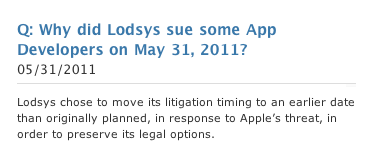
An excerpt from Lodsys' blog posting. See, Apple made them do it.
Some guys can't take a hint. Even though Apple sent a public nastygram their way, the guys at Lodsys are not shying away... they've moved up their lawsuit filings apparently because of Apple's action. So some app developers (like Iconfactory and Wulven Games) are going to have to respond to the legal actions. Meanwhile Apple must be trying to sort this all out... and Android developers are next on the hit list. It does take some chutzpah to see if you can anger both Apple and Google at the same time. Lodsys' lawyers will no doubt be racking up more than few billable hours.

A nice way to kick off Apple's Developer Conference coming up... I bet there's a resolution by then, or at least a clear signal from Apple that developers need not be scared by this. Hey, Apple, I hope you're handling the legal issues for these small developers... it's tough enough making money on apps without some patent troll costing you all your profits in legal fees.

Tuesday, May 24, 2011

Apple Fires Back Against The Trolls

This may be a picture of Lodsys' CEO.
Apple's legal team has fired off a letter to the trolls at Lodsys, basically telling them to lay off their threats to app developers over use of Lodsys patents on in-app purchasing. Apple's licensed those rights and app makers owe Lodsys nothing, according to Apple. Besides, Apple's lawyers are bigger, hairier, and meaner than yours. Nyah, nyah, nyah.

Hopefully this will shut down the attempt to extort fees from app developers; we'll see how Lodsys responds. My advice to them is to quietly slink away before Apple costs them more than they can ever hope to earn in the next few decades, by way of lawyer fees.

Wednesday, May 18, 2011

Trolls Attack Developers

No, not these kind of trolls. But it's a scary thought.
As if making money from developing iOS apps wasn't hard enough, now there's a company that wants to take a piece of your action. That is, if you're using in-app purchasing, which is rapidly becoming the most popular way to monetize an iOS game. A company called Lodsys has warned iOS developers that they are in violation of its patent, and they want you to give them a percentage of your revenue from your iOS app. Some iOS developers are getting legal nastygrams from Lodsys threatening legal action if there's no response in 21 days. Or, I suppose, a check.

Apple has had no response so far, but they are doubtless concerned about the issue. After all, if iOS developers give up 30% to Apple they sort of expect that Apple will take care of legal challenges. Meanwhile, apparently Lodsys has been receiving a lot of feedback about their action, and they've started a blog in response. I doubt they'll find much sympathy for their position out there.

Apple needs to step in and take care of this, sooner rather than later. After all, Lodsys apparently has reached agreements with Apple (and Microsoft and other large companies), but they are trying to get a piece of the multibillion dollar app market, too. This greed may rebound on them if it encourages Apple and some of the other companies to wage legal war on them.

Friday, May 6, 2011

AppDroid Apocalypse, Nowish

The face of destruction.
With Google's I/O conference coming up next week, it's a good time to look at what's happening to Google TV and Apple TV. According to this report, Google TV 2.0 will be coming with support for other chips than Intel, Android 3.0, and a full Android Market unleashed. What's that all mean? A lower price tag, since ARM-based chips are much cheaper than Intel's, an easier interface, and better graphics.

Which all means that Google TV may have a chance... if Google has been smart enough to cut some deals allowing content from major broadcasters to be shown through Google TV, unlike the first version. Sorry, Google, but if people can't watch the TV they want to watch through Google TV, don't expect the unit to take off.

Meanwhile, all is quiet on the Apple front... too quiet. Rumors have been bubbling up about the massive data center Apple has constructed in North Carolina, which apparently will be used in some fashion for iTunes. But it's probably connected to Apple's recent purchase of iCloud, and the streaming music service, and the deals Apple's been cutting with major music labels. I suspect even more than that... other rumors have Apple eying Netflix's business.

It all makes sense to me. Apple could certainly turn Apple TV into another huge growth center if they can put the pieces all together. Imagine streaming video deals where you could use the Netflix model, which has proven so popular Netflix now has more subscribers than Comcast. If you focus on streaming content, which you can do if you have a massive data center, then you don't need large local storage... a few GB in an Apple TV unit would suffice, thus keeping the costs of the unit way down. Streaming video, streaming audio, purchases kept in the cloud instead of stored locally... Now you put an A5 chip in the Apple TV, and suddenly the graphics power is now better than a Wii, and closing in on Xbox 360.

Flip the switch and allow the full App Store to be there on Apple TV. Now you're seeing a $99 box that outdoes a Wii for gaming power, easy use of an iPhone or an iPad as a controller (easily outdoing the planned Wii 2 controller-with-a-screen we're hearing about), and thousands... no, hundreds of thousands of apps available. Most of them for free or a few dollars... tens of thousands of games, and thousands of other types of apps, and more created every day.

Yeah, this is all coming soon to your family room, once Apple gets all the pieces in place. The media deals are the hardest part. The data center is ready, the hardware is ready. The gaming industry? Not ready. Nintendo, Microsoft, Sony... this is the next enemy you have to fight. Apple has hurt your handheld business, Nintendo, now they are aiming right for your jugular in the family room. Sure, Nintendo has their new console planned... but it will be hundreds of dollars, not $99. And I see no sign that Nintendo is going to embrace the new app business model that has propelled the smartphone business to amazing growth in the last few years.

Just to make it all worse, Apple is on a one-year hardware cycle, where the hardware gets a significant power boost every year. Think the new Apple TV that will be coming, with an A5 chip, is too wimpy? Wait a year for a newer $99 box. Another year or two after that and it will be more powerful than Nintendo's new console.

I still think Nintendo, Microsoft and Sony have some amazing assets in this fight, and a chance to continue to hold significant market share in the future. But unless they start embracing the future sooner rather than later, they are going to see their market share diminish between the onslaught of Google and Apple. The handheld business is just about a lost cause now, though Sony seems to be fighting an intelligent rearguard action with the NGP. Next up is the console business... and I can see that being upended the same way the phone business was upended in a few short years, by Apple.

Developers, get ready to rumble...

Monday, April 25, 2011

Tablet Wars Continue

Real Racing 2 HD lets you race on your iPad 2 with the visuals piped to your TV.
One of the few bits of bad news in Apple's Q2 earnings report was that they sold fewer iPads than they expected, due to the transition to iPad 2. Sales of the original iPad slowed in anticipation of the new device, and then Apple had problems building enough iPad 2's to meet demand. Apple is struggling to overcome the backlog, and it may take months to resolve all the problems.

So when you see a Gartner Group report predicting market share for 2015, it is wise to be skeptical. Really? Apple will get 47.1% market share in 2015? I wonder if they ever include error bars on those predictions... maybe it might really be 47.0% market share. Really, these predictions should be seen as a general look at what the future might hold if trends continue in the current directions without major bumps. But major bumps do occur on a regular basis, and thus predictions will vary wildly from reality at times. What if Apple introduces a new iPad plagued with defects? Market share will drop. What if an Android tablet comes out (say, from Amazon) with a terrific price point and an awesome feature set? Maybe it will steal a big chunk of market share from Apple.

The wise marketer prepares a strategy with some contingency planning in mind to take care of just such events. It's why you should try to diversify your revenue sources among platforms and product lines, as a hedge against the unexpected. If all of your revenue comes from one product on one platform, and then that platform suddenly goes dark for a while, your cash flow dries up. Not a good situation, so plan on how you can avoid it.

Meanwhile, games are the number 1 application for tablets, and we're starting to see some very interesting innovation. Take Real Racing 2 HD from Firemint, for example. This is a slick racing game with some interesting options... like shooting the visuals to your 1080p HDTV (through an AV adapter, or through an Apple TV). YOu get to see your racing on the big screen, and still get useful data on your iPad 2... which you use as a steering wheel, taking advantage of the sensors in the iPad 2. Check out the video:


This sort of title will be hard for a 3DS to compete with. Maybe Sony's NGP will be able to handle this sort of thing, or perhaps Nintendo's new console with the spiffy controller that's rumored can take it on. Meanwhile, we're getting a glimpse of where gaming is headed. Convergence between handheld devices and the family room is happening, leading to some very interesting combinations.

Hey, Microsoft, what do you have? Where's those Windows Phone 7/ Kinect connections you demo'ed? I hope you're planning to bring those to market... and maybe you should think about a tablet operating system someday. Just a thought. I wonder if HP is planning on making gaming important to the future of WebOS as they try to make that a major player in smartphones and tablets. Certainly they haven't shown a presence at GDC... someone should clue them in that gaming is the leading category of applications on smartphones and tablets. It would seem hard to gain traction in either market unless you make some kind of showing in the major application category... better still, have some killer apps in that category. This is one of those cases where marketing is supposed to help inform the product development guys... someone should be writing memos. Or carving the memos into the cubicle walls around the engineers, or sending up signal flares, or something.

Ah, marketing... you have to use those marketing skills in your own organization if you really want to have an impact.

Friday, April 22, 2011

How Much Do App Developers Make?

This chart has all the data...see the original here.
If you guessed "Not a lot, on average," you're right. While Apple in their latest earnings call mentioned that they've paid out over $2 billion to developers, when you analyze the numbers it's less impressive. An interesting analysis by 148apps.biz breaks down the numbers, and they are instructive. With approximately 370,000 apps on iOS from 78,000 publishers, that $2 billion gets spread pretty thin. The average app costs $2.52, which isn't a whole lot.

The numbers work out to about $8500 per publisher per year, which isn't a whole lot. Of course, that's averaging; the publisher with big hits make hundreds of thousands or millions, and many just make a few hundred dollars.

Games are more lucrative than non-game apps, and that's a good thing for game developers. But it underscores just how difficult it is to make money with an iOS game... or any smartphone game, for that matter. Developers need to be aware of the facts before charging into an expensive development process.

Thursday, April 21, 2011

Apple's Huge Q2

I believe this is made out of platinum, given their sales numbers.
Once again, Apple beat its own estimates and analyst guesses for a stellar $24.67 billion in revenue for Q2. More than half of their revenue came from the iPhone and related products... they sold 18.6 million iPhones in the quarter, up 113% over last year's Q2. The one thing that held them back was an inability to produce enough iPads to meet demand, and the backlog on the iPad 2 is monstrous, according to Apple.

In other Apple news, they've sued Samsung for patent infringement because of the Galaxy Tab and the Galaxy S products. Interestingly, in the legal filing we find out that Apple has sold 187 million iOS devices as of March 2011... 19 million iPads, 60 million iPod Touches, and 108 million iPhones so far. For comparison purposes, the Nintendo DS line has sold 144 million units and the PSP line has sold 62 million units. The iPhone should pass up the DS line this year, and so should Android phones, in total units sold.

The iTunes store is now bringing in $1.4 billion per quarter... not a bad little business.

The rumor mill is now saying not to expect too much from the iPhone 5... new processor (the A5), better camera, maybe a few other tweaks... and it won't hit until September. I think that may well be true, but the real story is going to be how Apple attacks the lower price point end of the market. So far, Android phones have mostly been at the high end in iPhone price territory. But we're starting to see pretty nice smartphones based on Android coming down into the $100 price range, without a contract. This spells trouble for Apple unless it can respond.

Sure, they keep selling older models of the iPhone at lower prices, but there's a significant difference in horsepower between an iPhone 3G and an iPhone 4... not to mention an iPhone 5. Looking at what Apple did with the iPod line over time may be a clue as to how they will approach the issue of extending the iPhone line. They came up with ways to cost-reduce the product, make it smaller and reduce the feature set to the core features. So I will expect them to come up with some smaller, sleeker iPhone models to hit lower price points, and eventually cover a full range of phone prices.

Which, in turn, will mean more variations for developers to support... but a larger market overall.

Tuesday, February 1, 2011

E-Book Market 2011: Apple Tightens Its Grip

Interesting news coming out of Cupertino... Apple is getting tougher with apps that sell products outside of Apple's usual 30% cut. Apparently Apple has blocked Sony's e-reader app and mandated that purchases of e-books cannot be sold without giving Apple their cut. Even books you bought outside the App would not be allowed within.

This has massive implications. Kindle has been successful partly because the software is available on all sorts of platforms, and wherever you bought your Kindle book it's available, and bookmarked the same. So if you start reading a book on your Kindle reader, then go to it on your iPhone, it's in the same place. No longer; under Apple's new policy apps can no longer access content purchased outside the App Store.

As you can imagine, there's already widespread concern since this article was published in the New York Times. I can understand Apple's concern, because at its logical extreme this would encourage app makers to funnel in-app purchases to outside places, and Apple would lose what's currently 50% of App Store revenue: the in-app purchase. On the other hand, you can see where Amazon wouldn't want to take an extra 30% hit on ebooks they sell... there goes the profit margin, and then some.

Conceptually there seems to be a difference to me between buying an e-book on Amazon, then wanting to read it on my iPhone or iPad, versus going to an app on my iPhone and buying an ebook there. Though it gets fuzzy when I think about using a Kindle app on my iPhone to buy an ebook... would the user even know where the transaction takes place, or care? Well, Apple and Amazon sure do.

So this struggle is going to be a major one, and it may well affect how ebooks are sold and distributed and read. I'd hate to see ebooks become walled off based on the platform where you purchased them, and I don't think consumers will sit still for that, either. This same policy would also affect things like Sony's plan to bring PSOne games to iOS, for instance; Apple would not allow sales of Sony games within a Sony app unless Apple got a cut, under this policy. Would Sony sit still for that?

This also bears on the magazine/newspaper subscription revenue issue that's still outstanding.

Apple's going to be in the middle of some interesting discussions. I hope this ultimately plays out to the benefit of the customers. Apple may have to make its simple 70/30 split structure a little more complicated to accommodate reality and customer needs.

UPDATE: Apple has responded, to clarify that content purchased elsewhere is OK as long as it is also available through an in-app purchase (where Apple can get its cut). If the app developer doesn’t want to use Apple’s in-app purchases to sell content, then the app can’t access content purchased elsewhere either. I don't think this solves the problem, and no doubt the discussions will continue.

Wednesday, January 19, 2011

iPhone Games Market 2011 Will Be Huge

Apple pulled out all the stops for the last quarter (their fiscal year Q1) and bettered not only their best quarter ever (that would be the previous quarter, at $20.34 billion), but even beat their own estimates of $23 billion to rack up an astonishing $26.74 billion in revenue. A healthy chunk of that, $6 billion, was profit.

What was responsible for this? Everything. Over 16 million iPhones sold, a year-over-year growth of 86%. Over 7 million iPads (now there are over 15 million iPads out there). iPod Touch sales were up 27%., so it's not just iPhones out there. Oh, and 4.13 million Macs and 19.45 million iPods were sold, too. Apple could have done even better had they been able to build more of everything. The iTunes store took in $1.1 billion, too.

Some other key facts to chew on: The iOS device market is now at 160 million. Apple has about $60 billion dollars in cash, in the bank. Over 80% of the Fortune 100 companies are testing or deploying the iPad now.

So what does this all mean for games and e-books?

In 2011, look for a huge explosion given the Verizon iPhone will send iPhone sales for Q1 to the 21 million unit neighborhood, or maybe beyond. Apple could be looking at selling over 100 million iPhones and iPod Touches this year. And perhaps 30 to 40 million iPads. And now that there's a Mac App store, and Mac sales keep growing, there's yet another easy place for developers to market their iPhone games (a quick port to iOS is the work of a week or two). E-books will find an even broader market with that number of iOS devices growing so rapidly.

There is a dark side, though: It will get even harder to get noticed. Sure, successful games from well-known companies will get an even bigger market. But new games from unknowns will have even more competition for awareness. Marketing iPhone games will be getting harder, not easier.

As for Nintendo, I think it's game over, man. Look, this year alone Apple will be selling nearly as many iPhones as all the Nintendo DSes ever sold. Sure, sure, the 3DS will sell a bunch. But it will never be the best-selling handheld game console, nor even close. Apple is running away with that title. And Nintendo can never catch them.

Thursday, December 30, 2010

7 Smartphone Gaming Predictions For 2011

Smartphones 2011... Produced by Photoshop.
The tech industry basically shuts down between December 25th and January 2, and so the usual spate of news becomes a trickle. What's a blogger to do except make predictions? That's how I intend to fill things out this week, with a series of prognostications for 2011. If nothing else, this will set me up for a retrospective one year hence where I can laugh at the foolishness of my younger self. Until then, here's my take on what's going to happen in the Mobile Gaming Market in 2011.

  • Smartphone games continue double-digit growth. Not a hard prediction to make, but let's go a little further: Smartphone games will pass handheld games sales numbers. There was about $1.6 billion in US sales for mobile games in 2010, and about $2.1 billion for handheld console games in 2010; with the trend lines smartphones can pass them up, if the 3DS and the PSP2 don't spawn massive software sales (which I don't think will happen). The battle is over, and smartphones have won. Handhelds just haven't figured out they're dead yet.
  • Smartphone games become a bigger market than PC games at retail. PC games were about $2.1 billion in US sales in 2010, and that was down about 19% from 2009. I expect space at retail for PC games will shrink, not expand, so smartphone games have a good shot at passing them up. Not only that, smartphones will become a bigger market than PCs this year, worldwide. We're looking at over 500 million smartphones sold in 2011, if predictions are correct. Now that's a market worth being part of.
  • Verizon adds iPhone. The rumors have reached a fever pitch, but I really start to believe when I hear from suppliers. Apple is now looking at selling around 20 million iPhones or more in 1Q, which looks like a truly astounding number for the entire year. Throw in some iPod Touches to that mix and Apple will likely more than double its iDevice installed base in one year. Whoosh.
  • A new iPhone model arrives. Have I heard rumors? Nope, just educated guessing. Apple has generally introduced a new model every year or so. Sure, they'd love to slow down and bank more profits, but the fevered pace of the smartphone business means if you're only running, someone is sprinting past you. I think Apple has to keep pushing new phone tech out there in order to keep sales up. Probably this year will see less technical innovation than the iPhone 4. I expect a faster processor, maybe more memory for the money, and reduce the price on the older technology. Oh, and a redesign to fix the antenna problem (though that seems to have been mostly forgotten). The new iPhone model probably won't arrive until summer, just in time to push the old model price down and boost sales going into the last part of the year.
  • Android outstrips Apple in units sold; Apple continues to make more money for developers. This will happen despite Apple vastly increasing its sales due to the addition of Verizon (see above). There are just more and more Android phones out there, and the competition will continue. Another release or two on the operating system will help. And I sure hope Google gets around to making in-app purchasing work, because that will be the best thing they can do for developers. But there's more than that going on: New chipsets will make smartphones even more affordable, with retail prices under $100 without a carrier subsidy. That's for a smartphone looking a lot like a Droid, and you'll be able to find them by next summer for around $75.... without a carrier subsidy. Oh, yeah, there will be a lot of those sold... and the buyers will be looking for apps.
  • Blackberry and Nokia will continue to lose smartphone market share, only faster this year. These poor companies will continue to flounder around, denying that there's a problem. Their new widgets will fix the problem... and then they come out and no one cares. The Blackberry Playbook? Will anyone even remember the name by next summer? Nokia will continue to try to get their online store moving, but will seem to forget that it won't matter unless they can sell a lot of hardware. Meanwhile developers will keep busy with their iOS and Android projects, and only if they have time on their hands worry about other markets. Which they won't.  Meanwhile, we see Windows Phone 7 and Palm making inroads in the market; they will likely eat up share from Nokia and Blackberry.
  • Data plans get cheaper. Virgin's offering a $25/month plan off contract. T-mobile has $10 a month plan. AT&T has a $15 a month plan. As the networks get built out, and carriers compete, prices will continue to drop. Tablets will only accelerate this. Cheaper data plans will be good for apps, and good for developers.

2011 looks to be a huge year if you're an app developers. But the extreme growth will probably mean little attention being paid to details like helping developers market their apps. It will be even harder to find apps in 2011, not easier, and marketing will be even more important.

Tuesday, December 28, 2010

Tablet Wars 2011

It's gonna get ugly for the hardware manufacturers. It'll be a bonanza for software developers. The tablet boom is coming to 2011.

Some analysts are estimating up to 75 million tablets will be sold in 2011, and Apple may sell half of those. Let's look at each segment of the market.

Apple: Expect a new iPad 2 this year, probably announced by April. Rumors suggest a higher resolution screen, thinner and lighter, and including front and rear cameras. My guess is that Apple will reduce the price of current iPads to make room for this new model, and boost sales even further (while fighting against the massive competition heading their way). I still expect Apple to cut some kind of deal with textbook publishers; the market possibility is huge (student signs up for classes, downloads all textbooks into his iPad... goodbye heavy backpack!). The gaming possibilities will expand as AirPlay allows iPad games to be viewed on an Apple TV-connected TV screen... with iPhones as controllers... we're gonna see some amazing games, especially if the new iPads have even faster processing than the current ones.

Android: The number of Android tablets heading to market is huge; we'll see a slew of them at CES soon. The big deal, though, will be the release of a version of Android crafted with tablets in mind. Google hasn't made any official announcements on this point, but there's plenty of speculation. Some point to the Chrome OS as Google's  reason for holding off on Android for tablets, being afraid that Android make make Chrome OS dead on arrival. I think Google will ultimately go with whatever sells, and right now the demand all seems to be lining up for Android. In any case, Google has to sort out the situation before Android tablets really take off. Even so, there is a wave of Android tablets headed to market soon.

Microsoft: Don't count them out of the tablet race. CES will see the introduction of a new variant of Windows designed for ARM processors as Microsoft aims to grab a slice of this fast-growing market. Still, they've failed miserably in the past to make Windows-based tablets sell; adapting Windows toa finger-based interface has been awkward and slow at best. Can Microsoft reinvent itself sufficiently to succeed? Certainly they've managed to do so with Windows Phone 7, so maybe they can pull it off after all. I think they have a very tough race ahead of them, though.

HP: Here's the real dark horse, with their PalmOS slated to become the basis for a new line of tablets. Certainly HP has the size and manufacturing capability to handle this task; can they be innovative enough? No announcements so far, but the rumors are pointing to a product introduction or several in 2011.

Developers will have multiple targets for tablet products. Gaming will be a major part of all of these platforms, if not the biggest part. It's going to be a wild year.

Saturday, December 11, 2010

The Dark Side Of In-App Purchasing

Who knew Smurfberries were so mothersmurfin' expensive?
It hasn't taken long for the dark side of in-app purchasing to emerge. Of the top 10 highest grossing apps in the App Store, 6 of them are free to download... and make their money from in-app purchases. Capcom's The Smurfs' Village was the highest grossing app shortly after its release a month ago, even though it's a free download. The secret? In-app purchases. You can buy Smurfberries to help you play the game, and in fact you can buy a wheelbarrow full of them for $59.99 if you want to. Who would be crazy enough to do that? Perhaps a 4-year-old child who doesn't really understand the idea of money, and all it takes is two taps to buy things. In the AP story on the link I posted, one kid racked up over $66 in a short time, and another hit $140.

Wait, isn't there a password protection to prevent unauthorized iTunes purchases? Yes, but there's a loophole: If you tap on another purchase within 15 minutes after entering the password, you're not asked for the password again. So if you use your password, then hand your iPad or iPod to your child, they can merrily buy Smurfberries until your credit card freaks out.

Well, but that loophole should only occur in a very limited number of cases, right? Apparently the 15 minute time limit doesn't work all the time... some parents are reporting they hadn't used their password that day and the kids are still able to buy things without re-entering the password. Not good, Apple.

On the positive side, Apple has been very good about providing refunds. And you can lock out in-app purchases using the settings menu. But there's an issue with publishers providing games with seductive in-app purchases aimed at children too young to be deciding on purchases. Wait, here's Capcom's response: Capcom spokesman Michael Larson says "Smurfs" is no different from other games in this regard, and the bulk purchasing option is useful to adult "power players."


Adult power players? For a Smurfs game? What kind of bullsmurf are you trying to hand out? Here's a general marketing tip: Try to avoid obvious flights of fancy when talking to reporters.


Of course, it's not just Capcom that's doing this. Four of the six top-grossing apps are kid-oriented games. Mixing in-app purchases into games aimed at children seems like a recipe for problems. Sure, you might make some serious money for a while, until the angry hordes of parents descend on you with tar and feathers.


In-app purchases are a very powerful tool... and like all power tools it's very dangerous if mishandled. Marketers need to tread carefully in this area.

Tuesday, October 19, 2010

New Apple Numbers Smashing Records

Apple has announced its numbers for the quarter ending September, and they are eyepopping. They hit a record $20 billion in revenue, with a profit of $4.3 billion. They sold 14.1 million iPhones... and they could have sold more, only they couldn't build them fast enough. Meanwhile, they also sold 9 million iPods and 4.2 million iPads (oh, yes, and Mac sales hit 3.9 million, a 27% increase).

Some very interesting information came along with this. First, the App Store has hit 300,000 Apps (for comparison purposes, the Android Market is over 90,000 Apps). Second, the number of iOS devices out there has hit 125 million, which is getting pretty darn close to the number of Nintendo DS units out there (132 million as of June). Clearly, given the respective sales rates, Apple will easily pass Nintendo's installed base this next quarter, and never look back no matter how well the 3DS does. Third, the iPad has become one of the fastest-selling gadgets ever, if not the fastest. Some analysts were disappointed Apple didn't sell 5 million, but there were supply constraints.

Oh, and Apple managed to sell over 9 million iPods, too, though that number was down 11% over last year. Probably had to do with the transition to the new iPod based on the iPhone 4. The new Apple TV sold 250,000 units, though of course it didn;t have very much of that quarter to work with. Still, it managed to match the Wii in sales for that month. (Wait until Apple puts the App Store on the Apple TV, then the floodgates will open.) Plus, Apple said they had hit a peak of 300,000 iOS product activations per day, handily beating Google's 200,000 per day. Apple also casually mentioned that Blackberry sold 12.1 million units in that period... the iPhone has now blown past the business leader. The iPad is making strong inroads into the business market, which is surprising to some people. Netbooks, notebooks, and consoles are all beginning to feel the impact of the tablet revolution, which is only just beginning. Note that the iPad-specific apps number over 35,000 and climbing.

What can we expect in the next year? Their numbers will only look better. Assuming Apple can get over their supply problems, they should be able to maintain their iPhone sales at least at that level. The long-rumored Verizon iPhone may actually appear next year, and if it does those numbers will climb higher. We should be seeing at least 5 million iPhones every month, maybe more. The iPad will probably hit close to 2 million per month. The iPod Touch will probably be 2 million per month. The Apple TV may even hit 1 million per month once it gets an App Store.

Consider, this, too: Apple is now the second largest company in the world by market capitalization. Their sales make them bigger than Microsoft, and in the upcoming quarter they'll beat Google and Microsoft, too. Cash in the bank is close to $50 billion... which means they can acquire whatever they feel they need to in order to increase their business. If they want to spend a bit more on marketing in any category, they can overwhelm any competitor.

Those numbers put the entire console business in the dust. No wonder sales are down. Will console makers figure out that their business model needs to change? Will Microsoft somehow get it together with Windows Phone 7 and the Xbox 360 and the Kinect to make a solid family room competitor? Can Sony put together a PSP2 and an online media store connected to the PS3 that will offer a compelling alternative? Will Nintendo finally create a successor to the Wii and reinvent their WiiWare and DSIWare stores? Or is Google the only effective competitor left?

Thursday, July 1, 2010

Microsoft, Nintendo's Barriers to Entry

Creating console games has been something that big companies do, or smaller companies only when they have a contract with a big company. Historically, console makers charged big bucks for development systems -- upwards of $50,000 not so long ago, and more than that you had to apply and they had to accept you. Then each game had to pass an evaluation in order to be cleared for manufacturing... which took months and cost a lot of money to manage.

You'd think it might be easier these days, at least for developers creating games for the online stores of Sony, Nintendo, and Microsoft. Hah! This interview with some local developers in Santa Cruz has them recounting the lengths they had to go to... posting videos on YouTube to get Nintendo's attention, waiting 5 months just to get to talk to someone at Microsoft. With all that, they still don't have an easy path to success. Imagine how difficult it would be to post an update or an add-on to a game.

Contrast that with Apple's process. You want to be an iPhone developer? OK, $99 gets you the development software. You'll need a Mac to develop on, which would run you another $700 if you don't have one. Build your App and upload it, and wait for approval. Usually it's less than a few days, and your product is in the store. Of course, you have to tell the world about it, and bring the customers in... Apple is no help there. But at least they don't get in your way.

Sony, Microsoft, and Nintendo are all failing to take advantage of the next great revolution in software. The App market has been a huge success, by lowering barriers to entry and creating a vast array of free and low-cost titles that are easy to download and install. This is all possible in a family room, but the Big Three are still too locked into their retail partners and $60 software pricing. They fear a rebellion by their retail partners and third-party developers if they tried to open the floodgates to small developers and free-to-play software.

Apple and Google face no such limitations... I'm sure the AAA titles on consoles will still attract an audience, but there is going to be some big changes coming and the landscape will look very different in a few years.

Monday, June 7, 2010

App Bonanza Expands

As I write this, Steve Jobs is busy telling developers about the new iPhone, and it does sound pretty cool. But the real news that should be getting you excited is not the new hardware, nor even the advent of Farmville for the iPhone. It's the state of the App market. Now there's 225,000 Apps in the App store, and they just crossed 5 billion downloads... and have paid out over $1 billion to developers. Plus, while Apple was showing stats on the growth of the iPhone and its App market, they were showing numbers about Android. They interesting thing is how Windows Mobile, Blackberry and Nokia are shrinking, while Apple and Android are growing at an amazing rate. Why does this matter? Because Apple and Android have easy App markets to get into, and by far the highest volume of App sales... so that's where the money is for developers.

New Android phones are getting pretty amazing, and it's nice to see sharp competition between Apple and other hardware makers. The result is the market for Apps of all flavors is growing fast. Interestingly, there is only a 5% overlap between iPhone Apps and Android Apps, according to Flurry (the leading mobile analytics firm). This surprises me... app developers are missing an easy way to expand their sales. Do an iPhone app, then port it to Android, or vice versa.

And all this App frenzy is even without counting the 2 million iPads sold so far (one every 3 seconds now), and the 17 apps per iPad that have been downloaded to this point. Oh, and PDFs are now part of the iBookstore... and the iBookstore is accounting for 22% of ebook sales from major publishers. Plus they are now allowing individuals to put ebooks up for sale. And the iBookstore (complete with PDF support) is coming to the new iPhone OS 4. So individual authors can now make their ebooks available to the 100 million iDevices out there, or will be able to soon.

Rumors have already started to emerge that Apple TV is going to get completely redone... as an iPhone type device, using that operating system and ecosystem. Imagine being able to buy games and play them on your TV... as Apple finally cracks the console market and completely upends that business, while opening up chances for small game developers to finally reach a huge audience. And did I mention Google TV, which has already been announced and is planning essentially the same thing? I wouldn't want to be Sony or Nintendo or Microsoft right now. They're going to be in LA in a week trying to get the world excited about what's coming for consoles, and meanwhile the world is changing in fundamental ways that they don't address.

Marketing is going to be even more key to this future...

Wednesday, May 5, 2010

Apple's Fixing Things

Apple is trying to clean up its act a little bit, apparently. First off, they've fixed the way they screwed up the App Store for iPads. Now you can actually find all the games for the iPad. Though the fundamental difficulties with the App Store still remain. There are too many products for the interface; unless you already know what you're looking for, you won't find it unless you get lucky. And let's not even talk about the categories and how the games in them don't belong there...

Meanwhile, having come under fire for blocking third-party development tools from being used on items for the App Store, Apple is quietly looking into altering their developer agreements. But this may be too late to stave off an anti-trust investigation. Oh, and questions are being asked about iAds and whether that may be an anti-trust violation because of its restrictions on data sharing.

All of this in the shadow of Apple's announcement that they've already sold 1 million iPads in less than half the time it took them to sell 1 million iPhones.

It's a tough market, but a growing one. Having now played with an iPad for a while (my wife got one for work), I do believe it has a bright future. I guess HP and Microsoft agree, since they've canned their slates that were originally looked at for this year. Back to the drawing board... Apple's changed the battlefield.

Friday, April 30, 2010

Apple Strangling iAds?

If this article is to be believed, Apple may charge advertisers $1 million to be an advertiser on iAd, and if you want to be one of the first, it might be $10 million. So, Apple, I guess you only want big advertisers. I was expecting something more like Google, where anyone can buy search terms to place their ads alongside. This is a completely different program... and it does make you wonder how much ability an advertiser will get to determine where their ads appear. What if your ad appears in a lousy app, or an off-color one?

Right now, since Apple has released very little information about this plan, I guess we have no answers. But the devil really is in the details. Do advertisers get to choose what apps their ads appear in? Do app producers get to choose what ads appear in their apps? How does an advertiser control their spending (do you set a price level, a number of impressions, what)? Do you pay for every time the ad appears, or just every time someone clicks on the ad?

From this article it sounds like Apple is setting up something more akin to traditional magazine advertising than the very individualized Google model. I was hoping Apple was planning to democratize advertising on mobile platforms the way Google did for desktops. I'm sure Google gets the bulk of its revenue from a very large number of small advertisers, rather than a few big advertisers. You can get started with Google for next to nothing, and scale up if your Google ads prove effective. Will Apple offer something like that? I hope so, but this article does not make me optimistic.

Thursday, April 15, 2010

It Was Broke, and They Made It Worse

So the iPad comes out and Apple takes a stab at revising the App Store. Good, you think... the App Store has never had great tools for finding games, developers game the hell out of the comment system, and now that there are more than 50,000 games finding anything not on the top 100 lists is purely by luck (or knowing the name from somewhere else). Ah, and the iPad arrives, and games are the single largest category for iPad-specific software. Excellent, Apple is right on top of things, they're going to revise the App Store before the situation gets out of hand...

And then you see what they've done. No more sub-categories, just some filters showcasing What's New and What's Hot. Excuse me? Did all of the creativity and thought go into the hardware, and then when it came to the App Store you just decided to be stupid? We need more ways to find games, not fewer. We need the commenting system improved. We need to be able to find an RPG without having a category stuffed full of pseudo-RPGs that are come-ons for social network games.

Look, Apple, I know you feel that it's up to the developer to sell their app, and you're just a store. But come on! Throw us a frickin' bone here. Even stores offer tools and programs for companies trying to sell things in their stores... shelf talkers, end caps, co-op ads in fliers, coupons... I sure hope iAd is a lot more thoughtful than what you've done with the App Store. Because it's broken, and you're making it worse, and as more apps pour into it, it's gonna get worser. (Somewhere, an English teacher just had a coronary.)