Game Marketing Tips, Analysis, and News


Showing posts with label Android game marketing. Show all posts

Thursday, April 7, 2011

Android Vs. iOS: One Developer Reports

Pocket Legends is a pretty cool MMO.
While many developers have put their bet on iOS, at least one developer is reporting that they make far more money from Android than from the iOS version of their game. Spacetime Studios makes the Pocket Legends 3D MMO for both Android and iOS, and they report that Android downloads are running about 9,000 per day versus 3,000 to 4,000 per day for iOS. Which is significant since they make money mostly from in-app purchasing, so having a large number of apps downloaded is important.

Here's the interesting part: Android users generate 30% to 50% more revenue per day from in-app purchases than iOS users, despite the fact that in-app purchasing on Android is a jury-rigged affair right now. (Google will debut built-in in-app purchasing for Android this May.) Even more interesting, Android users click on ads at three times the rate that iOS users do (Spacetime also uses ads to generate revenue).

I'm not sure why they are doing so much better on Android; perhaps it has to do with their marketing efforts. It's an interesting object lesson that you can't always predict revenue for a platform purely by the number of users or unit sales of hardware.

Thursday, March 17, 2011

Android Market Gets Real Search

If this thing really works, it could be huge... I'm gonna have to check it out. Chomp promises to be the search tool that Android really needs, that will classify Android apps by really figuring out what it's for rather than just what tags the developer hung on it. (I really hate the fact that all these social games call themselves "RPGs" and make it impossible to find a real RPG on Android or iOS.) We'll see if it amounts to anything... but it sounds like a good idea.

Tuesday, February 22, 2011

Android App Revenue: Barely There

You might think, looking at the number of Android phones out there (10 million new ones per month) , that Android app sales would be significant. You would be wrong... Check out the chart above, from UK research firm IHS, as reported by TechCrunch. Sure, Android app sales have grown 861% since 2009... which sounds like a lot until you realize it's because they started so small. The iOS App market topped $1.7 billion in 2010; the Android app market barely cracked $100 million. That means iPhone apps made 17 times what Android apps did in 2010... no wonder app developers are still developing first for iOS. Even if they may be annoyed by Apple's policies, it's where the money is.

Interesting to note is that Blackberry's app store made more than Android, as did Nokia's store. App development proceeds apace for Android, but Android phone users aren't buying all that many apps, it seems. Of course, the situation will probably change as in-app payments are put in place for Android. Still, app developers need to be conservative about how much they could make from Android versions of their apps. Hardware sales alone don't tell the whole story; the demographics of the buyers, and the details of the market itself, are obviously important.

Friday, January 7, 2011

Predictions For Adventure Gaming 2011

I get an excuse to show my game from the dawn of time.
I've dealt with other segments of the gaming market, so I might as well have a go at this one. Adventure gaming is in many ways the progenitor of the electronic gaming market, and is still a rich source of inspiration to electronic game designers. Roleplaying games, card games, board games, miniatures games and other less easily classifiable games are found in specialty gaming stores around the country, and some products make it into wider distribution through bookstores or other types of stores. Occasionally a product like the Pokemon trading card game breaks into wider mass-market distribution, but for the most part adventure gaming products are in limited distribution.

The industry has had its ups and downs over the past few decades. Once a sleepy little backwater of miniature games and war games, adventure gaming had its first big expansion when roleplaying hit with the introduction of Dungeons & Dragons in 1974. The concept took off and hundreds of products followed over the next decade (including my own roleplaying game Champions). Roleplaying was a phenomenon that got national attention, until the growth of electronic gaming (mostly computer gaming) in the 1980s took away some of its audience.

The next great expansion was the trading card game (TCG), which was led by Magic: The Gathering in 1993. Again, the phenomenon burst across the national consciousness, new stores opened, and many companies expanded (including Wizards of the Coast). Collectible miniatures games introduced in 2000 (HeroClix) was another boomlet, though not to the scale of the TCG.

The industry now is smaller than it was in days of yore (that would be the ancient times of the '80s and '90s). Much of the mojo (read: entertainment time and dollars) has been stolen by electronic games of all varieties. Still, there's great creativity in the adventure game industry and new products continue to attract buyers.

  • Publishers find more and more revenue coming from e-book sales. The e-book segment has grown tremendously, as witnessed by DriveThruRPG.com. (I believe I was the first to put e-books into a retail store, on a floppy disk in Acrobat 2.0 format in 1995.) E-books have become much more acceptable as a format, especially with inexpensive laptops and now tablets making it easier to use them in a gaming session. The major problem is the pricing; most adventure game publishers still price e-book versions of their rules quite high, which means piracy is an issue. Since many adventure game publishers depend on physical book sales, they are loath to reduce prices on e-books and so make it harder to be profitable on paper versions of the same book. I predict we'll see more experiments with lower e-book pricing, and greater e-book sales overall.
  • The number of retail stores continues to shrink. Game stores are an endangered species, and increasing electronic distribution is part of the reason. Bookstores are also endangered, and the combination will drive adventure game sales even more towards mail-order, convention sales, and electronic sales. The rate of attrition will slow, as surviving retailers are (by necessity) good ones, and are adept at finding ways to bring in customers and offering a variety of goods for sale. In-store gaming is a big help, as are miniatures games.
  • The explosion of e-book readers will be good for adventure gaming. Not just dedicated e-readers like Kindle, but also tablets and smartphones. If prices are reasonable, then all the players can have easy access to rules without lugging around huge books. More e-book readers means more willingness to buy e-book versions of rules, or at least a larger potential customer base.
  • The growth of smartphones will be good for adventure gaming. Not just because they can be used to read e-books (not well, unless rules are formatted especially for them... which would be a great feature that some publisher is going to stumble upon someday). Smartphones are also handy little computers, as witness the number of die-rolling programs out there. Many other aspects of gaming can be aided by smartphones... and we'll see more of that this year.
  • Adventure game companies will increasingly turn to technology. By necessity, adventure game companies have embraced the Internet as an easy way to communicate with customers. Now Facebook is a becoming a very important tool for customer relations. Twitter is everywhere. Social media is great for marketing purposes, and for connecting a farflung network of fans. I think we'll see more connections with social gaming and mobile gaming... many small games would make great smartphone apps, and some of Reiner Knizia's games are making their way to Facebook. We'll see more of this...
Adventure gaming will have another bumpy year, as new technologies continue to disrupt the same old way of doing business. Companies that take advantage of the trends will continue to do well; others, not so well.

Tuesday, January 4, 2011

PC Gaming 2011 Predictions

Continuing my series of 2001 predictions, I'll look at PC gaming. I define this as a wider field than some might; in this area I include MMOs, boxed retail PC games, downloadable games, Flash games, and F2P games like League of Legends. While the boxed retail PC game has certainly had a difficult few years, people still spend a lot of time playing games on their PCs. The PC game market's biggest threat may be the emergence of the tablet market, as it eats into PC and laptop market share. A tablet may be a better way to game for many people at home; it starts up right away and games are easy to install and acquire. Of course, tablets lack the control possibilities of a PC, so certainly hard-core gamers will still be attached to their cutting-edge hardware. Still, many game makers will want to look closely at the tablet market, if they aren't already.

Anyway, here's some of my predictions for PC Gaming in 2011.


  • The Star Wars MMO has a disappointing reception. Oh, they'll sell a bunch right away, but there will be a chorus of complaints about game balance, play style, and the Star Wars universe fidelity. I can predict this without having seen the game because that's the way MMORPGs launch: Game balance is wonky and they prefer to get that right while people are paying for the privilege of testing. Early adopters will complain about it, and complain about what they get to do or can't do, and Star Wars fans will no doubt find things to complain about. The real key is whether the game is compelling enough to attract people despite the flaws, and stick around long enough for the flaws to get fixed. I think it will be, but I don't think this is going to replace WoW. 
  • WoW remains subscription priced, but adds more items to be purchased in-game. Speculation will continue about a shift to F2P, but it won't happen this soon. Meanwhile, though, Blizzard will rake in more dough by ramping up the things you can purchase in-game. Plus they'll be making a renewed push to add more gamers and get their subs growing again, which won't have much effect. There are too many other gaming choices competing for players, and that sub price will get to be a heavier burden over time.
  • Most new MMOs launch as F2P; the ones that don't struggle. We'll see a number of high-profile entries into the MMO space this year, many of them with subscription pricing.  If these games don't grab and maintain a big audience, as I predict, the subscription model will be pretty much left for dead as far as new games are concerned. Certainly D&D Online's success has inspired other MMO's to follow suit. Game design is an issue, of course, but I think this will be the norm going forward.
  • Steam continues to grow and gain market share. This is an easy prediction to make; nothing succeeds like success. They're doing a lot right, and continue to refine what they do. As retail stores contract their shelf space for PC games, Steam will expand to fill the void.
  • PC games at retail continue to fade away. The flip side of the last prediction. Have you looked at the retail space devoted to PC games lately? Ugh. Aside form the occasional high-profile title like Call of Duty: The Sequel, there's a wealth of cheesy game shows and assorted low-priced stuff. Not very lucrative for the retailers, I'm sure. The smaller package size has meant less selling goes on in the store; the shelf isn't pulling in customers. GameStop better hope console games stay healthy at retail.
  • F2P games become even more popular. A major RPG is announced as F2P. Free-to-play is kicking ass and taking names. I have no inside info on Riot Games and how League of Legends is doing, but I infer from the fact that they're looking to hire dozens of people that it must be doing pretty well. I'm expecting somebody to realize that a Diablo-style RPG based around a F2P business model would make a pile of money. It's what Diablo III should be if they really want to make a bundle.
  • Call of Duty does not add a subscription plan. Some analysts have called for this, but it's not gonna happen. At least not right away; it may be part of a future release. But I don't think will see a move to try and migrate a user base over to a pay model when they purchased a game under a different expectation. If Activision really wants to do this, I'd say do it with a new release that you charge less for upfront... maybe even a free release.
  • DLC rules. Downloadable content expands even faster and generates a lot of money for companies. On the other hand, users may feel burned if they think they have to pay for DLC in order to compete at a game. Or that someone can pay to get some nifty ability that totally destroys you if you haven't paid. Game design issues will certainly impact marketing and business results here.
It'll be a good year for PC gaming overall, as long as you're not a retail store.

Monday, January 3, 2011

7 Console Gaming Predictions For 2011

In 2011, radiation from 3D TVs will cause gamers to emit a green glow.
The console gaming market is now the "traditional" game market, composed  of software sold in retail stores. Of course, publishers are exploring other business models and types of games, investing in social games, mobile games, freemium games and more. The console gaming market is the bulk of game sales; if you just look at software, it was $10.6 billion in the US this last year (if you add in hardware sales, including accessories, the total is north of $21 billion).

The last couple of years have not been kind to the traditional segment of the business, though. Sales grew an amazing 28% in 2007 to hit a total of $18.85 billion overall ($9.5 billion in software), but the worldwide economic problems of 2008 were bound to have an effect. Game sales in 2008 were up 19% to over $21 billion (up more than 26% in software to over $11 billion), though signs of the slowdown were already showing up in holiday sales. Then 2009  showed up and hit hard with an 8% decline in overall sales to $19.66 billion (software slid to $10.5 billion).

While the year-end figures aren't tallied yet, 2010 looks like a decline again despite a record November that wasn't enough to rescue the year. Total sales will probably end up a few percent below last year (it was down 8% until November, which was enough to make it only 5% lower than last year). What's on tap for 2011?


  • Software sales continue to erode. The overall picture doesn't look great for $60 software titles. While some releases will do well, overall I think the sales decline will continue as gamers move to lower-cost alternatives. And more lower-cost alternatives will continue to appear, and they'll be better.
  • Console sales stay steady due to price cuts. Much as they will resist it, price cuts will happen by the holidays for all the consoles, though they may be minor. Or they may be hidden by increasing the value of the bundle you get (an extra controller, more software, etc.) Growth in smartphones, tablets, social games, and F2P (free-to-play) will tend to keep people from console purchases unless the price gets more attractive.
  • Big hits are rare, and will get rarer. The high sales points get even higher for titles like Black Ops, but fewer titles will achieve orbital status. The publishers with the megahits may do well, but the ones without will be gasping for oxygen. It's going to be a cruel market.
  • XBLA and PSN continue to grow sales. Meanwhile, though, those sneaky little download games will continue to gain despite the barriers placed in their way. (I mean, Microsoft Points instead of dollars? Really? Or how about that interface, and all of the non-existent tools for finding the types of games you're interested in...) Heck, even WiiWare will do better, despite Nintendo's almost criminal neglect. It turns out that customers are interested in lower-price titles they can have via download without a trip to a retail store. Who would have thought that?
  • Nintendo finally reduces Wii to $149, then to $99 by Christmas. This one is actually more wishful thinking than a prediction. Yes, it would certainly be sensible for Nintendo to do this, but since they've been studiously avoiding sensible moves lately who can say what they will actually do.
  • A successor to the Wii is finally announced, but it won't appear until 2012. Although Nintendo may not actually announce this, and information will just leak out, to avoid ruining already devastated Wii sales. By the time it actually appears the market may be so different that no one will care, unless Nintendo embraces the market changes.
  • The 3DS and PSP2 appear to good initial sales that quickly decline to disappointing levels. Partly because the price points will be so high initially. Once the fanboys have gotten their units, less fanatical customers will look at the prices and think about buying a smartphone instead. Many will. Developers in particular will be annoyed, because developing for these new handhelds will be significantly more expensive than the old handhelds, yet software sales will be worse. This will lead to a quick fall-off of third-party support.
Overall, I expect the console business for 2011 to be up somewhat, mostly due to Kinect. Move, and price cuts. The software part of the business (at least the traditional retail boxed part) will be flat. Significant growth will continue to be in other areas like mobile, social, DLC and F2P.

Thursday, December 30, 2010

7 Smartphone Gaming Predictions For 2011

Smartphones 2011... Produced by Photoshop.
The tech industry basically shuts down between December 25th and January 2, and so the usual spate of news becomes a trickle. What's a blogger to do except make predictions? That's how I intend to fill things out this week, with a series of prognostications for 2011. If nothing else, this will set me up for a retrospective one year hence where I can laugh at the foolishness of my younger self. Until then, here's my take on what's going to happen in the Mobile Gaming Market in 2011.

  • Smartphone games continue double-digit growth. Not a hard prediction to make, but let's go a little further: Smartphone games will pass handheld games sales numbers. There was about $1.6 billion in US sales for mobile games in 2010, and about $2.1 billion for handheld console games in 2010; with the trend lines smartphones can pass them up, if the 3DS and the PSP2 don't spawn massive software sales (which I don't think will happen). The battle is over, and smartphones have won. Handhelds just haven't figured out they're dead yet.
  • Smartphone games become a bigger market than PC games at retail. PC games were about $2.1 billion in US sales in 2010, and that was down about 19% from 2009. I expect space at retail for PC games will shrink, not expand, so smartphone games have a good shot at passing them up. Not only that, smartphones will become a bigger market than PCs this year, worldwide. We're looking at over 500 million smartphones sold in 2011, if predictions are correct. Now that's a market worth being part of.
  • Verizon adds iPhone. The rumors have reached a fever pitch, but I really start to believe when I hear from suppliers. Apple is now looking at selling around 20 million iPhones or more in 1Q, which looks like a truly astounding number for the entire year. Throw in some iPod Touches to that mix and Apple will likely more than double its iDevice installed base in one year. Whoosh.
  • A new iPhone model arrives. Have I heard rumors? Nope, just educated guessing. Apple has generally introduced a new model every year or so. Sure, they'd love to slow down and bank more profits, but the fevered pace of the smartphone business means if you're only running, someone is sprinting past you. I think Apple has to keep pushing new phone tech out there in order to keep sales up. Probably this year will see less technical innovation than the iPhone 4. I expect a faster processor, maybe more memory for the money, and reduce the price on the older technology. Oh, and a redesign to fix the antenna problem (though that seems to have been mostly forgotten). The new iPhone model probably won't arrive until summer, just in time to push the old model price down and boost sales going into the last part of the year.
  • Android outstrips Apple in units sold; Apple continues to make more money for developers. This will happen despite Apple vastly increasing its sales due to the addition of Verizon (see above). There are just more and more Android phones out there, and the competition will continue. Another release or two on the operating system will help. And I sure hope Google gets around to making in-app purchasing work, because that will be the best thing they can do for developers. But there's more than that going on: New chipsets will make smartphones even more affordable, with retail prices under $100 without a carrier subsidy. That's for a smartphone looking a lot like a Droid, and you'll be able to find them by next summer for around $75.... without a carrier subsidy. Oh, yeah, there will be a lot of those sold... and the buyers will be looking for apps.
  • Blackberry and Nokia will continue to lose smartphone market share, only faster this year. These poor companies will continue to flounder around, denying that there's a problem. Their new widgets will fix the problem... and then they come out and no one cares. The Blackberry Playbook? Will anyone even remember the name by next summer? Nokia will continue to try to get their online store moving, but will seem to forget that it won't matter unless they can sell a lot of hardware. Meanwhile developers will keep busy with their iOS and Android projects, and only if they have time on their hands worry about other markets. Which they won't.  Meanwhile, we see Windows Phone 7 and Palm making inroads in the market; they will likely eat up share from Nokia and Blackberry.
  • Data plans get cheaper. Virgin's offering a $25/month plan off contract. T-mobile has $10 a month plan. AT&T has a $15 a month plan. As the networks get built out, and carriers compete, prices will continue to drop. Tablets will only accelerate this. Cheaper data plans will be good for apps, and good for developers.

2011 looks to be a huge year if you're an app developers. But the extreme growth will probably mean little attention being paid to details like helping developers market their apps. It will be even harder to find apps in 2011, not easier, and marketing will be even more important.

Monday, December 20, 2010

Console Market Shrinks, Social/Mobile Gains

Total spent on games in the US in 2010: $24.7 billion.
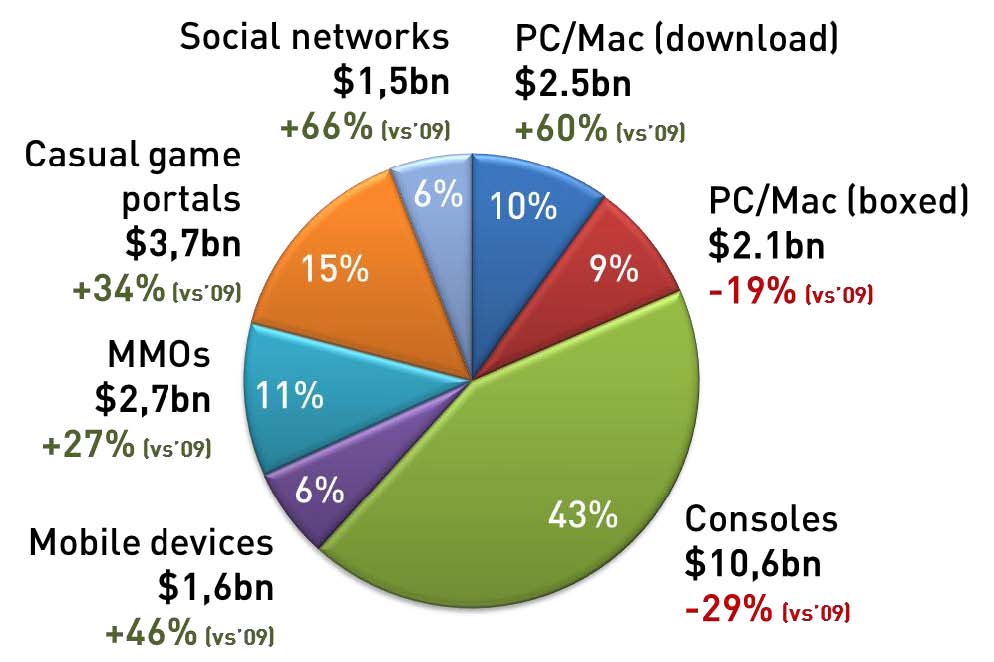
This study just released  by Newzoo has some very interesting data. They show the overall money spent by US consumers on  games to ring in at $24.7 billion, just 2% less than 2009. (Yes, I realize this isn't counting paper games... but that category is going to amount to just a percentage point or two on this scale.) Console game sales dropped 29%, which accounts for the grim faces of the major console publishers. Still, it's not as if those gamers just disappeared; they just started spending their money on other types of games. Yes, boxed retail PC games dropped, but every other category grew... and substantially.

Social games grew the most, by 66%, followed closely by PC downloadable content at 60%. (That must account for why League of Legends publisher Riot is looking to hire 100 people.) Mobile games grew 46% (note that the numbers for DS and PSP are counted under consoles, not mobile devices.) Growing 46% is a lot of smurfberries in one year.

The interesting lesson here is that yes indeedy, gamers will get their groove on in different ways. Console gamers are getting more picky about spending money on console games when they see interesting choices appearing on their PC, on Facebook or on their smartphone. All of those things are direct threats that the console game publishers need to deal with.

Some publishers are pushing into those spaces through acquisition; some are building their own titles or working with partners to get some traction in these new areas. Unfortunately, some are insisting that everything's fine with their current business model. If you're not concerned about the future of the gaming industry, you're not paying attention. Games aren't going away, but how consumers spend money on them is certainly changing. Design and marketing need to follow that money.

One thing marketers should think about: Social games can take advantage of a mobile client, and mobile games should have a social component (at least to their marketing through social media).

Monday, December 13, 2010

Angry Birds Are Angry About Android Payments

Rovio, developers of the smash hit Angry Birds, are attempting to fix what they see as one of the big problems with Android applications: Android payments. Rovio is producing the Bad Piggy Bank in combination with Finnish network operator Elisa, in order to process in-app payments for (naturally) more Angry Birds material. Angry Birds is free on Android because getting Android users to pay for apps is so difficult. This new payment plan, which Rovio hopes will be adopted by other developers, allows charges to be put on your monthly phone bill.

The idea of mobile phone billing is nothing new; many companies in Europe and Asia are used to getting money from customers by billing their mobile accounts. For many countries, that's how you pay for things online, since credit cards are not widely used in their culture. Rovio's trying to make this easy for game developers on Android, since Google has failed to do so. Especially in the fast-growing realm of in-app payments.

We'll have to wait and see if other developers jump on this. Or maybe Google will get its act together and start streamlining its payment process and promoting it, or buy another payment processor and build on that. This is the Achilles Heel of the Android platform. Getting more phone activations than Apple is interesting, but it's not making up for the fact that developers are making seven times as much money from the iOS platform as they are from Android.

Developers see the Android numbers and smell profit potential, but the road is not easy. Rovio's hoping their new payment processing will pave the way to profits for developers. And a nice piece of change for them, too.

Friday, December 10, 2010

Game Sales Up

For the first time since 2008, game sales have actually gone up over the previous year's sales. The NPD figures have arrived (perhaps smuggled out from behind their pay wall by heroic resistance fighters) and reveal that November sales were up 8% over last November... they even made it to the level of Best Sales Month Ever, ringing up $2.99 billion. Software was up 4%, hardware was up 2%, but the big winner was the accessories category, which was up 69%. Thank you, Kinect and Move.

Sales were also helped by Call of Duty: Black Ops, which in one month has become the 7th best-selling game ever with 8.4 million units sold. Sales were so good that overall sales for the year are now down only 5% instead of the 8% it was at last month.

Looking more closely at the data we find some sore spots. Portable hardware and software was down over last year. So Nintendo's troubles continue. The Wii was outsold by the Xbox 360, which is impressive especially when you consider the price differential. (Sales data put the 360 at 1.37 million units, the Wii at 1.27, and the PS3 at 530K.)

The disturbing part is that the joy was not widespread. It's not like sales were up for everything; take away Black Ops and the Kinect and the picture looks pretty dismal. This does not look like a resurgence in the game industry; it looks like a couple of new products did really well. Which doesn't mean that the industry is looking at a good 2011.

Monday, December 6, 2010

Marketing Android Games

If you thought marketing iPhone games was hard, wait until you tackle the problem of marketing Android games. The same basic problem exists in both markets: There are tens of thousands of games vying for attention, and there's very limited tools built into the app markets for finding your game.

The Android app market, though, has bigger problems than just numbers. Here's an excellent blog post on the Android market's problems, which I found via Gizmodo. This developer notes some of the key issues for Android developers, which is that they're just not making much money for the most part. The problems with the Android market can be seen in some very simple things, such as this: Where are the killer apps? If you look at the top apps for the Android platform, most of them are also available on the iPhone. Most of the rest are system-support type things, like anti-virus or system hacking tools. If you've been in the game industry for a while, you know the power of system exclusives. How much has Mario helped Nintendo sell hardware? How much has Halo helped Microsoft? It's hard to even say where Nintendo would be if it wasn't for the little plumber. And if you took away all of the impact of Halo, would the Xbox and Xbox 360 have been very successful?

Yet the Android market doesn't seem to be attracting many exclusives, despite the fact that sheer numbers seem to be looking pretty good for Android.

The latest Comscore numbers show that Android has just about the same market share as Apple in terms of subscribers in the US market. The Android is closing in on Apple as the phone platform most desired by potential buyers, too.

Look at the numbers from Nielsen's latest survey. The Android platform is almost as desired as the iPhone platform among likely smartphone upgraders. Wow, that all looks great for Android developers, right? If only. Revenue for the iPhone platform is many times higher than Android. Why the disparity? It's in the details. The marketplaces are just not comparable in interface or in ease of use. The Android Market is clunky, ugly, and bereft of even the limited ways the App Store provides to find and suggest apps to customers. At least the Android Market has finally introduced a Related tab to provide some suggestions for customers looking for apps. A step in the right direction, but there are still miles to travel. Hot picks? Lots of categories to make it easier to find what you're looking for? Sort by user ratings? No, aside from a few of the top titles, you're going to have to know about your Android app's existence before you go hunting in the Market for an app. This is not designed to help small developers sell products.

Speaking of which, the Android is not helping much with the freemium model. That's the model where less than 2% of the apps in the App Store are generating 30% of the App Store revenue... yet it's not something you can readily do on the Android platform. I know there are plenty of bright people at Google, and surely some are aware of this, but perhaps it's too hard to herd the engineers in the direction of making such improvements.

So some Android developers (or potential Android developers) are looking to get their apps paid for by Verizon or some other carrier and pre-installed on the phone. They may not get very much per unit, but at least it's something. Not a business model that works for everybody, though.

The Android Market needs to get a makeover, either from Google or from somebody else. Perhaps a third party can create a functioning app market where Google doesn't appear to be all that interested. Maybe the Android tablets already swarming to the storefronts will help catalyze the development of a well-done marketplace. Apple needs some good competition on the software and business model end of things, not just on hardware.

Meanwhile, marketers looking at the Android marketplace have to try even harder than on iOS. More social media, more ads, more PR, a better hook. You cannot count at all on the internal Android Market tools to help users find your game. You have to find an audience outside and bring them in.

Friday, December 3, 2010

Tablets Rising, PCs Shrinking

The Gartner Group has revised its estimates of PC shipments downwards for this year and into the future, saying that tablets are increasingly replacing PCs as purchases. They estimate tablets will replace 10% of PC sales by 2014. Other analysts are predicting even bigger growth in tablets; estimates for tablet sales in 2011 now range from 35 million to 70 million, depending on who you listen to. The latter figure includes an estimate that Apple will sell 40 million tablets in 2011. That's a mess of iPads.

What's driving all of this? Several factors. Price, of course, is one of them, though if you want you can certainly get a notebook computer (not even a netbook) for less than an iPad will run you ($499 at minimum). What's interesting is the growth in business users of iPads; just look at Apple's site, where you'll now find a section devoted to iPads in business. That wasn't there when they launched; it was only after business users began grabbing iPads in big numbers that Apple added that. I hear reports of increasing numbers of iPads turning up in meetings, where you need to reference an agenda, perhaps take notes, and maybe look up something on a web site or access a file. These are all things the iPad does very well, being speedy and light weight. No clickety-click either, a plus for meetings. (The big issue my wife identifies is the instant-on capability, where booting up her notebook takes several minutes.)

Around the household, tablets are handy when you feel the urge to hit the Internet, read a book or watch a movie. Or play a game, and that's going to be a bigger and bigger area. The iPad has some pretty good horsepower, though it's lacking in the control interfaces (no joysticks, d-pads or buttons here, except virtual ones). Yet developers are finding their way around those limitations.

Which makes sense, if you look at the size of the market. Anywhere from 20 to 40 million iPads selling next year dwarfs any videogame console (the hottest potential for 2011 is the 3DS, and that would be lucky to hit 10 million). Add in the iPhone/iPod Touch markets (which for most games would be a fairly easy variant) and you have serious potential sales, if you can get around the marketing problem. (Getting all those users to find you is only going to get tougher.)

The flip side of this news is the reduction in new PC sales. Much of that will come in developing countries, where they may shift to tablets or smartphones because they are cheaper than PCs. So it may not be as much of a loss as far as game developers are concerned. Still, it's a fair bet that many of the PC users most likely to buy computer games will also get a tablet, and be spending more time with that. Zynga probably doesn't care so much whether a user plays Farmville on a PC or an iPad, but this may matter to some developers. Particularly if your monetization plans depend on selling a $20 computer game by download rather than a $5 iPad game. Yet another reason the freemium model is gaining ground... it doesn't care what the platform is as long as you can make in-game purchases easily (Google, are you listening?).

It's a brave new future... happening fast.

Thursday, December 2, 2010

Mobile Game Revenues Doubling, In-Game Purchases Skyrocketing

Anyone who's been paying attention to the gaming industry has been aware that in-game purchases have become a big business. This report from Juniper (reported by TechCrunch) predicts the mobile game market revenues to pass $11 billion by 2015... which is more than double 2009 revenues. Not amazingly aggressive by some standards; I think growth may accelerate even more than they are claiming (especially if you think of tablets as "mobile game" platforms).

The interesting part is going to be played by in-game purchases. Juniper says that in-game purchases will be the primary source of revenue, overtaking pay-per-download, by 2013. That's two years away, baby. That freight train is moving fast.

Juniper also notes that discoverability is the big problem. Well, yeah, it's all about the marketing once you have a good game put together. There must be hundreds or thousands of good games languishing in obscurity in the App Store because you've never heard of them. As TechCrunch notes, "This is obviously an excellent opportunity for fledgling app discovery platforms such as Appsfire, Chomp, Mplayit, AppAware, Appolocious and, increasingly, StumbleUpon."

Just to back up Juniper's numbers, here's a report on GigaOm about the flourishing of the freemium model. If you look at the top-grossing 100 apps, 34 of them are free to download and make their money through in-app purchases. Analysts think in-app purchases account for 30% of the total App Store revenue. Which is pretty impressive when you consider that freemium apps are less than 2% of all apps in the app store.

Yeah, you read that right. Less than 2% of the apps generate 30% of the revenue. If you're planning on building a game app, and you're not seriously considering a freemium model, you need to reconsider.

Which all highlights how much more work Google has to do with Android. As this article mentions, while Android sales have passed up the iPhone in sheer units, and new Android apps appear at about the same rate as new iPhone apps, in-app purchases on the iPhone are 7 times the amount on Android. Google's got some serious work to do on their tools and the Android Market to close that gap.

Meanwhile, getting your app found is still the basic problem facing developers. More on that in another post.