Game Marketing Tips, Analysis, and News


Showing posts with label iPhone games. Show all posts

Wednesday, November 24, 2010

Size Isn't Everything, But It Is Impressive

I understand this comparison is not meaningful on many levels, but counting up the number of games on different platforms is an interesting metric. The total number of iOS games in a few short years has exceeded the total number of console games, and made a fair bid to exceed the number of Flash games.

Of course, it's far easier to create a game for iOS than for a console, and requires orders of magnitude less money and time. And without a doubt Sturgeon's Law applies, as it usually does. Still, it's an amazing example of creativity in a short amount of time, and certainly some real winners have appeared. Better still, some new game companies have emerged that otherwise would not have found financing, and some older developers have found a new source of income in repurposing old titles for the new platform.

It's also worth noting that the Android numbers would be similarly impressive, even if not quite as large as iOS numbers.

Of course, the size of the market only underscores the marketing challenge you face in trying to stand out amidst so many titles. It's hard to find gold when everybody is panning the same stream.

Monday, October 11, 2010

The Handheld Is Dying; Long Live The Handheld

Two trends are apparent that seem contradictory: Handheld game consoles are faltering in sales, and smartphone sales are skyrocketing. They are really two sides of the same basic fact: Most people will likely carry only one handheld device with them. Unfortunately for Nintendo and Sony, that's going to be a phone for any adult and most teens.

Part of why smartphones have taken off is that they know incorporate multiple functions. Smartphones were a small market segment when they consisted of Palm OS, Windows Mobile (or Windows CE), Symbian, and Blackberry. Blackberry was a huge hit because of email; it was the corporate must-have. It still is, but it's starting to fade. When Apple introduced the iPhone, it was popular not because of Apps; the App Store didn't even exist (and Steve Jobs apparently wasn't interested in creating an open software market). What sold the iPhone then was the integration of the iPod functionality, which at that point was the overwhelmingly popular handheld device. Plus you had a camera, and you could see pictures and videos, and maps... it was phone/camera/MP3 player/GPS in one device. Once the App Store came around, and you added games to the mix along with a rapidly growing market of Apps for virtually any purpose, the iPhone took off.

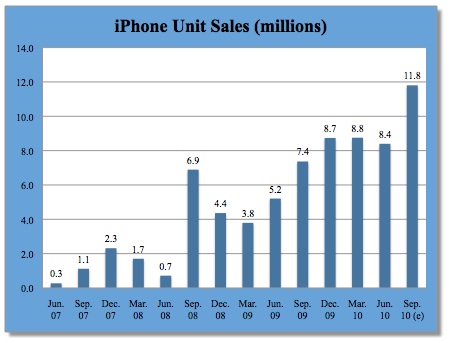
Apple's latest quarterly results will be announced October 18th, and analysts are looking for amazing results. It looks like we're seeing around 4 million iPhones sold every month. The iPad is over 1 million per month and will hit 2 million per month in 2011. The iPod Touch is probably doing similar numbers.

The Android market is based on the success of the iPhone, featuring multiple functionality in one device, with an open software market. It, too, is booming, with 6 million Android phones coming online every month.

The Nintendo DS? Selling around 320,000 units per month in August. The PSP is not even breaking 80,000 units a month. Nintendo is hoping to sell 4 million 3DS units in the first month.... and that will certainly drop off once the initial hardcore fans buy one. Nintendo will be fortunate if they are selling 1 million a month after a few months, especially if the price point is $299.

The realities are that there is no way Nintendo or Sony can hope to match the volume of iDevices or Android devices, which means Sony and Nintendo will be unable to match the hardware performance and pricing of Apple or Android. Volume means you can drive hardware pricing lower, and Nintendo is starting way behind in that race.

Oh, and Windows Phone 7 launches today.... millions more devices with an open software market and plenty of hardware horsepower.

Nintendo and Sony are going to see steadily shrinking sales of their handhelds. Their only hope is to open up their devices to be multifunctional. The hardware is perfectly capable of playing music, video and many other functions. Sony could certainly build a PSP2 that could be very nice, hardware-wise. But hardware mojo will not save Nintendo or Sony. If they had an open software market and could encourage developers to come to their platform, they might have a chance. (An Android-based PSP2 could be a real winner... with real gaming controls wedded to the fast-growing software market.) As Skype and other services grow, the need for a telecom company to make a handheld device into a phone is diminishing. Heck, phone calls are growing rarer, as people (especially younger ones) text all the time. So the phone advantage could be less important in a year or two, as long as the gaming hardware provides all the other functionality (Web browsing, music, video, camera, GPS, etc.) that people have come to expect.

The future is about personal handheld computers, not dedicated hardware for games or telephony or texting or music. Some of us can remember when dedicated word-processing machines were all the rage, and obviously so much better than some poor Apple II trying to word-process... we know how that ended up. The long-term trends are obvious; Sony and Nintendo have to get onboard or be left behind. Software developers and publishers need to be aware of this, too. I notice that EA is one of the key publishers of games for Windows Phone 7, so somebody there is thinking ahead. Marketers, don't get stuck in the past. Look forward to capture the next market.

Monday, September 20, 2010

Astroturfing Can Be Illegal

Astroturfing is the practice of fake grass-roots efforts, as in marketing firms or political consultants pretending to be just average folks. You can see the practice with iPhone apps, and the reviews.... many seem to be posted by friends and family, since their laudatory views are at odds with most of the other posts. This was driven home by the FTC in a recent agreement with a marketing firm over the practice, as detailed in this memo. Reverb Communications, a PR firm for video games, was caught red-handed posting reviews for clients in the iTunes store.

So the FTC is watching, and giving notice that it's not kosher for a person or company with a material connection to a product or company to post publicly without mentioning that connection.

I predict a sudden decline in the number of "OMG this game is AMAZING!" reviews in the iTunes store.

As marketers, you must be aware of these little legal niceties before you charge into social media marketing. It's OK to ask your friends, family and investors to post reviews, but they have to mention their connection. Which will tend to devalue their efforts. It's better for you to encourage the fans you don't know to post reviews, than to try and make up your own.

Here's what PR professional Dave Fleet posted on his blog: "Going into PR doesn’t mean giving up your own ethics." Marketing shouldn't, either.

Thursday, September 16, 2010

Apple Gaining On Nintendo

Since Apple doesn't release sales figures very often, it's hard to be sure. But one research firm has done their homework and says that over 40 million Americans use Apple devices (iPhone, iPod Touch, iPad) to play games... compared to Nintendo with 41 million DS installed base in the US. Plus, the latest sales trends are not exactly favoring Nintendo... Apple is selling over 1 million iPads a month, and more than twice that in iPhones and iPod Touches. Meanwhile, handheld sales are down 25% over last year's dismal sales numbers, which no doubt accounts for Nintendo's dropping the DS pricing by $20. (By the way, manufacturers reduce pricing only when they feel they need to because sales would be better. They will never do it out of the kindness of their hearts because their manufacturing cost dropped... they'll cheerfully pocket the additional profit as long as sales stay high.)

Nintendo is hoping the 3DS will revitalize their handheld sales. I think it will, to some extent; but Nintendo's market share will continue to erode as Apple's sales continue to increase with new models of their handhelds coming out every year. Also, the Android platform is growing like crazy, and games are an important part of that market, too. Nintendo may have a 3D display in the 3DS, but in many other ways the hardware is inferior to these other handhelds; processor, display resolution, orientation sensors, network connectivity, size of the software base, average software price an order of magnitude higher on Nintendo. It's hardly a fair fight any more, and it's only going to get worse.

Nintendo is losing the fight for developer mindshare, too. Even big developers are seeing great returns from iPhone software (like EA, for instance). Plus developers, large or small, prefer the unfettered market of Apple or Android to the regimented, bureaucratic, expensive and unpredictable Nintendo regime.

Bottom line: If you're already a Nintendo developer, you can probably make money continuing to do products for their handhelds. If you're not already a Nintendo developer, you should first make your products for Apple or Android, with far lower risk and expense. If you have a hit there, then perhaps think about a Nintendo version. If their handheld devices still matter by that time.