Game Marketing Tips, Analysis, and News


Showing posts with label PSP. Show all posts

Friday, February 18, 2011

Sony's Gaming Tablet

This sketch purports to show how Sony's tablet might look, but I don't really get it.
Sony's really stepping up their game, after spending the last few years trying to revamp the corporate structure. We'll get to see just how successful this effort is in the next year or two. Apparently they have decided to cover all their bets in the gaming hardware category. They've got the PS3, so the game console spot is covered. The PSP has really done very well, but more in Japan than in the USA, and it's time for a new handheld gaming device if they expect to get revenue from that market. So the NGP is scheduled for shipment later this year, and it seems like a very powerful handheld gaming device.

Perhaps surprisingly, Sony has said they will also keep the PSP around, too, perhaps to keep the lower-priced end of the market covered. That's really not such a bad idea, if they can keep software development going for it. I'd suggest revitalizing with an additional price reduction, and some new software to help it play music and video. Open up development more, and create a zippy online store for purchasing all sorts of content. If you can make it easy to develop and publish new PSP software, the device will keep selling.

Ah, but this strategy ignores the mobile phones, so what will Sony do about that? The Experia, also known as the Playstation Phone, is Sony Ericsson's entry there: A powerful Android phone with full access to the new Playstation Suite.

So what's left? Why, a dedicated Playstation Tablet... an Android device optimized for playing games. It would come preloaded with some Playstation games and Sony's Qriocity (music, games, and media on demand) service. No word on the specs yet, but you can probably bet on a dual-core processor and some nice graphics on a 9.4 inch screen.

The sketch shows an impression of how it might look... I guess that's the backside, showing a thick curve you can use to hold onto it more easily than a standard tablet. Be nice if that was a flexible cover... but we'll see when Sony gets more formal about the release. Right now, it's just being floated to get some initial response.

I believe tablets are going to be a huge market segment, so there should certainly be room for one optimized for gaming, if the price is right. Ah, the price... the ugly reality that can shatter dreams. Let's hope Sony comes up with a good price point.

Once again, game developers may have yet another platform to develop for...

Saturday, October 30, 2010

The AppDroid Apocalypse

Apple TV and Google TV: Threat or Menace?
The Appdroid Apocalypse is coming, and it poses a threat to the survival of the console business as we know it. Surviving, or better still, thriving, will require understanding the coming changes and changing business models in response. It won't be easy, and for some companies it may prove impossible. For others it's a huge opportunity. Either way, the Appdroid Apocalypse is arriving soon, and we'd all better be ready.

What is the Appdroid Apocalypse? The same App Store/Android Market that's busily eating up market share from the Nintendo DS and the Sony PSP is coming to a family room near you. The Apple TV and the Google TV will eventually offer the same gaming apps that you find on iPhone/iPad/iPod Touch and Android, but they'll be played in your family room. Yeah, the same place your console is plugged in. These apps, numbering in the tens of thousands, cost an average of less than $1.50. Thousands of them are free, or free-to-play. The most expensive ones are still under $10. The Apocalypse part is where this new console business turns the existing console business into a scorched wasteland... or at least, a market where sales are declining from year to year rather than growing.

Whoa, wait a minute, you say. That's not what Apple TV does... Apple hasn't said anything about offering Apps on Apple TV. Sure, and they didn't do that for the first year of the iPhone, either. Everything is there to make it happen; the new Apple TV runs on iOS, after all. You think maybe Apple hasn't noticed they've made a billion dollars selling Apps? Or the potential of selling a few billion more in family rooms? Apple can flip a switch and turn on an App Store for Apple TV at any time. They probably just want to get everything ready for the launch, so they can hit the ground running. It could happen soon, or they could wait a year. But it's going to happen.

Google is in a similar place. They see how much action they've gotten from the Android market, and how Apple has done with the App Store. Does Google want to lose the family room to Apple? No way.

One thing Apple and Google have in common is that neither one particularly cares what happens to the traditional console business. Gee, Microsoft might lose a lot of money? A happy side effect of Apple and Google's plans.

Where's the evidence for this Apocalypse? Let's look at the numbers. Android phones are now being activated at the rate of 200,000 per day, according to Eric Schmidt. Combined, Android (8.5 million through 2009) and Apple smartphones (according to this report) will be in excess of 150 million by 2012, and with iPod Touches and iPads, along with Android tablets, it may be well over 250 million units (Gartner Group projects over 100 million tablets sold in 2012). Compare this to an installed base of 132 million DS units as of June 2010; that's likely to grow by another 15-20 million units by 2012, but that still leaves it about half the size of the iOS/Android installed base.

Nintendo's DS business is faltering; both hardware and software sales are down (43% and 23% over the last six months). The 3DS is coming next year, but it will likely be $250 to $300, and it still won't have a business model akin to Android or Apple's relatively open markets. There are over 300,000 Apps in the App Store, and the Android app market has hit 100,000. By comparison the DS has in the low thousands of titles, and many are no longer available because you just can't find a cartridge. All of the apps are always available, since there is no physical inventory.

At least 25% of those apps for iOS are games, and the average price is around $1.50. Thousands of them are free, and many are free-to-play. Apple and Google are integrating advertising into their platforms, which promises to keep game prices low as publishers can make money from ads. Freemium business models, such as used in social games like Farmville, are wildly successful (to the point where Zynga is looking at $1 billion in annual revenue by 2012); this is not a model planned for consoles. Nintendo has some 241 downloadable titles available for the DSi, but they are mostly $5 or $8 (and the DSi is a small part of the overall DS base). Nintendo is careful to preserve its retail business by keeping retail titles out of its download store. They saw what happened when Sony introduced the PSPGo, which offered no way for retailers to take a cut from software sales since it was all downloads.

The handheld videogame business is rapidly being outsold by Apple and Google, and the trend will accelerate. Sony has done pretty well with the PSP (over 50 million sold) but it has paled in comparison to the DS and the iPod; their attempt to get into the future of the business with the PSPGo (which used digital distribution) failed miserably as a high price and massive retailer pushback doomed the device. They may try again with the PSP2, but they'll have to innovate with their business model to find a way to get retailers to support digital distribution (Sony also needs to get their internal music and movie units onboard, which also promises to be a fight). Nintendo has come out squarely against the idea of digitally distributing core titles. The even more fundamental problem is that Sony and Nintendo offer devices that are only game machines, while Apple and Google offer devices with a wide range of functions. The greater efficiencies of scale mean that Apple and Google can put more and more power into their handheld devices at lower and lower cost, and they release new hardware on a yearly schedule instead of the 3 year or more schedule of Sony and Nintendo.

Now Apple and Google are poised to bring this business model innovation into the family room (here's an overview of their current offerings). You'll see an App store for the Apple TV and the Google TV, offering many different titles. Developers can easily release software without elaborate bureaucracy. There will be thousands of titles available at average prices an order of magnitude below standard console games.

These Google TV and Apple TV boxes will not be close to the power of current consoles; at least, not at first. But they'll be plenty powerful enough to run, say, Farmville. Or any of the thousands of games on iPhone or Android. Advertising will be built in, and free-to-play business models will be welcomed.

And this is how the classic console industry starts to decline. Does anyone think the last two years of declining sales have just been a fluke?

Do these things mean AAA console titles are obsolete? No, there will still be demand for them. But development costs have to be kept in check to make these titles consistently profitable. Mid-range titles are getting squeezed by lower sales and higher budgets, and there's only so many AAA titles the market can absorb.

Surviving the Appdroid Apocalypse means investing in new types of games and new business models. We're already seeing EA buying mobile and social game companies; Activision is talking about a subscription model for Call of Duty. It's a difficult task, though, to take a company mostly based around a 2-3 year development cycle for its games and completely change the way it approaches business. There will be wrenching readjustments along the way. Creating a steady flow of profits on free or 99 cent software is a huge challenge, and it will mean different development models.

It's not all bad news, though. The changes favor smaller developers who can more easily adjust to a new market of smaller budgets and shorter development times. The indie developer has many more possibilities opening up than seemed possible a few years ago.

It's also true that marketing becomes a huge issue when you're trying to stand out among tens of thousands of titles all competing for attention, and that will be a big problem for smaller developers. Developers of all sizes will have to be able to make a profit on a game that may be given away. Big publishers will have many advantages going into this market due to their size, audience awareness, and the amount of dollars they can throw at things. Small developers will have more of a chance to break through into a big market than they've had before, but it won't be easy.

We're all going to have to figure out out how to first survive, and then thrive, after the Appdroid Apocalypse. Because it's coming soon to a family room near you.

Friday, October 29, 2010

Earnings Roundup For The Big Three

Sometimes it can be hard to sort out what's going on at the Big Three console manufacturers when their PR machines are churning out clouds of smoke. Fortunately, every once in a while we get financial reports that slip a few facts in there. Let's look at what's being reported. (I'm only going to cover revenue for the games divisions of Sony and Microsoft, but for both of those companies it's usually true that if the games division is doing well, the whole company is doing well.)

Microsoft, as you might have expected, had a great quarter with the release of Halo: Reach. The Xbox 360 business went up 33% over the same quarter in 2009. They sold 2.8 million Xbox 360's, about 38% higher than last year. Total revenues for the game section were $1.2 billion, with Halo: Reach accounting for over $350 million of that all by its lonesome. The division made $382 million in profit for the JAS quarter, which was a 46% increase from last year. Looks like a AAA sequel can still rake in the bucks, and doing an Xbox 360 themed around the release certainly didn't hurt. Microsoft expects to do well for Christmas, too with the Kinect poised to enter the market. They expect a 30% boost over last year's sales for the entire Entertainment and Devices division, though some of that is due to Windows Phone 7.

Looks good for Microsoft, but how's Sony doing? It's a mixed report for them. The PlayStation section had overall sales drop by almost 13% over last year, down to $2.12 billion. The PS3, though, had its number of units sold increase 9% over last year due to the PS3 Slim and the Move introduction, with total units sold hitting 3.5 million. Software sales rose from 23.9 million units to 35.3 million units. Why did sales overall drop? It's all thanks to the PSP, which saw sales drop by 50% year-over-year (I believe the technical term you see in the financial press is "plummet"). The PSP sold only 1.5 million units in the quarter, matching the 10-year-old PlayStation 2. PSP software saw a 2 million unit drop to 13 million, and PS2 software was almost halved with a drop to 5.6 million units, versus 11.4 million last year. Sony expects the PlayStation division to sell 15 million PlayStation 3s, 8 million PSPs, and 6 million PS2s for the year. Not bad, but not as good as Microsoft.

Looks like Nintendo gets to be the bearer of purely bad news. They lost almost $25 million over the last six months (compare that to the same period last year, when they had a profit of over $75 million; that's a $100 million dollar swing). Nintendo saw DS sales drop 43% over that period, down to 6.69 million units (about 1.1 million per month on the average). Wii sales dropped over 14%, down to 4.97 million units for that six-month period, with Wii software sales dropping a similar amount. DS software sales only dropped 23%, which I guess is cause for celebration compared to all the other numbers.

Some analysts think Nintendo can still pull out a good Christmas, but others (like this one) disagree, and don't see any happy surprises under the tree for Nintendo. Put me in the "Nintendo's gonna get worse before it gets better" camp. Though I'm not sure how much better they're going to get. I'm sure the 3DS will have a good launch, but that still doesn't solve the Wii problem, which probably wouldn't get new hardware until next fall at the earliest. The 3DS may have a rough time maintaining good sales with an impending PSP2 launch, and the continuing successes of the iPhone, iPod Touch, iPad, and Android devices.

It gives you some perspective when you look at the sales numbers from the Big Three and compare them to iPhone numbers (currently selling close to 5 million per month) or Android numbers (6 million per month) or even iPad numbers (currently at 1.3 million per month and rising). When iPads are outselling DS's, and the iPad is at least 5 times the price on average, you know Nintendo has a long-term problem. At least Nintendo is finally acknowledging that Apple is a threat. Of course, that's not the same as actually doing something about it, like opening up the DS to all kinds of software development with little or no bureaucracy.

We'll see where the industry sits once the glow of Kinect and Move introductions has worn off. I expect 2011 to be another lackluster year for software sales on traditional consoles.

Tuesday, October 26, 2010

Pandora: The Other Handheld

Here's another contender in the handheld gaming device market... only it's not really trying. Still, it's got some impressive hardware. It's an interesting testament to crowdsourcing: They managed to put together a fully realized handheld gaming device at a reasonable price of $349, which is pretty impressive considering the minuscule production runs (800 so far).

It's a cross between a gaming handheld and a PC, with an 800 x 480 touchscreen and enough horsepower to run various gaming emulators. You can surf the web, play videos, and use the built-in gaming controls to play a wide range of games. You've got WiFi, Bluetooth, dual SD card slots... the specs are really quite impressive. And it's only slightly bigger than a DS. You'll also have noticed the full QWERTY keyboard on it, which will make your Quake games easier (yes, you can play Quake with it).

What's the catch? It's a Linux box, which means you need to be comfortable with installing software and tinkering with the system. Not to mention hunting down software. This device does not have a mass-market veneer on it; it's a raw hacker's delight.

It took their team a couple of years to pull it together, which is not bad considering it was a hobby project. Heck, hasn't Sony been working that long on the PSP2? Which, by the way, continues to heat up the rumor mills. More people are saying it will ship sometime in 2011. Some people are looking at Sony job postings and wondering if their open reqs for Android programmers has anything to do with the PSP2. Others are looking at patent applications and talking about a backside touch-sensitive control scheme (while you're holding the PSP2, your fingers could be controlling it by touching the back of the device). Apparently there may still be battery and heat issues to overcome, though, as Sony stuffs plenty of power into a small package along with a drop-dead gorgeous screen.

Well, Sony should take their time and get it right; the competition is fierce, with the 3DS poised to hit in March, and the iPhone 4 already rocking an amazing screen and some serious horsepower (plus an array of sensors that makes for some interesting game design possibilities).

Still, the Pandora and the PSP2 and the 3DS are lacking a key competitive advantage the iPhone possesses: the iTunes store. Not just because it has a huge array of music and video to choose from, but because it makes buying games and media products dead simple. Yes, it can be hard to find the right choose among a zillion games, but compare that to the DSiWare store... it is to laugh.

I only hope Sony is putting some energy into an online store experience. Or hoping to tap into the Android Market. Nintendo... I'd love to be shocked and see them come up with a real online store for a wide range of products.

The Pandora? It's a niche machine, to be sure, but it sure looks like a fun one. A hat tip to Randy Reiss who told me about it. Randy, I hope you have fun with your Pandora!

Thursday, October 7, 2010

The PSP2: Does It Have A Shot?

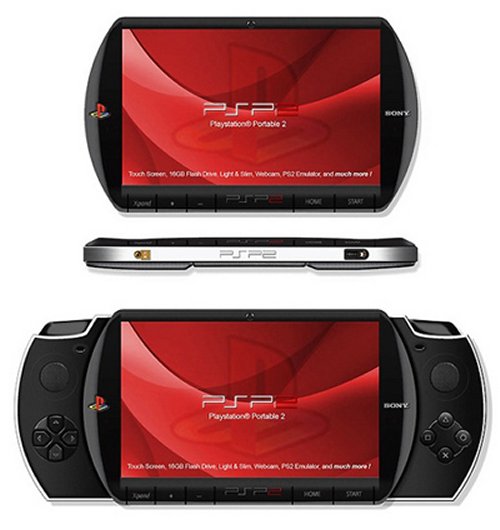
A possible PSP2 concept
Now that we've seen The Jungle, and the 3DS is on its way, what about Sony's poor lost little PSP? The PSP2 has been rumored for quite some time, but no one seems to know exactly what it will be or when it might appear. Certainly after the PSP and the PSPGo, expectations are not high for a new handheld from Sony. I'm sure part of the delay comes from headscratching at Sony over what the hell to do with a new device. I'm sure it galls them for Nintendo to have rolled over them so thoroughly with the DS line, with what is (in Sony's view) a technically inferior device.

Over at IndustryGamers, David Radd has some thoughts about what Sony could put into the PSP2 to give it greater sales. His prescriptions are a 3D screen (like the 3DS), a second analog "nub", make it a phone, use Kevin Butler as spokesperson, and make every game downloadable. Well, I'll agree with the second joystick; that seems obvious (though who knows if Sony can figure that out). It's a great way to differentiate the handheld from either the 3DS or the iPhone, and it shouldn't cost very much to add. But that's not going to make it a must-buy device.

I think making every game a download is a must, but it's not going to be easy for Sony because of the retail channel. They brought out the pitchforks and torches for the PSPGo (which was downloads only), and basically strangled that baby in its crib. Sony has to figure out a way to cut retailers in on a piece of the action; give them a chunk of money for downloads through their sites, or offer fast in-store downloads (and give the retailer a piece). Sony could get great promotions through the stores... maybe exclusive titles in some retailers, or exclusive DLC for a store. By promoting in-store visits and store web site visits, Sony could gain a lot of promotional help from retailers feeling besieged by all this digital download action going on around them.

Back on the hardware side, Sony has to compete with Nintendo and the iPhone and Android phones. I suspect Nintendo has locked up all the production of the only 3D screen supplier, so that route is closed (it's also an unproven feature, though it would dovetail with Sony's 3D push on the PS3 and with TVs). So the PSP2 should have some serious gaming horsepower. Give it a low-power Cell processor; or some CPU/GPU combo that will thrash anything Nintendo or Apple can produce. Make the PSP2 the most powerful handheld by a long shot, and you have a powerful attractant for hardcore gamers. Oh, and don't neglect the screen... it has to be high-res and gorgeous. The screen resolution is the 3DS' weakness; and the iPhone 4 has an amazing screen. Sony has to compete in that space, so the screen should be a killer.

Finally, open the PSP2 up to developers in a big way. Make sure it has a killer music player and video player. Sell your amazing catalog of music and video to the PSP2. Get thousands of Apps developed or ported; make the PSP2 a multipurpose device. People only have one pocket; if you want them to get a PSP2 instead of an iPod Touch the PSP2 had better do a damn fine job of playing music and video, and make it easy to acquire the content, too. (Beat Apple by having a removable battery and an option for additional storage via SD cards; give up on the damn Memory Stick already.) Make Skype a partner so you can neutralize the iPhone's communication ability without having to bring in a telco.

It's all a tall order, which may be why it's taken so long for Sony to get something together. Will they do something like this? I doubt it... Besides, with The Jungle about to take the handheld world by storm, what are the odds the PSP2 could compete against that?

Thursday, September 2, 2010

Some PSP 2 Details

Reports from Gamescom indicate that the PSP 2 has a touch screen, and will be completely digital in storing games (no UMD). (The image above is just a concept... cool, but not necessarily what the thing will look like.) So Sony is once again charging into the retail lion's mouth... will they withstand the uproar this time? Remember, the PSPGo faced open rebellion by retailers, who reasoned that if they couldn't sell games for the device they wouldn't bother to sell it. (Hmm, I wonder how many of those same retailers sell iPhones...) Perhaps Sony has figured out a way to buy them off participate in the revenue stream this time. I'd love to see a unified download store for Sony, with music, movies, games... and open up the developer side of things to allow for many more games at a variety of price points. Oh, and don't forget books and audiobooks, too. Sounds like an iPod Touch? Well, yes, that really is the competition these days.

Sadly, I don't think it will happen that way. I expect Sony will price the PSP2 around $250, which certainly won't help. Perhaps if they could line up some gotta-have-it software... but that seems to be pretty difficult to do these days. Farmville, anyone?

Friday, August 27, 2010

"I'm Not Dead Yet!" -- PSP

Sony UK's exec Michael Denny gave an interview with GI.biz, and when asked about the PSP 2, said "the PSP has life left in it yet." I'm irresistibly reminded of Monty Python: "I'm not dead yet!"

Here's a rule of thumb for you: If you find yourself having to defend the viability of your product, it's either already dead or your marketing efforts are just not working. Sometimes I guess you have to limp along as best you can, which is probably the case here. Sony's not ready to announce the PSP 2 yet, but it's coming in the near future, so Sony doesn't want to spend money marketing the PSP which will be going away soon. Yet they want to keep selling the inventory they have, and not let the software languish on the shelves, nor have more developers give up future PSP development. So we end up with weak statements about how the PSP isn't dead yet, not really, it's feeling much better. Or maybe it's just pining for the fjords.