
It seems like only yesterday that I was saying it wouldn't be hard to get a classic videogame controller to work with a smartphone... in fact, it was yesterday. Today, here's the proof: some clever developers at Dancing Pixel Studios have an app that lets you use your Sixaxis or DualShock 3 controller with and Android phone. Yes, there's some hoops to jump through in order to make it work. As the saying goes, though, it's not how well the bear dances; the remarkable thing is that it dances at all.
This technology demonstration shows that we are on the verge of smartphones replacing consoles. Console controllers can now be used with smartphones; smartphones can output their video to a TV; this sounds like a videogame console to me. The only questions now are the hardware performance and availability of software. Sure, sure, the technology has to be made simple and seamless, but that won't take all that long. By the time smartphones are equal in processing power to current consoles (another year or two), the control and output issues should have been solved for a long time.
Within the next year, I bet we'll see a major software publisher announce plans to port a major title to smartphones, and not just a dumbed-down version, either. Once that happens, there will be a flood of such titles. The current console makers have to be ready for what happens after that...
Showing posts with label app marketing. Show all posts
Showing posts with label app marketing. Show all posts
Wednesday, August 10, 2011


Friday, July 29, 2011
Good Advice On App Pricing
 |
| This reminds me of some other game... wait, don't tell me... |
The data have convinced them that straight pricing is the inferior business model. (Though they call 99 cents premium pricing, which sure doesn't sound premium to me.) They plan all their future titles for a freemium business model. They do understand, though, that the design of the game has to incorporate that idea from the start in order to be really successful. The game balance becomes critical between paid and unpaid players; you can't make it feel like the only way to succeed is to buy your way to success.
Tuesday, July 26, 2011
Average Mobile In-Game Purchase: $14
 |
| Some interesting data on in-app purchases. |
Their take-away lesson for game developers: You're whale hunting. Whales, that is, in the casino phrasing, which are players who spend big money.
Find a way to attract whales, and you're going to make some money.
Wednesday, July 20, 2011
Could The App Store Collapse?
 |
| App Invaders... hey, I've got an idea for a game... |
Of course, there's plenty of crap in the App Store. There's plenty of just OK games with nothing special to make them stand out. There's also thousands of good games, and some amazing ones. Could sheer volume in all of these categories really cause the App Store to go away?
Certainly things will not remain the same. New apps are added all the time... but it's also true that a lot of apps are effectively dead, with sales numbers so low that they might as well be gone. Their pretty little shells remain, but they are mostly lifeless. Still, they clog up the searches and make it hard to find other games.
Certainly there's some problems with in-app purchasing, and it can get annoying if overdone. I'll note that this business model is still very young, so there's plenty of refinements to expect in the next few years.
Other problems Buffa notes: People are getting tired of Angry Birds; well, yeah, but Angry Birds is just one title. Technology of consoles keeps advancing... well, smartphones are advancing at about 5 times the rate of consoles. Finally, he thinks that console makers could have their own App Stores on their devices. True, it's theoretically possible, but the tightly controlled marketplaces on consoles are a far cry from the (nearly) anything-goes mentality of the Android Market or the App Store. Console makers are loath to give up control, or to allow low-priced products that might compete with their high-priced products, or that might compete with retail stores... I just don't see it happening.
Will there be changes in the App Store? Absolutely, but no one knows exactly what shape that will take. I'd guess there will be better search tools, and more marketing tools for developers, but beyond that... who knows? It will be shaped by technology, to be sure, but also by clever ideas that take hold. A big advantage of the smartphone market is that development times are typically measured in weeks, not months or years. So adapting to changes can be rapid. Developers need to stay flexible and ride the waves of change that will continue to come.
There's really only one sure-fire strategy for success I can think of in the app market: Be one of the first titles to take advantage of new hardware and really show off what it can do. Now, that may be tough if you're not one of the favorite developers who's got an inside track on new stuff. But even without that access, it's not hard to figure out what to code for: the next hardware iteration will have a faster processor and a better GPU. You can pretty much bet that the iPhone 5 (whatever it may be called) will have an A5 processor in it (the same thing that's in the iPad 2). Build a title that stretches that processor to the max with some eye-popping graphic effects, and you'll certainly be able to get a lot of press.
With that strategy, there's always new hardware just around the corner; smartphones get new mojo on a 12-month cycle, or maybe even sooner. Keep abreast of that and you won't have to worry about the app market collapsing. You'll be too busy counting your profits.
Friday, July 15, 2011
Reality Check: One App's Marketing Story
 |
| Touched by a marketer? |
- Banzai Bugs got listed on the gamespress website (thanks guys) and stayed on their front page for... less than 12 hours.
- Posting a release in the correct forum within touchArcade gets you top post for around 30 minutes to an hour at best. Within a day you are out of the first page of posts.
- Emailing journalists at various games websites got zero response.
He did get interest from one web site due to the listing on gamespress, and got a review out of it. But when he made the app free for a day to celebrate and try to get some attention, the press ignored it. Worse, Apple screwed up with his app's listing on What's New, so he never made on the list.
His takeaway? Work to get noticed before you launch. If you aren't noticed, you won't get noticed... it's pretty tough out there.
Really, the marketing should be thought of before you even spend time building your product. You have an idea for a game, but before you run off and code it (spending months in the process) you should consider the marketing. Who's it aimed it? What's special about it? What will get this game noticed out of the hundreds of thousands of other games? Have you done your research and looked to see what other games are like it, and how yours would be different or better? Perhaps after going through this exercise you may decide not to do that game... or find a way to make it more marketable. Either way, you're better off.
Wednesday, July 13, 2011
The Brutal Battle To Get Your App Noticed

Their real growth, though, is coming from the Android market. They're seeing growth in that area double from month to month, and they recently started a $5 million fund to encourage developers to bring titles to Android. They've also started working on Windows Phone 7; not much now, but it may grow into something.
Android, for now, doesn't ban incentivized app installs, so Tapjoy can still exploit that loophole on Android phones. They're pushing hard on the Android platform, which sure needs it. Even though the Android market share is bigger than Apple's, when it comes to selling apps Apple is the clear winner.
Recent info from Piper Jaffray analyst Gene Munster shows Apple app downloads up 61% over last year, with users downloading an average of 83 apps (as opposed to 51 last year). Over 31 million apps are being downloaded every day. Average app prices for Apple are up 14%, which is a cheery sign for app developers. Munster expects the App Store to generate $4.2 billion this year, with developers getting $3 billion. (It's interesting to note the average iPad app price was $6.32, up 36 percent from last year, which no doubt helps these numbers.) Munster thinks App Store revenue could hit $7.7 billion next year, with users downloading an average of 94 apps.
Which is all why developers are sticking with Apple first; it's where the money is right now, despite Android's best efforts so far.
Monday, July 11, 2011
App Discovery Evolving

Apple took a dim view of this practice and outlawed it, resulting in a short-term problem for the companies that offered such deals. As you might expect, though, they are coming up with new ways to get an app noticed while avoiding problems with Apple. And still managing to make a nice piece of change from the business, too.
W3i has come up with what they call the Mobile App Ad Network, which allows a developer to offer an app for a free download in a banner ad that appears in other apps. The idea is that since it doesn't work like incentivized app installs (where you'd get virtual currency in exchange for downloading an app), it shouldn't run afoul of Apple's rules. At least until Apple changes the rules again, of course.
Another company, TapJoy, which also had been running incentivized app installs, has now begun offering cost-per-action ads, where you can get virtual currency by watching ad videos.
The problem still remains unsolved, though, as evidenced by the fact that most app developers only manage to sell a few hundred copies of their apps, which is far less than some of these apps deserve. It's also true there are far too many me-too type games out there that don't deserve to sell very many copies.
Bottom line: Be very careful about spending money on app advertising campaigns.
Friday, July 8, 2011
Games Are The Most Downloaded App
 |
| Games are even more popular than the weather. |
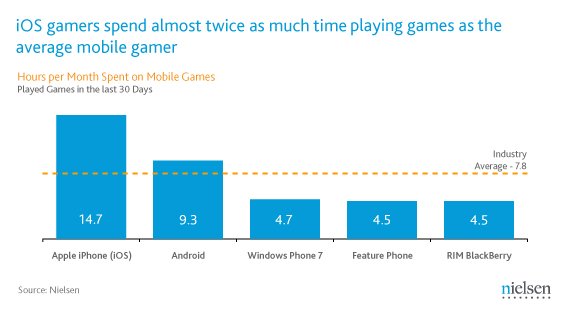
Apple's App Store has reached 15 billion downloads, a rather impressive number when you consider it's only been around since 2007. This has resulted in Apple paying out about $2.5 billion to developers... of course, most developers only see a few hundred or a few thousand dollars, while some rake in millions. About thwo-thirds of the revenue from the top 100 titles comes from Free-To-Play (F2P) titles. For those titles, anywhere from about 0.5% to 6% of the users actually spend money on the title, which means over 90% of your players play for free. Still, when you can see over a million daily average users, you can make a nice chunk of change. The trick, of course, is getting to that number of customers...
Saturday, May 28, 2011
Real App Sales Numbers
 |
| Check out the larger version here. |
 |
| This shows how few paid apps are sold; larger version here. |
Here's reality: Some 96% of Android apps sell less than 1,000 units, and most of those are less than 100 units. If you are a developer, you can see you're unlikely to make any money from your Android app.
While Google has been working on improvements to the Android Market, and selling lots of Android devices, you can't count on that to lift your app revenue to the point of profitability. So why do an Android app at all? Perhaps you can cross-sell a number of other apps, or hope to monetize your app through advertising (but that means getting lots of downloads). Maybe you have other products your app can help you sell... or maybe you just want to try out some design ideas when there's no restrictions on what sort of app you can offer.
I can't emphasize enough the importance of proper business planning before you spend any time developing an app, either for Android or iOS. Really, while the situation is certainly better for an iOS app, it's not all that dissimilar. Most iOS apps sell less than 1,000 units, too. That's not a great return unless you only spent an hour or two putting your app together, which seems unlikely.
A successful app is going to be a lucky break, and it's going to have to be very well executed, too. Regular updated content and solid marketing are going to help, but there's no magic potion that will make your app a hit.
Wednesday, May 25, 2011
iOS Apps Hit 500,000
 |
| Just a bit of the entire infographic, showing the top titles... |
I urge you to click through and check out this infographic which is chock full of details about the apps, but it's unfortunately too big to put into this blog post. As you look at the info, remember it covers all iOS devices, and that iPad apps tend to be more expensive than iPhone apps. Some key tidbits:
- There are over 85,000 unique developers.
- 37% of all apps are free
- The average price for a paid app is $3.64
- Of all apps, 29% are 99 cents, and 13% are $1.99
- Games started out as 24% of all apps, and are now 15% of all apps
Friday, April 29, 2011
44 Billion Apps
 |
| Apps... by the billions. |
Yeah, the companies taking 30% of the revenue from each app sold...
Thursday, April 28, 2011
100 Million Free iPhone Games... In March Alone
 |
| In-app purchasing is becoming very popular, very fast. |
Maybe... or maybe not. The dark underside of this wave of free apps is the pay-per-install method of marketing your app. Seems there are lots of places where you can pay a fee per installation to get your app installed in thousands of phones... in order to drive up your numbers so you can appear on Apple's best-seller lists. This can run upwards of $30,000 or so, but the payoff can be considerable; being in the top seller list is about the only way to get noticed in the App Store since Apple's tools are so feeble.
Now Apple is cracking down on apps that offer this cross-marketing opportunity. Which is also shooting down more legitimate cross-marketing efforts. It's really a mess right now, and hopefully Apple will take charge and solve the fundamental problem: App discovery. It should be a warning sign when developers are gaming your system to be able to sell games on your system, if you know what I mean.
Apple may be facing some real retail competition when Amazon really gets rolling selling Android apps (and their own Android tablet... and maybe an Android iPod competitor? Or an Android phone?). Which is exactly why Apple should really be working hard to improve their shopping tools right now.
Friday, April 22, 2011
How Much Do App Developers Make?
 |
| This chart has all the data...see the original here. |
The numbers work out to about $8500 per publisher per year, which isn't a whole lot. Of course, that's averaging; the publisher with big hits make hundreds of thousands or millions, and many just make a few hundred dollars.
Games are more lucrative than non-game apps, and that's a good thing for game developers. But it underscores just how difficult it is to make money with an iOS game... or any smartphone game, for that matter. Developers need to be aware of the facts before charging into an expensive development process.
Tuesday, April 19, 2011
Natural App Discovery
 |
| Another way to find apps, rather than trying your luck in the App Store. |
Friday, April 1, 2011
Check-in App Marketing
 |
| Users can help market your apps. |
Of course, this depends on the idea getting some traction, and ultimately your app has to get some traffic before the viral marketing really kicks in. There's still no magic bullet... but I welcome attempts to craft one.
Wednesday, March 30, 2011
Apple Being Investigated By FTC
 |
| Look, kids! These can be yours if you just hand over mommy's credit card... |
Also of concern is how sneaky companies are prepared to be in order to drain dollars out of hapless children. Excuse, I meant "adult power users," how silly of me to think that children would be the only players of The Smurf's Village. I wonder how this will affect Capcom's revenue stream? Probably makes them feel a little blue...
Friday, March 25, 2011
Games Make Less on Ads
 |
| In-game ads don't look like this, but it might be kind of cool... especially if I could blow them up. |
Of course, this study didn't look at virtual goods in comparison. But it does show that ad-supported games are generally not as good a solution as other types of apps. Something to think about when you look at monetization options.
Friday, March 11, 2011
Will The App Market Close Down To Small Developers?
 |
| This game by an 8-year-old was #1 in the iTunes Store... will that ever happen again? |
Another factor is the increasing influence of pay-per-install networks from companies like Flurry and Tapjoy (the company formerly known as Offerpal, which was known for less than scrupulous deals). You can buy your way onto the bestseller charts if you pay enough, rumored to be up to around $30,000 now. Certainly it's way beyond the means of a small developer.
I agree to a certain extent with this theory. Certainly we'll see bigger developers, or those with venture money, perhaps investing more in the development of individual mobile titles than was previously seen. Then again, if higher investments in development don't tend to produce correspondingly higher revenues, that practice won't continue for too long. And just raw volumes of artwork aren't enough to make the difference in smartphone games. Few titles are designed for large quantities of artwork on smartphones, anyway; that's not the type of game experience people are looking for in a smartphone, at least not so far.
I think the big difference for smartphone games is that distribution will continue to be non-capital intensive. Regardless of how much you spent on development, distributing your game costs nothing. A venture-funded developer or a big publisher may be able to put large amounts of money into marketing (or a license, which has a similar effect), but the small developer can at least get their product on the shelves.
I think more money will tend to mean the top seller lists will be dominated by big companies or venture-funded developers, but the smaller developers will still be able to break through with a great title and some clever marketing.
Thursday, February 24, 2011
Game Developers Can Make Toys, Too
 |
| A software toy, it draws millions of downloads. |
The apps have some interesting social aspects, such as letting you upload clips to YouTube. Of course, some of them are free, which is part of why they are so popular, but Outfit7 also charges 99 cents for some of them. They expect 100 million downloads this year... and it doesn't take too many of those at 99 cents to add up to a lot of money. These apps are on iOS, Android, and iPad, and they will be expanding the lineup to include other devices, I'm sure.
The key thing here is that any game developer can build something like this if they can build an iPhone app. No, it's not a game, but you can have a lot of fun with it. Game developers should be widening their horizons to think of other types of apps they can build that would have a low investment and a high return. App toys are an interesting idea, which can even build off of other IP you create as a game developer. There are many ways you may be able to leverage that artwork and animation you create, to increase your brand awareness and generate some revenue.
The app market means a whole different approach to game development and marketing... and maybe making some things that aren't games.
Tuesday, February 22, 2011
Android App Revenue: Barely There

Interesting to note is that Blackberry's app store made more than Android, as did Nokia's store. App development proceeds apace for Android, but Android phone users aren't buying all that many apps, it seems. Of course, the situation will probably change as in-app payments are put in place for Android. Still, app developers need to be conservative about how much they could make from Android versions of their apps. Hardware sales alone don't tell the whole story; the demographics of the buyers, and the details of the market itself, are obviously important.
Subscribe to:
Posts (Atom)

 Posts
Posts


