
If you thought Zynga's IPO was big news, what would you say about an even bigger social gaming company going public? South Korea's Nexon is going to file somewhere in Asia, not on Nasdaq or NYSE, but it's still huge. The company is 17 years old, and pioneered the free-to-play business model that's been revolutionizing the gaming industry. (What have they done? Maplestory is one of their biggest hits...) They have over 1 billion registered customers, and in 2010 their revenue was $643 million, or just a bit more than Zynga's. Their revenue has been growing 30% a year for the past five years, so in 2011 they are expected to take in over a billion dollars. Their margins are actually better than Zynga's since they don't have to hand 30% to Facebook; reports are that they have 50% margins, which is amazing.
Nexon hasn't made much of an inroad into the US, mostly because our broadband is so pathetic compared to South Korea. Now the US is finally developing enough households that can handle the graphics that Nexon wants to toss their way. Along with Tencent and Perfect World, we're finally seeing some of the Asian companies making serious inroads into the US market. It's going to be a marketing battle with old-line publishers like EA struggling to be a player in these new areas, and Zynga (which will be flush with cash from the IPO) working to maintain and grow its position.
We're going to see more and more sophisticated games being offered for free or very low prices, which is going to really wallop the traditional business (which, by the way, looks like it's going have another month of sales declines; numbers get released Thursday). Yet the gaming business overall continues to grow... the changes are happening fast.
Showing posts with label F2P. Show all posts
Showing posts with label F2P. Show all posts
Tuesday, July 12, 2011


Friday, July 8, 2011
Games Are The Most Downloaded App
 |
| Games are even more popular than the weather. |
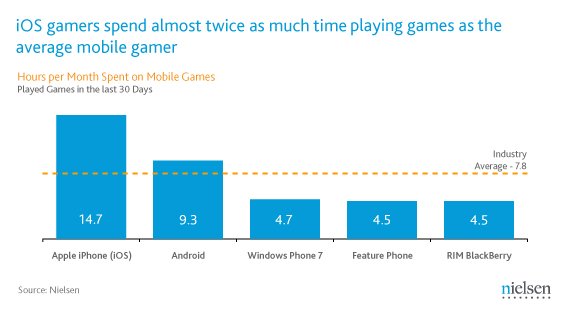
Apple's App Store has reached 15 billion downloads, a rather impressive number when you consider it's only been around since 2007. This has resulted in Apple paying out about $2.5 billion to developers... of course, most developers only see a few hundred or a few thousand dollars, while some rake in millions. About thwo-thirds of the revenue from the top 100 titles comes from Free-To-Play (F2P) titles. For those titles, anywhere from about 0.5% to 6% of the users actually spend money on the title, which means over 90% of your players play for free. Still, when you can see over a million daily average users, you can make a nice chunk of change. The trick, of course, is getting to that number of customers...
Monday, July 4, 2011
EA Embraces Free-To-Play
 |
| Better than Cars 2, at any rate. |
Another major plus for the F2P games is that they enable EA to make money from markets where there is no retail game market, and there's not likely to be one. Such as Russia, Brazil, and the Ukraine, where Need For Speed World is tops. It's another example of how developing countries leapfrog older technologies and go straight to the latest technology. For example, much of Eastern Europe never did have much of a phone network, nor does sub-Saharan Africa. And they're never going to bother building out a land-line network, because it's much cheaper and faster and more efficient to build out a cellular network.
Similarly, no one is going to bother going to the effort of creating retail store chains for software in countries where roads are chancy and gas is expensive. Why bother when digital distribution makes so much more sense? Which is also why, when you think about it, that console games with a reliance on physical media are never going to make much headway into developing countries. Not unless they embrace digital distribution for all their titles, which at least in the case of Nintendo will happen at about half past never.
The gaming platform of the rest of the world will be smartphones and tablets, not consoles and computers. Yet another reason to diversify, if you needed one.
Friday, February 11, 2011
Riot Sold To Tencent
 |
Riot Games is the creator of the amazingly successful game League of Legends, a real-time strategy game that's free to play. They make money by selling you different skins for the characters, and additional characters that you can use in the game. This model has been a winner for them. Not that they've released any revenue numbers, but I deduce this from the fact that they have 100 job openings (!). Tencent was an early investor in Riot, and they are positioning this as just a further investment in Riot Games. Tencent plans to leave Riot Games management alone, according to their press release. Why mess with success?
 |
| Tencent's totem creature apparently lays gold coins. |
What's more interesting is what this acquisition might mean for the future. We'll no doubt see other games from Riot Games at some point, and they'll probably use the same basic F2P (free-to-play) monetization scheme that's been working so well. I'm sure Tencent, who has other game studios in the US, will be using F2P in their games as well. How long will it take big US publishers to figure this out? Well, it could take a while. Converting an existing game is not easy; you can't just take Call of Duty and make some weapons cost money, not without unforeseen consequences to gameplay. A whole lot of testing and tweaking would have to happen, and even then it's not clear that existing players would go for it in a console game. Then there's the sheer guts it would take for a game publisher who gets the majority of their revenue from physical goods sold in retail stores to take one of those franchises and try to get the same revenue without selling it in stores... or without pissing off the retailers they depend on.
Wednesday, January 12, 2011
F2P Means $$$

Certainly competing with the World of Warcraft juggernaut is difficult, but the free-to-play mechanism seems to be working out extremely well for Turbine. This certainly seems like the way to get some traction for MMORPGs in the current environment. It will be interesting to see if some of the new MMORPGs that have launched with subscription plans continue to hold onto that, or make the switch sometime during the year.
Of course, the landscape will alter in a big way when WoW itself makes the transition to F2P, but I don't expect that until 2012 at the earliest.
Tuesday, January 4, 2011
PC Gaming 2011 Predictions

Anyway, here's some of my predictions for PC Gaming in 2011.
- The Star Wars MMO has a disappointing reception. Oh, they'll sell a bunch right away, but there will be a chorus of complaints about game balance, play style, and the Star Wars universe fidelity. I can predict this without having seen the game because that's the way MMORPGs launch: Game balance is wonky and they prefer to get that right while people are paying for the privilege of testing. Early adopters will complain about it, and complain about what they get to do or can't do, and Star Wars fans will no doubt find things to complain about. The real key is whether the game is compelling enough to attract people despite the flaws, and stick around long enough for the flaws to get fixed. I think it will be, but I don't think this is going to replace WoW.
- WoW remains subscription priced, but adds more items to be purchased in-game. Speculation will continue about a shift to F2P, but it won't happen this soon. Meanwhile, though, Blizzard will rake in more dough by ramping up the things you can purchase in-game. Plus they'll be making a renewed push to add more gamers and get their subs growing again, which won't have much effect. There are too many other gaming choices competing for players, and that sub price will get to be a heavier burden over time.
- Most new MMOs launch as F2P; the ones that don't struggle. We'll see a number of high-profile entries into the MMO space this year, many of them with subscription pricing. If these games don't grab and maintain a big audience, as I predict, the subscription model will be pretty much left for dead as far as new games are concerned. Certainly D&D Online's success has inspired other MMO's to follow suit. Game design is an issue, of course, but I think this will be the norm going forward.
- Steam continues to grow and gain market share. This is an easy prediction to make; nothing succeeds like success. They're doing a lot right, and continue to refine what they do. As retail stores contract their shelf space for PC games, Steam will expand to fill the void.
- PC games at retail continue to fade away. The flip side of the last prediction. Have you looked at the retail space devoted to PC games lately? Ugh. Aside form the occasional high-profile title like Call of Duty: The Sequel, there's a wealth of cheesy game shows and assorted low-priced stuff. Not very lucrative for the retailers, I'm sure. The smaller package size has meant less selling goes on in the store; the shelf isn't pulling in customers. GameStop better hope console games stay healthy at retail.
- F2P games become even more popular. A major RPG is announced as F2P. Free-to-play is kicking ass and taking names. I have no inside info on Riot Games and how League of Legends is doing, but I infer from the fact that they're looking to hire dozens of people that it must be doing pretty well. I'm expecting somebody to realize that a Diablo-style RPG based around a F2P business model would make a pile of money. It's what Diablo III should be if they really want to make a bundle.
- Call of Duty does not add a subscription plan. Some analysts have called for this, but it's not gonna happen. At least not right away; it may be part of a future release. But I don't think will see a move to try and migrate a user base over to a pay model when they purchased a game under a different expectation. If Activision really wants to do this, I'd say do it with a new release that you charge less for upfront... maybe even a free release.
- DLC rules. Downloadable content expands even faster and generates a lot of money for companies. On the other hand, users may feel burned if they think they have to pay for DLC in order to compete at a game. Or that someone can pay to get some nifty ability that totally destroys you if you haven't paid. Game design issues will certainly impact marketing and business results here.
It'll be a good year for PC gaming overall, as long as you're not a retail store.
Thursday, December 23, 2010
Sony's Getting Real Profits, Virtually

Interestingly, most of the games on Playstation Home are free-to-play, with Sony making their money from the virtual goods. They are planning to try and bring in more indie developers, too. It's a way for Sony to take part in the new business models without messing up their standard business of retail packaged goods. One wonders if this area could grow to swallow up more of the business... it will be interesting to watch. If you're a developer, it's another place to get your game out there (if you've got some virtual goods in your design).
Meanwhile, Sony's got another reason to get a PS3 coming out. Their new Music Unlimited service debuted in the UK today, and is rolling out in the US and other countries next year. For a subscription price you get streaming access to a library of 6 million songs through your PS3 (or a PC or your Bravia TV). Sony's trying to move away from the iTunes model of buying songs, especially since iTunes has such a lead in that area. An interesting idea, but it remains to be seen if users go for it. A lot depends on the subscription price, which hasn't been mentioned yet.
Apple's poised to offer some sort of streaming music service, too, according to the rumor mill. Which could crush Sony's fledgling effort if it launches around the same time, or even if it launches well after it. Still, it's nice to see Sony trying harder, and their PS3 sales are certainly looking up. If the Wii doesn't reduce its price soon, I wouldn't be surprised to see the PS3 pass it up on a regular basis.
Thursday, September 23, 2010
Western F2P Design Not Good Enough?

One of the interesting points raised in the article is the fact that Asian games generate a whale of a lot more revenue than Western games. Based on surveys of users, DFC concludes that Western F2P games just don't have as compelling a game design when it comes to getting customers to opening their wallets for additional content. This is a big issue for the future, and it points to the need for marketing and game design to work closely.
It's important to understand the needs of the audience when designing content for F2P games. Game balance is always a delicate thing, and you can easily generate anger if players feel the only way to compete is by buying items. Yes, the whole business model makes designing games even trickier... good news for game design jobs, as long as designers understand how to handle this new element.
The above image is from Dungeons & Dragons Online, which is now F2P. I'm not sure how well things are going with the transition to that business model; it must be even more difficult to switch from a subscription model to F2P, designwise. Once I get a new computer, I have a lot of such games to check out... this old beast is getting a tad slow to deal with today's games.
Subscribe to:
Posts (Atom)

 Posts
Posts


