Game Marketing Tips, Analysis, and News


Showing posts with label game app marketing. Show all posts

Monday, August 8, 2011

App Makers Relying On Repeat Users

In-app purchasing is where the money is gonna be, according to developers.
Given how hard it is to find new customers for your mobile game, it shouldn't be a big surprise that developers are increasingly looking to existing customers for revenue rather than new users. A survey of 2,000 developers taken last month shows that new sales are the key strategy for about half of developers (43%) and that percentage is expected to keep rising.

With Apple's new iOS 5 coming soon, apps on both iOS and Android will have a pretty good set of tools for notifying users... which means more opportunities for in-game purchases. This all goes to show that if you're planning on making money with mobile games, your strategy should not be based on just creating one game and hoping it becomes a mega-hit. Sure, that may happen, but your odds are better buying lottery tickets. A more sure path to revenue is in planning a series of games (connected in some way, or not) that don't cost you a huge amount to develop. Execute them well and build an audience, then try to sell that audience on your other titles. If you have a design that lends itself to in-game purchases, that's even better.

The more games you have out there, the more cross-selling you can do. Also, it improves the odds of one of your games becoming a hit. Of course, this does assume you're making sure each game is a well-polished little gem. Cranking out a series of crappy games isn't going to help you at all. But don't pin your hopes on one title; create a series of games, or a game with lots of additional content and new variations. Make an audience happy with your game, and then you market other things to them. They will also become your best salespeople, especially if you make it easy for them to spread the word about your game.

Once you've got a big enough group of customers that like to give you money, you've got yourself a dependable income. Keep turning out things they like and you won't be worrying about where the next megahit is coming from; you;ll be too busy watching your bank account grow.

Friday, July 8, 2011

Games Are The Most Downloaded App

Games are even more popular than the weather.
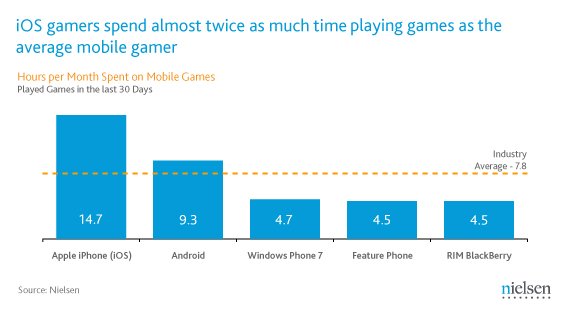
I don't think this will surprise anyone, but it's nice to have the data: Games were the most downloaded app in Q2, according to Nielsen. Better still, 93% of game downloaders are willing to pay for games they like. Interestingly, iOS owners spent twice as much time playing games as the average mobile gamer.


Apple's App Store has reached 15 billion downloads, a rather impressive number when you consider it's only been around since 2007. This has resulted in Apple paying out about $2.5 billion to developers... of course, most developers only see a few hundred or a few thousand dollars, while some rake in millions. About thwo-thirds of the revenue from the top 100 titles comes from Free-To-Play (F2P) titles. For those titles, anywhere from about 0.5% to 6% of the users actually spend money on the title, which means over 90% of your players play for free. Still, when you can see over a million daily average users, you can make a nice chunk of change. The trick, of course, is getting to that number of customers...

Wednesday, May 25, 2011

iOS Apps Hit 500,000

Just a bit of the entire infographic, showing the top titles...
It's just getting more and more crowded out there on the virtual store shelves. The number of apps approved for Apple's App Store is now over 500,000, with over 400,000 available for download. Good luck finding any particular one, if it's not a best-seller.

I urge you to click through and check out this infographic which is chock full of details about the apps, but it's unfortunately too big to put into this blog post. As you look at the info, remember it covers all iOS devices, and that iPad apps tend to be more expensive than iPhone apps. Some key tidbits:


  • There are over 85,000 unique developers.
  • 37% of all apps are free
  • The average price for a paid app is $3.64
  • Of all apps, 29% are 99 cents, and 13% are $1.99
  • Games started out as 24% of all apps, and are now 15% of all apps

Friday, March 11, 2011

Will The App Market Close Down To Small Developers?

This game by an 8-year-old was #1 in the iTunes Store... will that ever happen again?
How long will the doors remain open to small developers? That's a question being asked among VCs and developers alike, as venture money has been pouring into social and mobile developers. Big companies like EA are investing heavily in mobile and social games. As this article argues, the influx of big money and big companies could squeeze out the small developers.

Another factor is the increasing influence of pay-per-install networks from companies like Flurry and Tapjoy (the company formerly known as Offerpal, which was known for less than scrupulous deals). You can buy your way onto the bestseller charts if you pay enough, rumored to be up to around $30,000 now. Certainly it's way beyond the means of a small developer.

I agree to a certain extent with this theory. Certainly we'll see bigger developers, or those with venture money, perhaps investing more in the development of individual mobile titles than was previously seen. Then again, if higher investments in development don't tend to produce correspondingly higher revenues, that practice won't continue for too long. And just raw volumes of artwork aren't enough to make the difference in smartphone games. Few titles are designed for large quantities of artwork on smartphones, anyway; that's not the type of game experience people are looking for in a smartphone, at least not so far.

I think the big difference for smartphone games is that distribution will continue to be non-capital intensive. Regardless of how much you spent on development, distributing your game costs nothing. A venture-funded developer or a big publisher may be able to put large amounts of money into marketing (or a license, which has a similar effect), but the small developer can at least get their product on the shelves.

I think more money will tend to mean the top seller lists will be dominated by big companies or venture-funded developers, but the smaller developers will still be able to break through with a great title and some clever marketing.

Monday, January 17, 2011

App Store Marketing 2011

App Stores other than Apple's may be smaller, but they are growing faster.
The whole App Store idea is growing and changing. First off, the phrase "App Store" is the subject of a fight, as Apple's trademark application for the term (filed in 2008) is under attack by Microsoft. Not unreasonably, Microsoft is arguing that the term App Store is generic, like "shoe store", and should be available to all. As you might expect, Apple disagrees. You'd expect Apple to want the term reserved for themselves. It's amusing, though, how fast technology has forced the progression of language. Why, back in the Twentieth Century it could take decades for a company's trademarked term like Kleenex or Xerox to become generic. Now it happens so fast the trademark hasn't even been granted before the term becomes generic.

Anyway, regardless of what you call it, stores that sell Apps have been growing and changing. Here's some interesting data on on various App Stores have been growing in the last year. Blackberry, Android and Ovi app stores have been adding apps at a tremendous rate far outstripping Apple's. Of course, they have far further to travel since they are smaller. And Blackberry and Ovi desperately need apps to compete with Apple and Android, though this seems like a rearguard action that will do little to delay the outcome of the war.

Something entirely different is coming up with the Android app market. One of the interesting things about the Android Market is that Google has always said other companies are free to create Android app markets of their own, unlike Apple who assiduously tries to keep it all to themselves (though Cydia offers some interesting capabilities to those willing to jailbreak their iPhones). Now Amazon is about to take them up on it... and Amazon is planning to change the way apps are priced.

Typically, app developers set their prices and the app store takes a 30% cut, passing 70% of the revenue on to the developer. Simple, straightforward, no muss, no fuss. Amazon, though, has invested a lot of effort into figuring out how to maximize revenue from pricing. Amazon has engaged in dynamic pricing in the past in an effort to maximize revenue. So Amazon is setting up their Android App Market to allow them to do that with Android apps.

Here's how it will work: The developer sets a Manufacturer's Suggested Retail Price (MSRP) for their app; this MSRP has to be less than or equal to the lowest price of the app as listed anywhere else. Amazon will pay the developer 70% of whatever Amazon sells the app for, or 20% of the MSRP, whichever is greater. So Amazon can put the app on sale, or give it away for free if they like. If the developer lists an MSRP of $5, Amazon will pay the developer $1 if Amazon gives the app away for free. If Amazon sells the app for $2, the developer gets $1.40. It may well turn out that the developer will make more money overall by Amazon selling the app for $2 than at the MSRP of $5. (For instance, if Amazon sells 100,000 copies at $2, versus the developer selling 1,000 copies at $5, the lower price is clearly better for everybody.)

Developers may be annoyed at the idea that they won't have control of their price, but clearly Amazon's interested in finding the maximum revenue, which is good for the developer as well as Amazon. Pricing digital goods is not the same at all as pricing physical goods. I think Amazon's going to be very successful with this idea... if developers will get past their prejudices and put apps into the Amazon app store despite losing total pricing control.