Game Marketing Tips, Analysis, and News


Tuesday, October 12, 2010

DRACULAS Reviewed

I'm doing something a little different on my blog today; I'm reviewing an upcoming ebook, DRACULAS. Why? As part of a marketing effort by the ebook's authors they have pre-released the book to blog authors who agreed to review the book on their blog or web site. Plus, I've interviewed one of the authors about their marketing efforts for the book. One further note: I got into this by reading J.A. Konrath's blog (on the blogroll to the right); he's one of the authors under his pen-name of Jack Kilborn.

DRACULAS
By  Blake Crouch, Jack Kilborn, Jeff Strand, and F. Paul Wilson

Teaser chapters available here; full novel available here  for $2.99 on October 19th. For more information about the book see www.draculasthebook.com.

If you're looking for a leisurely voyage into a world where vampires fall in love with young women, you'd better turn right around and head back inside. Maybe you should lock the door... there are dangerous things out here. Things that run ravening through a rural hospital and tear your expectations to shreds, right before they latch on to your throat and start to drink the rich red nectar. Oh, yeah, it's like that.

DRACULAS takes off running after just a step, and never lets up. The story takes place almost entirely within and around a hospital. Vampirisim turns out to be easily communicable, and it doesn't take long for someone to turn, so the problem escalates rapidly. The authors have chosen a fast-acting plague to create a fast action novel, and the characters are quickly sketched but memorable. Even the bad guys are given the chance to develop some interesting twists and turns.

There's plenty of graphic violence, and some horrific puns, and some choice movie references by the film buffs trapped in the hospital. If you like movie references, this will, in fact, make your day. The writing is well-honed; you barely feel the needle when it slides under your skin, until the punchline finds a nerve. I found it hard to believe that four different authors worked on this, since their styles meshed so well. It did feel at times as if there was some one-upsmanship going on, as I would find some gruesome scene where I thought "Wow, that's just nasty!" and then I'd find something even nastier in the next scene. The closest analogy I can give you is the recent film Machete, where there was some amazing action scenes that I just didn't expect, but thoroughly enjoyed.

Let's be clear: There are disturbing images in this novel that will haunt you for some time to come. The clown, oh my god, the clown... I didn't know I could laugh while grimacing in horror. If you like action, and horror, and a fast-paced novel with some twisted scenes you've never before encountered, this is the place for you.

Marketing DRACULAS

I asked some questions of Blake Crouch, one of the authors of DRACULAS, about their marketing efforts for the ebook.


What are the three most important marketing efforts for Draculas?

First, the grass roots pre-publication review campaign we initiated. We’ve had 260 people confirm advance reviews.  If 70% - 80% come through, we will consider this a rousing success.

Additionally, we are placing targeting advertising on KindleBoards and KindleNation.

Finally, we’re all sending out newsletters on the release date to our fan bases.

Are you able to track the effectiveness of different marketing efforts? If so, how?

We’ll only be able to directly track the review prong of the campaign. Of course, where DRACULAS debuts in the Kindle Store, and how long it stays there will be the ultimate test.

Do you expect Draculas to perform as well as other ebooks from any of the four authors? Better? Worse? Why?

Hard to say. We are pushing harder from a marketing and publicity standpoint than we ever have. We think the title, the premise, and the execution could make this a hot book, coupled with the strategic near-Halloween release date. Potential drawbacks…will people be enthused for a 4-way collaboration, and will the violence in this book be a drawback for some?

How much time, between all of you, do you expect to put in on marketing Draculas?

We have invested about two weeks toward marketing and promotion.

I'll be interested to see how their promotional efforts pay off for them. I suspect it will have been well worth the two weeks of effort in terms of additional sales. Combining the existing fan bases should prove very useful not only for this novel, but for cross-promoting other novels. Authors who can seek out their author friends and cross-promote are probably going to get some good results for not a lot of effort.

Of course, it all starts with having a good product. An interesting aspect here is that because it's an ebook, they were able to put in a lot of extra material: An interview with the authors, short stories, excerpts from novels, bibliographies and biographies, and an extensive look into the creative process via hundreds of emails the authors exchanged. All of this adds to the value, and at $2.99 it brings me back to the casual book-buying days of my youth.

Among other things for marketers to note about this: They have a well-designed cover; they've established a web site just for the book; it's being published on multiple platforms; and they've gotten some additional promotion through this effort to get pre-release copies into the hands of bloggers like me.

I think it will be a happy Halloween for the authors of DRACULAS.

UPDATE: The marketing is a success... read about it in this post.

Monday, October 11, 2010

The Handheld Is Dying; Long Live The Handheld

Two trends are apparent that seem contradictory: Handheld game consoles are faltering in sales, and smartphone sales are skyrocketing. They are really two sides of the same basic fact: Most people will likely carry only one handheld device with them. Unfortunately for Nintendo and Sony, that's going to be a phone for any adult and most teens.

Part of why smartphones have taken off is that they know incorporate multiple functions. Smartphones were a small market segment when they consisted of Palm OS, Windows Mobile (or Windows CE), Symbian, and Blackberry. Blackberry was a huge hit because of email; it was the corporate must-have. It still is, but it's starting to fade. When Apple introduced the iPhone, it was popular not because of Apps; the App Store didn't even exist (and Steve Jobs apparently wasn't interested in creating an open software market). What sold the iPhone then was the integration of the iPod functionality, which at that point was the overwhelmingly popular handheld device. Plus you had a camera, and you could see pictures and videos, and maps... it was phone/camera/MP3 player/GPS in one device. Once the App Store came around, and you added games to the mix along with a rapidly growing market of Apps for virtually any purpose, the iPhone took off.

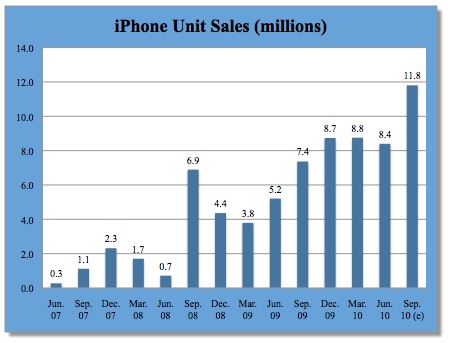
Apple's latest quarterly results will be announced October 18th, and analysts are looking for amazing results. It looks like we're seeing around 4 million iPhones sold every month. The iPad is over 1 million per month and will hit 2 million per month in 2011. The iPod Touch is probably doing similar numbers.

The Android market is based on the success of the iPhone, featuring multiple functionality in one device, with an open software market. It, too, is booming, with 6 million Android phones coming online every month.

The Nintendo DS? Selling around 320,000 units per month in August. The PSP is not even breaking 80,000 units a month. Nintendo is hoping to sell 4 million 3DS units in the first month.... and that will certainly drop off once the initial hardcore fans buy one. Nintendo will be fortunate if they are selling 1 million a month after a few months, especially if the price point is $299.

The realities are that there is no way Nintendo or Sony can hope to match the volume of iDevices or Android devices, which means Sony and Nintendo will be unable to match the hardware performance and pricing of Apple or Android. Volume means you can drive hardware pricing lower, and Nintendo is starting way behind in that race.

Oh, and Windows Phone 7 launches today.... millions more devices with an open software market and plenty of hardware horsepower.

Nintendo and Sony are going to see steadily shrinking sales of their handhelds. Their only hope is to open up their devices to be multifunctional. The hardware is perfectly capable of playing music, video and many other functions. Sony could certainly build a PSP2 that could be very nice, hardware-wise. But hardware mojo will not save Nintendo or Sony. If they had an open software market and could encourage developers to come to their platform, they might have a chance. (An Android-based PSP2 could be a real winner... with real gaming controls wedded to the fast-growing software market.) As Skype and other services grow, the need for a telecom company to make a handheld device into a phone is diminishing. Heck, phone calls are growing rarer, as people (especially younger ones) text all the time. So the phone advantage could be less important in a year or two, as long as the gaming hardware provides all the other functionality (Web browsing, music, video, camera, GPS, etc.) that people have come to expect.

The future is about personal handheld computers, not dedicated hardware for games or telephony or texting or music. Some of us can remember when dedicated word-processing machines were all the rage, and obviously so much better than some poor Apple II trying to word-process... we know how that ended up. The long-term trends are obvious; Sony and Nintendo have to get onboard or be left behind. Software developers and publishers need to be aware of this, too. I notice that EA is one of the key publishers of games for Windows Phone 7, so somebody there is thinking ahead. Marketers, don't get stuck in the past. Look forward to capture the next market.

Friday, October 8, 2010

App Store Success Story

If you're looking for a way to succeed in the App Store, you should take a look at what happened with Hungry Shark. This blog post on GamesBrief lays it out very nicely; the game had done very well in the UK as a paid app (250,000 copies!) and they wanted to take a big bite out of the American market. So they introduced it as a free game during Discovery Channel's Shark Week, and it hit the #1 spot for six days in August. Now they're moving 250,000 copies per day as a free app. So what, you say? Well, about 7% of those go on and pay 99 cents for the full version.

If you're doing the math, after you take out Apple's 30% cut, they're raking in a cool $12,000 or so. Every day. Pretty good for a free game, isn't it?

Note, though, you have to have a damn good game to start with, with good production values. They were clever enough to tie in to an external event that provided a PR hook, and they pushed the connection. They were clever enough in the design that they could create a free version that was fun, and there was enough impetus to get a reasonable number of conversions to the paid version.

Could this be duplicated? Yes, but more likely is that you'll have to work on each piece of the puzzle for a while to make it happen. Your conversion rate may be very low, so you'll have to tweak the design or improve the added value to boost the conversion rate. Using the analytics provided by someone like Flurry you can improve things based on what users are doing. Getting the word out to all the right web sites, getting the review copies in the right hands... orchestrating the buzz is very important.

Still, it all starts with a good game at its core. Marketing can help a good game succeed, but in this era of widespread information and reviews a mediocre or poor game won't make it, no matter how much rich creamy marketing you put on top.

The old market of packaged goods in retail stores, where an EA exec once famously said "We could sell dog shit in a box", is going away. Good riddance. Now you have to have a good game, and good marketing, to succeed. The customers are better off being surrounded by good quality games.

Thursday, October 7, 2010

The PSP2: Does It Have A Shot?

A possible PSP2 concept
Now that we've seen The Jungle, and the 3DS is on its way, what about Sony's poor lost little PSP? The PSP2 has been rumored for quite some time, but no one seems to know exactly what it will be or when it might appear. Certainly after the PSP and the PSPGo, expectations are not high for a new handheld from Sony. I'm sure part of the delay comes from headscratching at Sony over what the hell to do with a new device. I'm sure it galls them for Nintendo to have rolled over them so thoroughly with the DS line, with what is (in Sony's view) a technically inferior device.

Over at IndustryGamers, David Radd has some thoughts about what Sony could put into the PSP2 to give it greater sales. His prescriptions are a 3D screen (like the 3DS), a second analog "nub", make it a phone, use Kevin Butler as spokesperson, and make every game downloadable. Well, I'll agree with the second joystick; that seems obvious (though who knows if Sony can figure that out). It's a great way to differentiate the handheld from either the 3DS or the iPhone, and it shouldn't cost very much to add. But that's not going to make it a must-buy device.

I think making every game a download is a must, but it's not going to be easy for Sony because of the retail channel. They brought out the pitchforks and torches for the PSPGo (which was downloads only), and basically strangled that baby in its crib. Sony has to figure out a way to cut retailers in on a piece of the action; give them a chunk of money for downloads through their sites, or offer fast in-store downloads (and give the retailer a piece). Sony could get great promotions through the stores... maybe exclusive titles in some retailers, or exclusive DLC for a store. By promoting in-store visits and store web site visits, Sony could gain a lot of promotional help from retailers feeling besieged by all this digital download action going on around them.

Back on the hardware side, Sony has to compete with Nintendo and the iPhone and Android phones. I suspect Nintendo has locked up all the production of the only 3D screen supplier, so that route is closed (it's also an unproven feature, though it would dovetail with Sony's 3D push on the PS3 and with TVs). So the PSP2 should have some serious gaming horsepower. Give it a low-power Cell processor; or some CPU/GPU combo that will thrash anything Nintendo or Apple can produce. Make the PSP2 the most powerful handheld by a long shot, and you have a powerful attractant for hardcore gamers. Oh, and don't neglect the screen... it has to be high-res and gorgeous. The screen resolution is the 3DS' weakness; and the iPhone 4 has an amazing screen. Sony has to compete in that space, so the screen should be a killer.

Finally, open the PSP2 up to developers in a big way. Make sure it has a killer music player and video player. Sell your amazing catalog of music and video to the PSP2. Get thousands of Apps developed or ported; make the PSP2 a multipurpose device. People only have one pocket; if you want them to get a PSP2 instead of an iPod Touch the PSP2 had better do a damn fine job of playing music and video, and make it easy to acquire the content, too. (Beat Apple by having a removable battery and an option for additional storage via SD cards; give up on the damn Memory Stick already.) Make Skype a partner so you can neutralize the iPhone's communication ability without having to bring in a telco.

It's all a tall order, which may be why it's taken so long for Sony to get something together. Will they do something like this? I doubt it... Besides, with The Jungle about to take the handheld world by storm, what are the odds the PSP2 could compete against that?

Wednesday, October 6, 2010

Marketing Lessons of a Fiasco

I savaged Panasonic pretty good in my last post about the lousy marketing job they've done (so far) with their new handheld. Upon consideration, I think it's instructive to look at what they've done wrong and how it should be done better.

The Product. Let's start with the behind-the-scenes part of the marketing effort, which should have begun well over a year ago... or at least, whenever the product was being considered. Somewhere deep inside Matsushita (the owner of the Panasonic brand), some bright boy (it's a Japanese company, odds are it's a male engineer) had an idea for a handheld device. It was probably an engineer, rather than a marketer, as Matsushita is a typical engineering-driven tech company. Perhaps a prototype was cobbled together, or at least a specification list and some rough drawings. At this point Matsushita had to decide whether or not to move forward with this product idea. What should have been done before making this decision was to bring in Marketing to figure out what the audience for such a device might be, and how many Matsushita might be expected to sell. Ideally some user surveys might be consulted. A competitive analysis would be done; what are the direct competitors to the product? (The DS line, PSP, iPhone, etc.) How many do the competitors sell? How can the product be positioned against the competitors? All of which leads to a sales and profitability estimate (which really should be a range, given uncertainties), which should inform the decision about whether or not to proceed.

Sometimes you do go ahead even if the product doesn't look like a moneymaker, because it's useful for strategic reasons. (Example: The Prius didn't turn a profit for many years, but it helped Toyota's brand immensely as a technology leader.) Usually some changes would be made to the product based on the marketing analysis (it needs more RAM, a sleeker design, compatibility with some technical standard... whatever).

The Launch. Once you've decided to go ahead with the product, you plan the launch. Usually you look at the production schedule and find out when you can actually have the units, and in what quantities. Then you see what makes sense for a release date given that, and the marketplace. For a gaming device, you'd want to make sure you hit the holiday season with plenty in stock. Working backwards from there, you'd want to start the buzz building well in advance to help generate retailer preorders. The counter-argument to releasing info far in advance is that it gives your competition time to arrange countermeasures (like introducing their own new widget, or lowering prices, or bundling software, or other things). Usually you'd want to start showing off the device in January at CES (especially if you have little or no track record as a hardware company in the gaming industry), then provide details of the device and the ship date and the starting software lineup by E3, so you can book orders for your October/November launch (you absolutely need to be in stores by Thanksgiving).

January is when you'd release key info about the device, particularly why it's better than the competition. You need at least some key details for the fans to slaver over. Importantly, you need to line up software support big time, and announce them as early as you can. Specific titles are even better; they validate the machine. If EA says Madden will be on it, that's validation of reality. Support from major publishers is essential if you want to be seen as real; if you don't have that, you'd better offer something incredibly compelling if you're launching as a gaming device.

You also need a trademarkable name that's recognizable and suggests the key selling points of the device (the ones you identified in your product plan). Plus a PR strategy that will get buzz building at magazines and web sites. An incredible convention presence to drive home your messages. Maybe an Alternate Reality Game to get buzz going. Some high-profile celebrity endorsers. An amazing web site that has key info, dates, constant information updates.

Compare all that to what The Jungle has... it makes you wonder why they are wasting their time and money. Look, the hardware could be amazing for multiple reasons, but I don't know. Neither do you. Because they haven't said anything about it. A scrap of data or two would be enough to get the buzz started; say "The screen resolution is better than an iPhone 4" or "The CPU runs rings around any other handheld" or "Jane Famousperson says it's the most revolutionary thing she's ever seen in gaming." Instead, we get a German Flash game company with a CGI movie suggesting it is part of a game, and an animated talk show. And no data.

I've only scratched the surface here, but this should give you a better idea of just what's wrong with this product launch.

Tuesday, October 5, 2010

Panasonic's New Handheld -- "The Fiasco"

Sometimes reality is far more surreal than a Chris Nolan film. When I first  saw this news release from Panasonic via CrunchGear, I had to check the calendar to make sure it wasn't April 1st. When you know the details (the few that exist), you'll be wondering if you're imagining this. I'm pretty sure it's real; Panasonic has job postings for engineers in San Jose to work on this. Ah, but you want to know what I'm talking about, so prepare yourself for the impending introduction of... The Jungle.

Wait, what? You thought I was talking about a new gaming system. Well, I am. That's the name Panasonic has chosen for its new handheld gaming device, no doubt because it automatically suggests cutting-edge hardware oriented towards gaming. Or not. I have rarely seen a worse name for a product. Let me explain why... First, the name has nothing to do with gaming, or technology, or online, or connectivity. It doesn't even have any inherently positive qualities that you would like to adhere to your brand. Second, it's not even remotely trademarkable; it's not an unusual spelling and it's utterly commonplace. Third, it's entirely unmemorable; at least a made-up hi-tech name like Gizmondo or N-Gage is unusual enough so you have a chance to remember it. My suggestion for a name: The Fiasco. Or, to make it trademarkable, The Fiazco.

OK, well what about the device? As you can see from the picture above, it looks like an engineer pumped steroids into a spec sheet and called it a product, right after cold-cocking the designer before they could attempt to make it look pretty. It's a clamshell, with lots of buttons, and a full mini-keyboard, and various ports, all wrapped up in a chunky, ugly shape that looks like a Before picture in an ad for an industrial design firm. From the 1980's. All we know is that it has a high-res screen, and a mini-HDMI port, a micro-USB port, and a headphone jack, and it's built on some kind of Linux kernel.

At this point you're probably wondering if this is a North Korean plot to sabotage Panasonic's brand. You may be right. I wasn't sure how much worse this launch effort could be until I went to the Jungle's web site and watched the videos. Yep, it's a North Korean plot all right. The annoyingly 90's retro-hip web design clashes perfectly with the pseudo-snarky withit-wannabe text. I rate this site NFR (No Finger Required to begin evacuating your stomach contents). It's ugly, it's annoying, it's not compelling or interesting, and it's so lacking in information content it could be a standard political stump speech.

Of course, what hardware launch would be complete without a lengthy list of companies developing for the device, and all the cool titles they're developing, along with screenshots and... You have how many? One? The only announced title is Battlestar Galactica Online, a browser-based MMO from Bigpoint. Bigpoint is a German developer known for browser-based games (think Farmville clones). On the web site is a CGI movie from BSG... no gameplay, of course. That would be telling. The only other content mentioned is a video podcast from Machinima, which looks sort of funny... but how is this content for a handheld device that makes you want to buy the device? Wouldn't you be able to put this on anything that plays video?

Listing all the things Panasonic is not doing would be a very lengthy post. Suffice it to say that this is by far the worst product launch I've ever seen in videogame history, and I was there when the Virtual Boy was introduced, and the N-Gage, and the Gizmondo, and the Phantom... The Jungle wins hands down. You would've thought Panasonic would have learned something from the 3DO experience. I can't figure out why someone at Matsushita (the owner of the Panasonic name) would have greenlit this project. Compromising photos? A huge debt to some yakuza oyabun? I can't wait to see more of this train wreck unfold in slow motion over some period of time... I don't know how long because, of course, no timeline for launch was even hinted at. In any event, keep watching to pick up valuable tips on what not to do with your own product launches.

Monday, October 4, 2010

3DS Software Will Be More Expensive

Ah, Nintendo, always one to buck the industry trends. Sometimes this can be wildly successful; the Wii didn't go in the direction of HD and more horsepower like the PS3 and Xbox 360, but instead added motion control for a different type of gaming experience (and, not incidentally, a lower price point than the competition). Result: Nintendo wins that generation of the console wars hands down.

Now, as Nintendo's hardware and software sales are sagging, they are looking to the 3DS to give them a boost. The handheld itself won't be coming in at a low price; the launch price in Japan will be the equivalent of $300. Now Iwata-san is hinting that the software for the 3DS will be even higher than current DS software pricing.

A bold move, certainly, with the average price of game software dropping for years, and software sales down significantly over last year. It doesn't really seem like the right time to be raising prices. Between a very expensive handheld and higher software prices, this would seem to play right into the hands of Apple and Google, offering thousands of inexpensive titles (and even more free ones). Yes, you can only get Zelda on a 3DS... but at some point the overall price of the hardware and software will be too much for the customers.

I have my doubts that Nintendo can sustain these high prices over the long term; I predict sales will be less than stellar after the initial wave of early adopters. I think the shifts in the marketplace call for fundamental rethinking of business models; tinkering at the margins just isn't gonna do the job.

Here's your take-home marketing thought: If you're going to make a bold move, have some contingency plans handy in case it doesn't work out the way you think. Nintendo should have some plans ready...