Game Marketing Tips, Analysis, and News


Showing posts with label social games. Show all posts

Friday, May 27, 2011

Zynga Readies IPO

Now you know what the dog is hiding... money.
Since LinkedIn had their IPO and zoomed, other companies have reconsidered their pending IPOs. Rumors are flying that Zynga will be making their initial public offering soon, now that the market seems to be ready for IPOs again.

Some people have been critical of the valuation that Zynga is sporting, which is somewhat north of Electronic Arts ($8 billion compared to $7.71 billion). It does seem amazingly high given that Zynga has only been around a few years... on the other hand, it's going to pull in somewhere around $2 billion in revenue this year with an eye-popping gross margin. (Hey, those virtual goods are made from handwoven profits.) There's a lot of concern that this kind of valuation is a bubble, and that social games are due for a major crash soon. Others disagree.

I think that there's certainly way too much venture capital being thrown at social gaming or anything that smacks of it these days. That's different than the question of whether or not social gaming will disappear soon or at any time. I think social gaming has tapped into a much wider audience of gamers than the traditional "teen-age boys of all ages" demographic that marks hardcore gaming. It's ironic, really, that for many years game publishers would wish out loud that they could sell games to women, to people older than 30, to everyone. Now their wish has come true... only it's not the kind of games they're used to making or even games that they like to play.Their companies are mostly not benefiting from this huge new market, which naturally leads to jealousy.

Social elements are finding their way into games on many different platforms, and we're seeing many new types of social games on Facebook and in browsers. It's a period of great experimentation, and we're just seeing the beginnings of what games will be in the future. Sure, individual valuations of companies may be overblown. Will Zynga be fairly priced when it goes public? Beats me. It'll probably jump up when it's offered, then fall back at some point when the initial excitement fades. But I expect that in the long haul Zynga will do quite well. Their first-mover advantage has been solidified with a number of smart decisions, and I don't see them getting stupid right away. The high growth rate will certainly slow, and we'll have to see if they're smart enough to shift gears and slow down properly as growth slows.

Social gaming is here to stay, and even if you don't plan on creating or playing social games, you'll need to deal with this reality in the game industry.

Monday, April 18, 2011

If Facebook Goes To China, Games Would Win

Or tried to play Homefront.
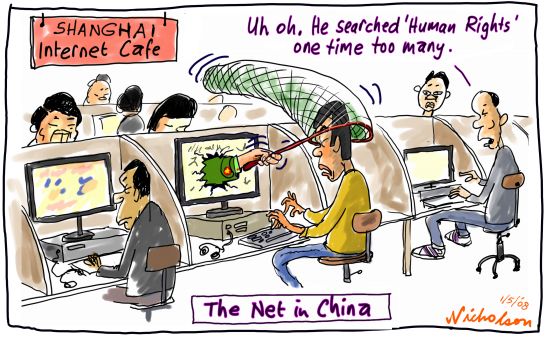
One of the interesting things about China is the Great Firewall, which is the term for the Chinese government's efforts to block access to sites they consider subversive or bad for some reason. This includes such sites as Google and Twitter, and of course, Facebook. I experienced this first-hand while voyaging across China last month; it was odd and annoying to be denied access to social networking. Fortunately, once I boarded our cruise ship and used the satellite uplink, the Great Firewall was neatly circumvented. I'm sure tens of millions of Chinese would like to do that, too, but the government won't allow it.

Of course Facebook has been trying to get into the Chinese market, but China simply won't allow it. They are too wary of Facebook being used as an anti-government tool. China is in the midst of a crackdown on suspected activists and anti-government behavior, triggered by their fears that what's happening in the Middle East might spread to China. So it would seem like a difficult task to convince the government to allow in a social network being used in other countries as a way for people to communicate about their shared dislike of their government.

Still, word is that Facebook is looking for ways to make a deal with the Chinese. This would no doubt involve making big concessions to the Chinese government about access to information on people. No doubt, the Chinese government would want to be able to get full information about any Facebook user in China. This sort of data access is what led Google to abandon the Chinese market directly and move their site to Hong Kong, which though nominally ruled by China still has a great deal of autonomy. Will Facebook take a high moral stance, or will the lure of the enormous Chinese market be too much for them?

Assuming that Facebook is able to eventually cut a deal for access to China, what would this mean for games? China is obviously a huge market for games... it's set to top $8 billion in revenue by 2014, according to this study. That would make China 25% of the total game industry in 2014... and the US would only be at 22%. Ouch. As a point of information, Tencent took in $1.4 billion in revenue in 2010, followed by Netease at $749 million, Shanda Games at $680 million, and Perfect World at $374 million. They are all growing rapidly, too.

Facebook in China might change this dynamic; certainly it would affect Chinese gaming companies, who would be looking at having to adapt to a new platform or face some erosion of market share. This could open up huge new revenue streams for companies like Zynga, who have Facebook games that would likely be very popular in China. (Farming? Gambling? Yeah, those would do well... remember Farmville is huge in Asian countries that allow Facebook to operate.)

Even smaller developers who were able to quickly translate their games could see a big benefit. Facebook could see massive growth in China, and games would doubtless be a top usage of the platform. Keep that in mind as you build your social game titles; keep all those text strings in easy-to-find places in the code.


Wednesday, February 2, 2011

Social Games Revenue Revealed

The Call of Duty numbers are slightly cut off in this view, but it's 12 million players.
While it's pretty clear that social games are virtually printing money, since the major players are private companies the exact height of their stacks of cash has been a matter of some conjecture. Estimates appear in the press, but they're just educated (or wild-ass) guesses. Now we have a bit more of an attempt to add up the numbers by IGN, and they compare the results to some of the top console games. The results probably shouldn't surprise you: Zynga's making a lot of money. More so than any console game except the latest Call of Duty title, which has set new records for a console game.

These numbers are guesses, though, for the social games. They may well be wrong... probably on the low side, is my guess. This gives you some insight into why EA and Disney are trying to buy their way into the social game market with purchases of Playdom and Playfish. (Though it doesn't explain why Activision is avoiding it.)

Game development costs are, of course, far lower for social games than for console games. I have no doubt that Zynga spent a lot more developing CityVille than they did on previous titles... and I also have no doubt it's still an order of magnitude or two less than Activision spent developing Call of Duty: Black Ops. Another key advantage of a social game is that the developer can continuously tweak it to optimize revenue (and user enjoyment). Given the number of players, social game developers have a huge stream of data to work with, and they can try things out and see the results very quickly. And they see how those decisions affect revenue right away, so they can optimize revenue rapidly.

It's because of this inherent feedback advantage that I see social games continuing to expand their revenue. They'll keep finding ways to get new players, and ways to get them to spend money. I've been resisting playing social games too much because of the time required, but now that my son has beaten my gladiator in Spartacus I'm tempted to buy a new fighter to whup him good... and so the social games tweak my amygdala to make themselves some money. Damn, that combination of game design, marketing and psychology is powerful...

Wednesday, December 1, 2010

Activision Doesn't Believe In Growth

Bobby Kotick of Activision has once again caused his PR staff to reach for the Tums bottle by opening his mouth to investors at the Reuters Global Media Summit . “The place where you have the opportunities for growth is within the communities of franchises we control,” said Kotick. “We don’t view the App Store as a really big opportunity for dedicated games. It’s a different question assessing [social games] as a business opportunity. Right now we don’t see an opportunity for us to participate in that market.”

In the meantime, EA is investing heavily in those areas.

If you find yourself puzzled by Kotick's remarks, I took the liberty of rephrasing them a bit in the time-honored fashion of PR professionals putting words in the mouths of CEOs. Try my version out below and see if it clarifies the picture for you:

"We don't believe in investing in the highest growth segments of the market," said Bobby Kotick. "We prefer to place our bets in the part of the industry that has shown negative sales growth for the past two years."

Usually you pay at least a little attention to the parts of the market that are growing the fastest. Even if you don't want to get your own dollars invested, at least license your properties to someone who's in those spaces... for brand marketing and some profit-heavy licensing revenue if nothing else. Does Bobby really think he can keep doing CoD sequels forever and sales will only grow? Shouldn't the collapse of music titles have shown him that growth is not forever?

"We're completely happy owning large dinosaurs and feel no need to invest in those pesky little mammals," said Kotick. "Oh, look at the pretty light in the sky... I wonder what that means?"

Thursday, November 4, 2010

Social Games Adding Gambling

The fast-moving world of social gaming is heading to some interesting places. First off, a survey done by looking at Facebook ratings shows that users feel the games are becoming higher in quality. Or, perhaps, more adept at delivering what the users want, which is not necessarily the same thing. The survey looked at 5 games with at least a thousand ratings from users, and found that the ratings are generally rising, from 3.82 to as much as 4.5 or so. It's not clear what this can mean for developers, though it's certainly something you can tout in your marketing. There does seem to be a correlation between higher ratings from users and games that grow faster and have larger user bases.

While social games may be getting better, they are also changing their nature. One of the interesting new trends is adding gambling. Yes, games of skill tucked into social games, or just explicit games of skill, where you can wager your virtual dollars and hope to bring in more virtual dollars or prizes. The games, of course, always win... not only through a house edge, but from the fact that the user is spending more time on their site. And, of course, spending more virtual dollars.

The more explicit use of gambling is in the game shows, like Wheel of Fortune. The Game Show Network is at the forefront of this trend. It's yet another way to make money from games that are free to play, though of course you have to worry about fraud, and cheating, and a host of other issues which are not simple to solve. Which is why this technology is being offered as back-end support to social game companies, which you can expect to start signing up for as the revenue possibilities become clear.

The whole thing points up the absurdity of trying to ban Internet gambling. Not only is it difficult to control Internet access for your whole country (look at the effort the Chinese put into the Great Firewall, and that's still pretty porous), but even defining gambling gets much trickier in an age of virtual currency. Why not simply tax it and let it grow? Yes, gambling addiction (like other addictions) can ruin lives, but that's why you take some of the revenues and put it into treatment programs and education.

Anyway, the take-home message is that social gaming is evolving rapidly, monetization options are increasing, and this category will continue to grow faster than traditional gaming. Marketers take note.

Tuesday, September 28, 2010

Social Games Competition Isn't Casual

MAU =Monthly Average Users, in millions


Things are heating up in the social games arena. Zynga continues to expand, starting up a Japanese office and now a German office. Meanwhile, many other companies are eying the wheelbarrows full of cash that Zynga is dragging in, and wondering why they can't have some of that, too. This article surveys some of the players and what's happening.


Here's the fun part... Bobby Kotick of Activision seems to think he's sitting on top of the online world. Maybe he's spent so much time gaming he can't tell the real world from a virtual one, but I think that Activision is seriously behind in the transitions affecting the gaming business. Where's free-to-play? Where's social gaming? Where's digital distribution? Yes, Blizzard makes a mint... with a subscription MMORPG model that everyone else in the business is busy abandoning, and even they admit they'll have to transition away from at some point. Otherwise, Activision is sitting on a pile of old-style disc-based games sold in retail stores, and the costs get higher every year while the odds of huge sales get longer.

EA's been struggling for years, but at least they're making moves in the right direction. Activision looks to me like once-huge company Broderbund back in the late 80's and 90's... going from hit to hit and performing well, until one day the current hit expires and there is no next hit title. Oops.

Will Microsoft succeed in making Windows gaming popular? They're trying again, but with the launch of Windows 7 Mobile they may actually have some traction, since that integrates their Xbox Live audience into the phone experience. Will Apple continue their gaming onslaught into the living room through Apple TV? They haven't said so, but it looks like an obvious move with a big potential upside for them. Will Google TV do that as well? Again, it seems obvious, but nothing's announced so far. Same with all the rumors flying about Google's effort to replace Facebook, which has to include a strong gaming component (considering that gaming accounts for more than 40% of Facebook's activity).

What gamers would really like to know is if we're ever going to see some social games with the some sophisticated game play, some meat that hardcore gamers can sink their teeth into. Sure, it's coming... but Zynga hasn't been making all that money by targeting gamers. Competitors will likely aim for the biggest markets first, at least the well-funded competitors. Smaller companies might do very well by carving off a niche too small for the likes of Zynga to focus on.

The land rush for market share is under way, and it will be interesting to see who grabs the most acreage.

Tuesday, August 24, 2010

Social Ads Getting Bigger

While social gaming companies are making most of their money from selling virtual goods, advertising is already part of their business model. Projections from market research firm eMarketer say that ads in social games should bring in $220 million this year, up from $183 million last year. Doesn't sound like much compared to the $1.6 billion size of the industry, but it's growing. And companies like Zynga intend to help it along, in case at some point people get over buying things that aren't real. (Hey, it could happen!)

The classic banner ad probably won't be the wave of the future, though. Ad integration is becoming more creative, and we should expect to see more though on how to get advertisers mixed into the gaming experience without turning off the customers. And while getting the advertiser a suitable amount of click-throughs. Looks like game designers will have to work closely with marketers on this; companies that are creative in mixing design with marketing will reap the benefits.