Game Marketing Tips, Analysis, and News


Showing posts with label smartphone game marketing. Show all posts

Thursday, September 8, 2011

Who's Spending Money For Freemium Games?

The 18-24 crowd spends more time, but the 25-34 crowd spends 3x the money.
That's a key question for mobile game developers. At least, it should be if you expect to maximize the revenue you get from the freemium game you're developing. (And if you're a mobile developer who's not working on a freemium game, you're missing out on more than half the revenue produced by mobile games.) Mobile analytics firm Flurry has some data for you.

The data was gathered from a sample of iOS and Android freemium games with over 20 million users across more than 1.4 billion sessions, so I think most people would agree that's a statistically significant sample to look at.

From the chart you can see that game usage skews heavily towards the younger audience, which shouldn't surprise anyone. I'd also guess that smartphone usage tends to follow a similar distribution, with the over 55 crowd being the least likely to even have a smartphone, much less play a game on it. However, the money is definitely coming from the older audience; teens don't spend much at all on freemium games even though they play a lot of them. The real pot of gold lies with the 25-34 age range (spending nearly half the money) and with the 35-54 group (spending more than a quarter of the money). If your game targets those older spenders, you could make more money with fewer overall downloads.

This is important data as you consider the design of your game, the style of the artwork, and the marketing. If you're interesting in maximizing your returns, you need to consider the realities of the marketplace.

Tuesday, August 9, 2011

Smartphones Vs. Game Consoles

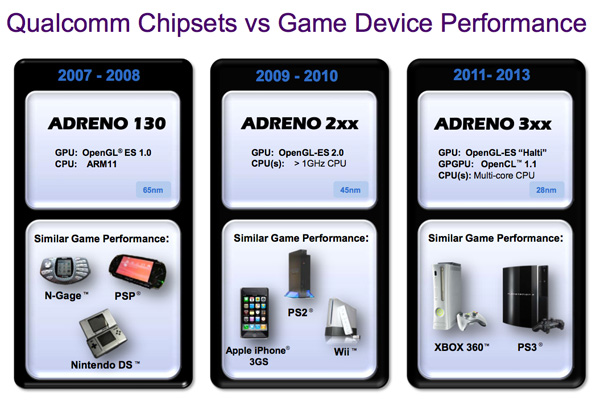
These are Qualcomm chips, but are comparable to other ARM-based chips.
I keep seeing articles about how smartphone technology is increasing rapidly, and some very experienced people   say that smartphones will soon equal and then exceed console capability. These articles usually have a string of comments from gamers saying things like "I hate smartphone games, they suck!" and "There are no good smartphone games" and "The smartphone games are nothing like the games you see on consoles" and "You can't ever have a good game on a smartphone because there are no real controls".

These commenters just miss the point completely. Let me walk it through so it's perfectly clear. It's also important to note that in this context, the smartphone technology I'm talking about also applies to tablets and to connected TVs (that is, boxes that connect to a TV, like Apple TV or Google TV or Roku or Tivo, or TVs with built-in Internet and other capabilities). The same basic chip technology (mostly ARM-based, though Intel is trying hard to get into this area)

The first place to start is by comparing the current graphics technology. The latest smartphones with the best graphics are about equal to a Wii, or somewhat better, in terms of their ability to display polygons and colors at various resolutions. (The Wii handles around 22 million triangles per second, or around 16 million polygons per second, from the info I could find.)


Here is a GPU comparison for some of the leading smartphones:
  • Motorola Droid: TI OMAP3430 with PowerVR SGX530 = 7 million(?) triangles/sec
  • Nexus One: Qualcomm QSD8×50 with Adreno 200 = 22 million triangles/sec
  • iPhone 3G S: 600 MHz Cortex-A8 with PowerVR SGX535 = 28 million triangles/sec
  • Samsung Galaxy S: S5PC110 with PowerVR SGX540 = 90 million triangles/sec
And for comparison a few consoles:
  • PS3: 250 million triangles/sec
  • Xbox 360: 500 million triangles/sec
You can see that the latest smartphone, the Galaxy S, is clearly better than a Wii but still not up to PS3/Xbox 360 territory. The iPhone 5 will likely use the A5 dual core chip, which should be about the same power range.


Smartphone technology is currently introducing new generations of CPU and GPU chips every year, with quad-core chips coming in 2012. Graphics performance has been improving at anywhere from 3x to 9x with each generation; the A5 was rated at a 5x to 9x improvement over the A4, for instance. Conservatively we can expect a 3x jump in performance every year with smartphones. Why is this happening? The intense competition in the smartphone market, and the sheer size of the smartphone market (measured in hundreds of millions of units per year; Android alone is activating nearly 600,000 units each day.) Massive volume helps drive down hardware costs, and encourages huge R&D and manufacturing investments to keep up with competitors.


At this rate, clearly smartphone technology will be exceeding the current consoles in the next year or two. And it won't stop there. Yes, we can probably expect new consoles beginning with the Wii U in 2012. Note, though, that Nintendo is on record as saying that the Wii U will be comparable to the PS3 and Xbox 360 in terms of graphic performance, perhaps a little better. Microsoft and Sony may introduce a new generation of consoles in 2013, which will probably offer a 5x improvement over the current generation if the past console history is any gauge. It's not at all clear whether they'll really be able to offer that much of a graphics advance, given the enormous price pressure they are already under, which will only get worse. Where's the price pressure coming from? That huge volume of smartphones is not only improving in performance, they are driving the price down even faster. Smartphone hardware is small, and inexpensive, and low in power consumption. Next-gen consoles won't be able to get away with $699 price points, or even $499. Not and sell a huge number of units... and the best case they can hope for is to sell, say, a couple of million units per month. Which would put them at about 1/10 the level of smartphone sales, or maybe less by that time. That's a race the consoles can't win.


What about output? Smartphones are currently outputting full 1080p graphics; some even have HDMI plugs so you can push the output to your TV. Apple's got their AirPlay, which allows you to run your smartphone display through your Apple TV to your TV set. It's pretty clear that wired or wireless output from smartphones to your HDTV is going to be a standard feature of smartphones going forward. Which means you can either use your smartphone as a controller, or connect another controller to it, and see the output on your TV. (You can also have a second display in your hand, which offers many game design possibilities.)


Let's talk about controls. The big knock on smartphone games is that a touchscreen as your only controller is too limited to allow many of the more popular console games, such as first-person shooters. Certainly the screen is pretty small, and taking up space on it to control the game action makes it worse. The problem is much less on a tablet, but using a touchscreen just is not as effective as an Xbox controller.


There's no reason, though, that you can't have a Bluetooth controller that looks exactly like your favorite console controller, with all of the same buttons and analog controls, that works with your smartphone or tablet. Then you can easily handle any of the console games.


Ah, you say, but console games just aren't available on smartphones, except maybe in lame dumbed-down ports that aren't much like the original. True enough... but how long do you think that will remain the case as the smartphone market grows at 10 times the rate of the console market, and the graphics capability catches up and then passes consoles? Not long, as I assure you the third-party publishers know how to run sales projections.


Smartphones (and their cousins, the tablets and the connected TVs) will be dominating the family room and leaving the current consoles in the dust. It's possible that Sony and Microsoft can see this coming and become part of the revolution, adopting the new business models. It's already happening, as the consoles are being used to stream Netflix, and Sony and Microsoft are beginning to allow free-to-play games to appear. Microsoft will be attempting to connect their Windows Phone 7 audience to the Xbox via Xbox Live; Sony has been embracing Android phones with the Experia Play. Nintendo, sadly, is still pretending that none of this mobile stuff matters at all to them. I expect they'll change that tune at some point; there are already signs of a thaw in some of their public statements.


The bus is leaving, console makers. Be on it, or be under it. Your choice.

Monday, June 27, 2011

Secrets of a Successful Mobile Game

OK, so their games skew young... but kids have money, too.
While there are plenty of companies jumping into mobile games, there aren't that many that are successful at making games people want to play. One of the new hitmakers is Pocket Gems, which has put out 6 games so far with a total of 40 million downloads. Of course, they aren't mentioning how much money they've made, but they seem to be doing pretty good.

What are they doing right? They are focusing on long-term customer engagement. Their games are free-to-play, with the monetization coming from in-app purchasing. Some critics have grumbled that this is not a sustainable strategy, having just a small percentage of your users essentially paying the bills for the rest of the players. What if that small percentage collectively decided not to spend money on in-game purchases any more? Sure, I guess that could happen. Of course, all the molecules in my coffee could decide to move vertically at the same time, but that hasn't happened yet as far as I've noticed.

Seriously, Zynga's whole business depends on the same concept of a small percentage of players funding the entire audience. They seem to have brought in over a billion dollars so far, so I think we can say that this is not some collective hallucination.

Anyway, Pocket Gems is trying to keep players engaged and coming back again and again. It's a different design philosophy stemming from the differing business model. A decade or two ago wiith traditional retail packaged games, it was all about the sell-in... the game was gonna sell 75% or more of its lifetime sales in the first few weeks, and everything was geared to that. You didn't worry so much about reviews or reactions, because in the pre-Internet days the reviews wouldn't reach everybody, and individuals couldn't get their opinions out to the world easily. So you could get away with a crappy game, at least once in a while. Now, that's become impossible. And you have to build an audience over time, which you can only do with quality and a game design that keeps 'em coming back.

Thursday, May 19, 2011

Smartphone Games Zooming

Some impressive numbers of games being downloaded per day.
Smartphone games are soaring high, with over 5 million games downloaded per day just in the West. OK, 88% of those downloads are free, but that doesn't mean developers aren't making money from them. More than half the games these days have in-app purchases as an option, or are cross-selling other games. Or they are making some money from advertising.

Speaking of which, Angry Birds has now hit the astonishing figure of 200 million downloads. That's over all platforms, of course. Some 5 million of those are on the Chrome browser. However you look at it, though, that's a lot of downloads. Not bad for a $140,000 development cost. Rovio is now planning for an IPO.

Meanwhile, naysayers like Nintendo and the now-infamous Denis Dyack say smartphone games are hurting the game industry. Yeah, tell that to Rovio. Of course, if the average gross is $700 per game, that's not a lot. According to Dyack's quoting an EEDAR conference, that's what they said the average smartphone game brings in. I really don't know where that number came from, but it seems absurdly low. I'm perfectly willing to believe that 90% or more of smartphone games don't really make money, at least not a significant amount. But to really hit an average of $700 there would have to be a whole lot of games making less than that in order to balance out the ones that are making millions.

I think the odds certainly favor a smartphone game not making much money at all. Perhaps that will reduce the number of new games rushing into the market, but it sure doesn't seem to have done much at this point to reduce the number of new games.

Piracy might, though, if you listen to the strident anti-pirate crusaders. Is piracy a problem for smartphone games? Not enough to worry about, say developers.When a game is free, who would bother to pirate it? With most games going to the freemium model, piracy turns out to be a non-issue.

When games are priced lower, piracy goes away. When you can track every customer, and you're selling virtual goods for the game, you don't really need to worry about piracy. Piracy becomes a marketing tool. The worse problem these days is going unnoticed; you really need to be worried if nobody wants to pirate your game.

I do think the smartphone game market is ridiculously crowded, and the tools to let good games stand out are still not that robust or widespread. There are ways and means to make money on smartphone games, and it's not just about being lucky. Good design, excellent execution and smart marketing are all important. Sure, luck is still important to becoming a mega-hit. Persistence is probably the most important quality you can have; keep making good games and eventually one of them will do really well. The real trick is to keep your costs down, and find ways to be profitable without relying on a mega-hit.

Wednesday, May 4, 2011

Gaming On Smartphones Is Popular

Games are almost as popular as social networking.
We knew gaming was a popular activity on smartphones, but it's always nice to get your data quantified. Seems that 60% of smartphone users play games on a monthly basis. This data isn't just coming from a survey, where people might make up the answers, but from actual data on how people used their phones.

Zokem's data has Words With Friends leading the usage, with 20% of smartphone owners playing that game, and 13% playing Angry Birds. I do wonder how widespread their sample is, but it's interesting data nonetheless. I guess it's easy to see why Zynga bought Words With Friends, isn't it?

http://gigaom.com/mobile/sorry-super-mario-smartphones-are-the-new-game/

Saturday, April 30, 2011

Gamer Growth

The USA has the most gamers, but other countries are growing.
Some interesting information from a survey by Newzoo about gamers in emerging markets. Especially interesting is that two-thirds of gamer spending is online, and passing the retail market in the West for the first time. Growth is swift in emerging markets, especially when payment processing becomes easier; transactions grew over 100% in Russia and 228% in Brazil in 2010, for instance.

It's pretty clear that developing countries will be see explosive smartphone growth, as people there bypass computers and consoles to go directly to Internet-capable phones (and perhaps tablets). Gaming will grow tremendously, but the majority of the growth will be outside the traditional console/computer markets of North America and Europe. Companies and developers that want to catch the growth surge will want to get a firm grip on the smartphone market.

Monday, April 18, 2011

A New Way To Monetize Mobile Games

There's a new business model making its way to mobile games, spearheaded by a startup named Kiip (pronounced "Keep"). It's a clever fusion of game design and advertising: When you get an achievement in the game, you get an actual reward like a coupon for a free smoothie or some other product from one of their sponsors. The plan is to connect various games with sponsors, and provide rewards linked to the gameplay and to the demographics of the users.

Kiip: An Introduction from kiip on Vimeo.

Kiip is complementary to other ad models, as they plan to focus on rewards and stay away from banner ads and other forms of advertising. The targeting is a crucial element; their system won't be offering a free lipstick to a game where the demographics don't include females.

It's an interesting concept, and I'll be keeping an eye on Kiip to see how users and advertisers respond to it.

Wednesday, March 9, 2011

Angry Birds, Happy Company

That's some tasty game sales.
I know a number of industry veterans have looked down on the smartphone game market. They say things like this: "Sure, there's lots of smartphones out there. But games are mostly free or only a few dollars! Maybe we'll sell a lot fewer copies of a title for the DS, but at least we can charge $30 for it. We'll never see that kind of money from a smartphone game!"

Well, unless you're Nintendo, the best you can hope for on a DS game is about 5 million units (Dragon Quest IX). Which, assuming a retail price of $30 and the publisher makes 30% of retail, means about $45 million in revenue. A DS game would cost somewhere in the realm of $250,000 to create (although some cost less; new games for the 3DS and the Sony NGP are going to be more in the $1 million cost range or more). So that's a pretty good return, right? Let's see a smartphone game do better than that!

OK, here's the info on Angry Birds. The game cost Rovio about $140,000 to create, and to date has brought in $70 million. Yeah, you read that right. Rovio is making $975,000 a month just from the free-to-play Android version of the game, and about that much from the cuddly toys. OK, they do say that 40% of the Angry Birds revenue comes from non-game sources like licensing and merchandising. But that still means that the game revenue is about equal to the best-selling thirdparty DS game ever, and Angry Birds is nowhere near finsihed generating revenue, thank you very much.

What about the best-selling Nintendo handheld game? New Super Mario Bros. has sold 26 million copies, so it's roughly in the $250 million dollar revenue range. Angry Birds isn't there yet, but give it a couple of years.

This should make executives wake up and smell the opportunity, or the danger. Revenues from smartphone games will likely exceed revenues from handheld games this year, and the gap will just widen in the future. Sure, there are thousands of smartphone games that never sell very many copies and never make money. But large game publishers should know how to make games that sell, and how to sell them... at least, you'd like to think so. And Rovio was not a large company when they created Angry Birds, even though now they are up to 40 employees.

This is a huge opportunity for smaller developers, if they can figure out how to make a great game and let the world know about it. Don't let anybody tell you smartphone games will never amount to anything. Maybe that's true of most of them, but certainly not all.

The Playbook

RIM has a need for speed in bringing this to market... time's a-wastin'.
With a name like that, it has to be for games... right? And yet it's from RIM, makers of the Blackberry. Who are busily losing market share as Android and iOS eat their lunch. But they were at GDC, with a large booth, trying to entice developers to create games for the Playbook.

I got my hands on a Playbook at the show, and it was impressive. Kind of small, compared to an iPad, but zippy game performance with high-quality graphics (at least, Need For Speed looked good and played well). True multitasking with no apparent slowdown, although when asked about battery life (especially with all sorts of apps running) the rep was suddenly extremely vague.

They were trying hard, though, offering a free Playbook if you could get your app up and running before March 15th. Seems like a pretty short time frame even if you already had an app done for iOS or Android... but perhaps they have some amazing development tools.

Still no announcement of price point or release date, and that's why it's hard to judge how well the Playbook might do. If it's $399... it could do well. At $699, the iPad 2 looks like a far better deal. Hanging over the whole thing, though, is the shadow of the development environment. Will developers really want to spend time and effort on yet another platform, when iOS and Android already have such a large base?

Which is where this story takes an interesting twist... according to this rumor from Bloomberg via TechCrunch, the Playbook will run Android apps. More than that, supposedly they are porting their Blackberry Messenger to Android (that's the crown jewels of RIM's empire).

Seems to me if RIM did this, the battle for developers would be over... who would develop specifically for Blackberry when they could get it just by doing an Android app? Nobody, especially when you hear just how messed up their developer program is (it's worth a read). Of course, if RIM still insists that the Playbook can't do email without being connected to a Blackberry, this is all academic. No one except a Blackberry owner will even consider getting a Playbook, and I bet damn few Blackberry owners would buy a crippled device.

Still, RIM is working hard to get games on the Playbook. Which is puzzling, unless they really feel they can sell it to everyone, not just Blackberry owners. Look, Blackberry is dying; their hardware just isn't competitive with iPhones or Android phones. Maybe the email is a little better, but that's not enough to overcome all the other advantages. Now RIM has to decide if they are a hardware company or a software company, and step up their game. Half-measures won't cut it when you're facing an existential threat, which is the situation they are in if you look at their market share numbers over the past year. Nokia realized they had to do something dramatic, and they did just that by embracing Windows Phone 7. RIM either needs to pull dramatically better hardware out of nowhere, or team up with a winner. Android seems like the obvious choice; RIM could embrace Android and say "We have the very best phone for business, and tablets for business or fun, too."

But time grows short for them. If we don't see something dramatic from RIM this year, I think it will be too late.

Friday, February 11, 2011

Microsoft & Nokia: Windows Phone 7 vs. Android vs. iOS

Now, it would be cool if they actually used this logo.
Two foundering giants have found each other and bonded in cross-cultural matrimony to create a serious competitor in the race for smartphone dominance. Nokia announced today that it's dropping its Symbian operating system over the next year or two, and going full speed ahead with Microsoft's Windows Phone 7 as its smartphone OS of choice. Nokia plans to have its first device out by the end of this year, with high volume in 2012.

The partnership makes a great deal of sense for both parties. Nokia's been watching its smartphone market share crumble, despite rather nifty hardware. They could never get their act together on software and interface and an ecosystem. Evidence of this was their efforts to get the N-Gage going, which was just kind of sad.

Meanwhile, Microsoft desperately needs Windows Phone 7 to get moving.

Microsoft's smartphone marketshare continued to decline in the 4th quarter, dropping to 8.4 percent in December (down from 9.9 percent in September). Since Windows Phone 7's debut in September, Microsoft confirmed on January 26 that they have now sold 2 million phones.. .to retailers, not customers. Which works out to around 500,000 a month. That may sound like a lot, but not in a world where iPhones are being sold at a rate of 500,000 every 4 days, and Android phones are selling 500,000 every 3 days or even less.

Microsoft has been successful at getting a storefront up and running, and selling some games at least. The most successful game is Fruit Ninja, which has sold in the high tens of thousands at $3 apiece. Microsoft has been trying to attract developers and has just announced a program to buy Windows Phone 7 handsets without contracts, so developers can get a device to work with. Oddly, though, their price is higher than what you can get the phone for sans contract from AT&T. Brilliant.

What does all this mean for game developers? A significant new market supported by a company that actually has experience working with game developers. Nokia will be selling Windows Phone 7 handsets around the world; they are the largest cellphone maker in the world, after all. Nokia will find ways to hit all the market segments they can. Microsoft will take over the Ovi store duties, so  you won't have to worry about that. You can expect some pretty powerful hardware from Nokia, and now it will have a slick interface and some interesting cross-platform links (hello, Xbox Live!).

Windows Phone 7, at the stroke of a pen, has been transformed from a nice idea into a real competitor. Sure, it'll be well behind at the start, but by 2012 it should be significant enough to be worthy of strong support (and there's always some advantages to early support... heck, Fruit Ninja has shown that already). Now we'll have a three-way race between iOS, Android, and Windows Phone 7. HP has a shot with WebOS, though they will need to line up some serious marketing and partnerships in order to get anywhere in a crowded field.

Which leaves poor old Blackberry to shrivel on the vine... unless maybe they get smart and partner up with someone... hello, HP? Have I got a deal for you...