
Game Marketing Tips, Analysis, and News


Showing posts with label tablets. Show all posts

Tuesday, April 12, 2011

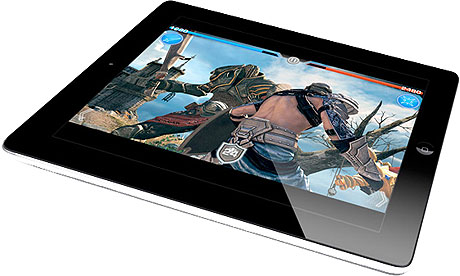
Tablets Are For Gaming

We'll be seeing more tablet games, if this survey is correct.
A new survey from Google's AdMob division shows that gaming is the most popular activity on tablets. Which should not be a huge surprise given the number of games appearing in App stores. Games beat out email and surfing the web, as 84% said it was their number one activity. Given that tablets are undergoing explosive growth (Apple is expected to sell about 48 million iPads this year, and then there's everybody else's tablet...) this is rapidly becoming an important market for game developers. It's not just revising your iPhone game to fit a different resolution; the larger screen size offers many more possibilities.

A full 38% said they spend more than two hours a day with their tablets, while 43% say they use it more than they used their computers. 82% said they primarily used it at home, which is interesting given the way businesses have been snapping up tablets.

I think the tablet market looks like an exciting place for game developers in the next few years. The expansion looks to be huge; the latest figures from Gartner Group show they expect the total tablet market to hit 294 million by 2015. That's up from about 15 million at the end of 2010; Apple's share will fall from 83% of the market to 47%, but that's still a hell of a lot of tablets. Consider this compared to the installed base of consoles; about 85 million Wii's, 50 million Xbox 360's, and 48 million PS3's... even if you added them all together it's about half the number of tablets expected in a few years. The capability of the new iPad 2 is getting quite robust, being perhaps better than a Wii in raw horsepower and graphics performance, and approaching the other consoles. Tablets are on a yearly upgrade cycle, not the 5-7 year (or more!) cycle that consoles usually follow (and this generation of consoles wants to stretch things out for years more if they can), so in a couple of years I'd expect tablets to be outstripping console capability. It's also important to note that right now, with a $99 Apple TV, you can shoot your iPad output straight to your TV... hey, that sounds a lot like a console, doesn't it?

Tuesday, March 29, 2011

The Power of iPad

Some fascinating facts and figures about the iPad.
The iPad 2 has gotten good reviews, and it's easy to see why: Thinner, lighter, faster, with cameras, and at the same price as the old one. What's not to like? Still, we saw a flood of Android tablets being shown at CES... why haven't we seen them yet? Wait, the Xoom is finally hitting the stores... but it seems to be more expensive than the equivalent iPad. What's up with that?

Apple is being clever, that's why. Apple's sneaky strategy is using its $60 billion in cash to buy up displays, forcing other tablet makers to delay release or pay a lot more, thus raising the competition's prices. Apple has reportedly bought up over 60% of all factory capacity for touchscreen displays... and laid out wads of cash (over $4 billion) to do so.

Talk about a win-win... Apple secures production capacity for their projected needs for years ahead, and at the same time forcing competitors to either build new factories, pay significantly higher prices, or accept inferior quality. No wonder the competition doesn't look so good yet.

I expect that Apple will maintain their market share pretty well; they're likely to be constrained more by how many they can build, than by the competition. Android tablets will be here by summer in droves, more than likely (and HP's WebOS tablet, too), just in time for a rumored iPad 3 launch in September or October so Apple can regain the high ground... it's going to be an interesting year.

Tuesday, March 22, 2011

iPads Replacing Textbooks

These guys are working on a tablet for education.
This news item from AppleInsider notes that Georgia is looking to put iPads in all of its middle schools, replacing all the textbooks. Other schools are testing this, and it looks like it will be a growing trend. Especially if textbook publishers ever get smart and embrace it, but that may require new publishers. College textbooks can easily run hundreds of dollars per quarter if you buy them new... enough to buy an iPad for one quarter's worth of books is not unusual at all for an engineering major.

Imagine that, once you have your classes, you could go to a page where you could download all your books to your tablet. Better still, how about paying maybe $50 each instead of $100 or more? Perhaps even less if the professors start putting excerpts in there from their own works, instead of full books.

A dream scenario for students, a nightmare scenario for textbook publishers bloated on decades of high prices. They will delay this advance as long as they can, but there's an opportunity for new publishers to step in and make a killing. I hope, for the student's sake, they do so.

And please note that this could mean tens of millions of tablets sold for students... on top of other tablet sales. Want to bet whether those students would be putting games on their tablets?

Friday, December 31, 2010

E-book Market Predictions 2011

The e-book market is finally arriving in a big way. Amazon hasn't released sales figures for the Kindle, but they have admitted that it's their best-selling product ever. Even beating out Harry Potter... and Kindles are a tad more expensive. Barnes & Noble reports the Nook is their bestselling product ever. Meanwhile, Borders edges closer to bankruptcy. Here's some relevant info:


Forrester Research expects U.S. e-book sales to total $2.8 billion in 2015, up from nearly $1 billion in 2010. The research firm projects the number of e-readers and tablets in the U.S. will soar from more than 15 million in 2010 to nearly 60 million in 2015.


And I think those numbers are conservative.

  • Regular book sales drop, e-books continue explosive growth. There's an easy prediction for you. I might as well start off with a no-brainer. B&N is selling more digital books online than physical books. With physical bookstores going out of business, it's clear which way the trends are going. Physical books will tend to be more for certain types of books (like coffee-table books), and popular fiction will inevitably for the e-book.
  • E-book readers hit $99 or less. This is already happening, but expect it from the market leaders (I'm looking at you, Kindle) with a resulting jump in sales. When the e-reader is less than 3 or 4 hardback books, it's harder to resist. When publishers finally get smarter and lower e-book prices more, sales will jump even further. If they don't, authors will step in. Lower prices are inevitable in a friction-free distribution network; publishers should get ahead of the trend instead of being rolled over by it. Sadly, very few if any will.
  • Explosive growth in the tablet market contributes to e-book sales growth. Tablets are eating into dedicated e-reader market share, too. The Kindle has a 47% share, down 15 points, while the iPad has a 32% share, up 16 points. The Nook and Sony's E-reader are hanging in around 5%, though I expect the Nook's numbers to improve. It looks like the iPad sold about 13 million units in 2010; Apple is expected to at least double, and maybe triple that number in 2011.
  • More companies spring up offering a la carte services to authors; big publishers lose some big names to self-publishing. These two things are related, of course. The easier it gets for authors to publish their e-books themselves, the more authors will do it.
  • Magazines finally crack the e-reader market in a big way as Apple makes it easy to buy subs. This one is dependent on Apple and magazine publishers reaching some sort of agreement on revenue splits. Publishers don't want to give up 30% of their sub fees to Apple, and Apple doesn't really want to go to the extra effort of negotiating with everybody. I'm hopeful Apple will do something to really help magazines out, but I fear they won't. Eventually magazines will be viewed on tablets, but getting to that point will be difficult for the businesses. Current iPad versions of magazines are individually priced and difficult for the magazines to produce well, since they take different skill sets. I foresee many magazines having trouble until subscriptions to tablet versions become easy, and magazines get more adept at crafting them. Maybe Google will add this capability to Android before Apple gets around to it; if so, a big win for Android. Hey, Google, if you really want to make an inroad on the iPad's market share, cut a deal with textbook publishers before Apple does.
  • Android tablet version finally appears; Android tablets boom; e-book sales zoom faster. It may happen late in 2011, but it will happen. The opportunity is huge and Google won't pass it up. Prices will drop as competition roars. Maybe we'll even see a two-page tablet at a reasonable price.
  • Apple introduces iPad 2, drops iPad prices, sales zoom. Yeah, it's inevitable. People are so focused on the new iPad that they forget what Apple does with old technology... they drop the price. So even more iBookstores will open up.

All in all, it will be a great year for e-book authors. The only downside is that marketing e-books will get tougher due to the increased numbers of titles. Authors will need to make sure they've done their marketing properly. Persistence is a key virtue; if you don't do something correctly at first, figure it out, fix it and continue.